
Trump says US forces kidnapped Maduro in aggression on Venezuela
 4 Min Read
US President Donald Trump announces that US forces have kidnapped President Maduro and are flying him out of the country.
-
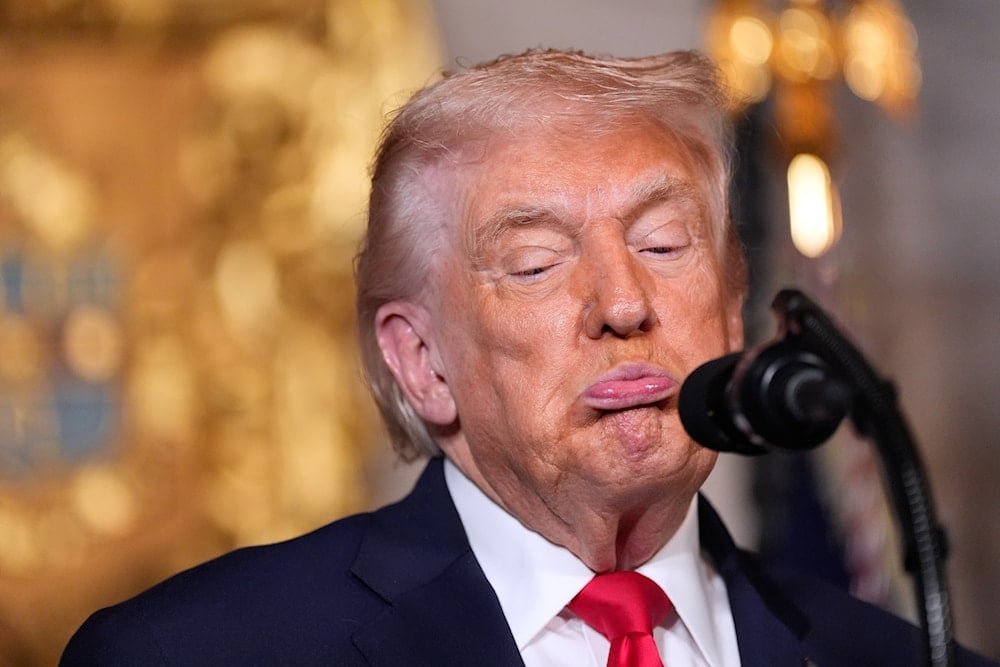
The United States President Donald Trump speaks at his Mar-a-Lago club, in Florida, the United States, on December 22, 2025. (AP)
United States President Donald Trump said that the US forces "captured" and flew out Venezuelan President Nicolas Maduro, along with his wife, early on Saturday.
In a post on Truth Social, Trump stated, "The United States of America has successfully carried out a large-scale strike against Venezuela and its leader, President Nicolas Maduro, who has been, along with his wife, captured and flown out of the Country."
"This operation was done in conjunction with US Law Enforcement," the US president said, adding, "Details to follow."
Trump said that a news conference will be held at 11:00 am (EST) at Mar-a-Lago, in reference to his resort in Florida. These remarks are the first official US confirmation of military action in Venezuela.
Later, Venezuelan Vice President Delcy Rodriguez, in a voice message to state television, said that the Venezuelan government does not know the whereabouts of President Maduro and his wife.
Heavy airstrikes hit Caracas as Venezuela activates national defense
Earlier on Saturday, Venezuela’s capital, Caracas, came under heavy US airstrikes and a reported aerial assault led by numerous military attack and transport helicopters. Al Mayadeen’s correspondent in Caracas reported loud explosions across the city and intense military aircraft activity, with power outages affecting multiple neighborhoods.
Reuters separately noted a blackout near a military base south of the capital. Additional reports indicate that strikes also targeted Margarita Island in Nueva Esparta state.
The attacks hit both civilian and military installations, including the Fort Tiuna military complex, La Carlota air base, and Higuerote Airport. Venezuelan media reported explosions at La Guaira port in Vargas state, the country’s largest seaport, while footage shared by citizens showed military transport helicopters flying over Caracas.
Venezuela will activate mobilization plans
The Venezuelan government strongly condemned the strikes, calling them a “blatant violation of the United Nations Charter, particularly Articles 1 and 2." Caracas said the attacks endanger “the lives of millions of people” and are part of an attempt to seize the country’s strategic resources, particularly oil and minerals, warning that the effort to break Venezuela’s political independence “will not succeed.”
The statement also recalled that “since 1811, Venezuela has faced and defeated empires.”
In response, Maduro has ordered the immediate implementation of all national defense plans and the enforcement of a decree declaring a “state of external emergency across the national territory.” The government called on “all social and political forces in the country to activate mobilization plans and repudiate this imperialist attack.” The Bolivarian National Armed Forces, together with civilians and police, have been deployed in coordination to “guarantee sovereignty and peace.”
Venezuela also plans to pursue international recourse, filing complaints with the UN Security Council, the UN Secretary-General, the Community of Latin American and Caribbean States (CELAC), and the Non-Aligned Movement, “demanding condemnation and accountability from the US government.”
Read more: REDH condemns US aggression against Venezuela
Strikes prohibited under international law, expert says
Professor Marc Weller, director of the international law program at the London-based think tank Chatham House, told NBC News that US strikes on Venezuela are prohibited under international law, while noting that a potential criminal trial of Nicolás Maduro in the United States could still proceed.
Weller explained that the use of force is "only available in response to an armed attack or possibly to rescue a population under imminent threat of extermination," adding, "Clearly, none of these requirements are fulfilled by the armed operation against Venezuela."
He further said that US efforts to suppress the drug trade or claims portraying the Maduro government as a criminal enterprise "offers no legal justification."
At the same time, Weller pointed to precedent from the 1989 US invasion of Panama and the capture of President Manuel Noriega, who was taken to Miami to face drug-related charges, as grounds for a possible trial.
"US courts follow the so-called Kerr-Frisbie doctrine," Weller said. "According to that controversial doctrine, it does not matter how a suspect is brought before a US Court. A trial can go ahead, even if it results from an unlawful armed intervention or abduction, provided the suspect has not been severely tortured in the process."


