
US farmers face rising costs as Iran war fuels uncertainty
 4 Min Read
US farmers grapple with surging fertilizer and fuel costs amid the Iran war, raising concerns over planting season, inflation, and political fallout.
-
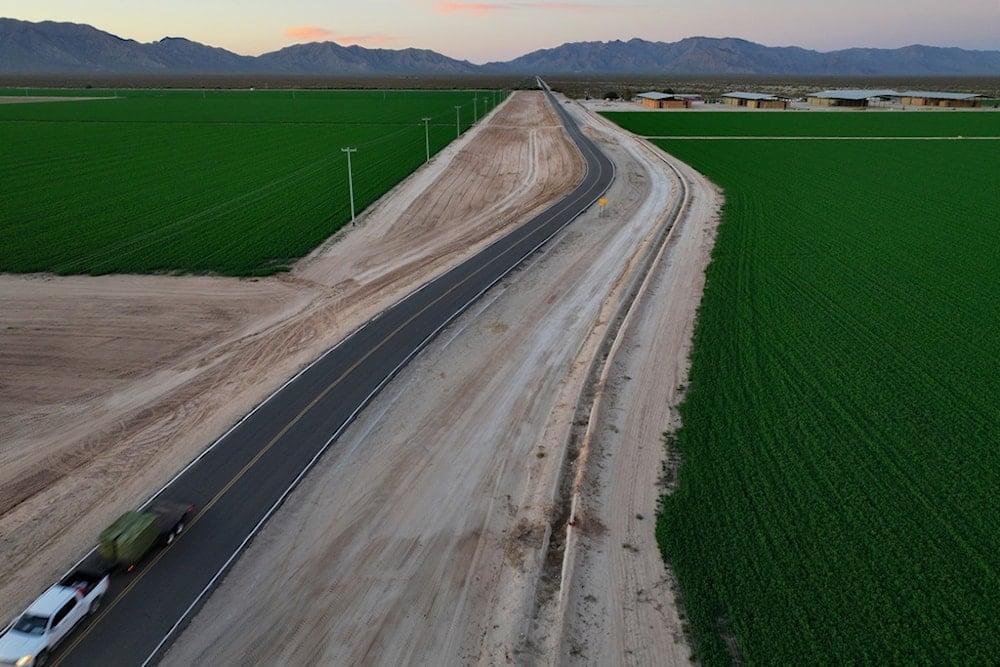
A truck hauling hay drives near Al Dahra Farms, Tuesday, October 17, 2023, in the McMullen Valley in Wenden, Arizona (AP)
US farmers are entering the planting season under growing financial strain as the war on Iran drives up fertilizer and fuel costs, compounding existing economic pressures across the agricultural sector, Bloomberg reported.
Producers across key farming sectors report increasing difficulty securing essential inputs, particularly fertilizer, while also facing sharply rising diesel prices needed to operate machinery. The added burden comes at a critical time in the agricultural calendar, when planting decisions directly impact annual yields and income stability.
According to Bloomberg, the economic impact of the war is unfolding alongside preexisting challenges, including trade disruptions linked to Trump's massively unpopular tariffs and persistently high input costs. Together, these pressures are tightening margins and raising concerns about the sector’s near-term outlook.
Fertilizer, fuel costs surge
Prices for key agricultural inputs have risen rapidly since the start of the US-Israeli attack. Nitrogen-based urea, widely used by corn growers, has surged significantly in recent weeks, reaching levels not seen since the early stages of the Ukraine war.
The increase is partly tied to disruptions in global supply chains, particularly in West Asia, where a substantial share of global fertilizer shipments passes through the Strait of Hormuz, which has been blocked by Iran since the start of the US-Israeli war on the Islamic Republic. Ongoing attacks on shipping routes have heightened fears of supply constraints.
At the same time, diesel prices have climbed sharply, increasing operational costs for tractors, harvesters, and other essential equipment. Farmers report that the combined effect of higher fertilizer and fuel expenses is making it more difficult to plan for the season ahead.
Economic strain adding pressure
The financial stress on farmers could extend beyond the agricultural sector, with potential implications for US politics and consumer prices.
Rising production costs are expected to feed into food inflation, adding to broader concerns over the cost of living. As farmers adjust to higher expenses, consumers may ultimately bear part of the burden through increased prices at grocery stores.
At the same time, the situation could influence voter sentiment in rural areas ahead of the midterm elections. Analysts suggest that economic dissatisfaction among farmers, traditionally a strong support base for Donald Trump, may affect turnout and reshape competitive races in key states.
Uncertainty shapes planting decisions
With input costs rising, farmers are weighing adjustments to their planting strategies. Some are considering shifting from corn to soybeans, which require significantly less fertilizer.
However, such a shift carries risks. The US is already projected to increase soybean acreage this year, raising concerns about oversupply and downward pressure on prices. In addition, export uncertainty, particularly involving China, the world’s largest soybean buyer, adds another layer of risk for producers.
Many farmers report entering the season without having secured fertilizer in advance, reflecting tighter financial conditions compared to previous years. This has contributed to a sense of uncertainty across the sector as producers attempt to balance cost management with production needs.
Calls grow for government intervention
Agricultural groups and policymakers are increasingly urging action to stabilize input costs and protect farm incomes.
Industry organizations have called for measures to secure fertilizer supply chains, including proposals to safeguard shipping routes in key global chokepoints. At the same time, some lawmakers are pushing for additional federal support, warning that current market conditions are leaving many farmers operating at a loss.
The administration has signaled that steps to address fertilizer costs may be forthcoming, while also highlighting previous financial aid provided to farmers impacted by trade disputes.
Farmers navigate war-fueled uncertainty
As the war continues, farmers report growing concern about how long elevated costs will persist and what the long-term implications may be for the sector.
The lack of clarity over the duration and outcome of the war is complicating planning decisions, particularly when combined with ongoing trade tensions and market volatility.
For now, US agriculture remains in a holding pattern, with producers adapting to rapidly changing conditions while bracing for further disruptions tied to the evolving geopolitical landscape.


