
US-Israeli war on Iran dives China’s expanding role in Gulf
 3 Min Read
The US war on Iran is accelerating China’s growing economic and diplomatic presence in the Gulf, amid Beijing’s expanding trade and investment role.
-
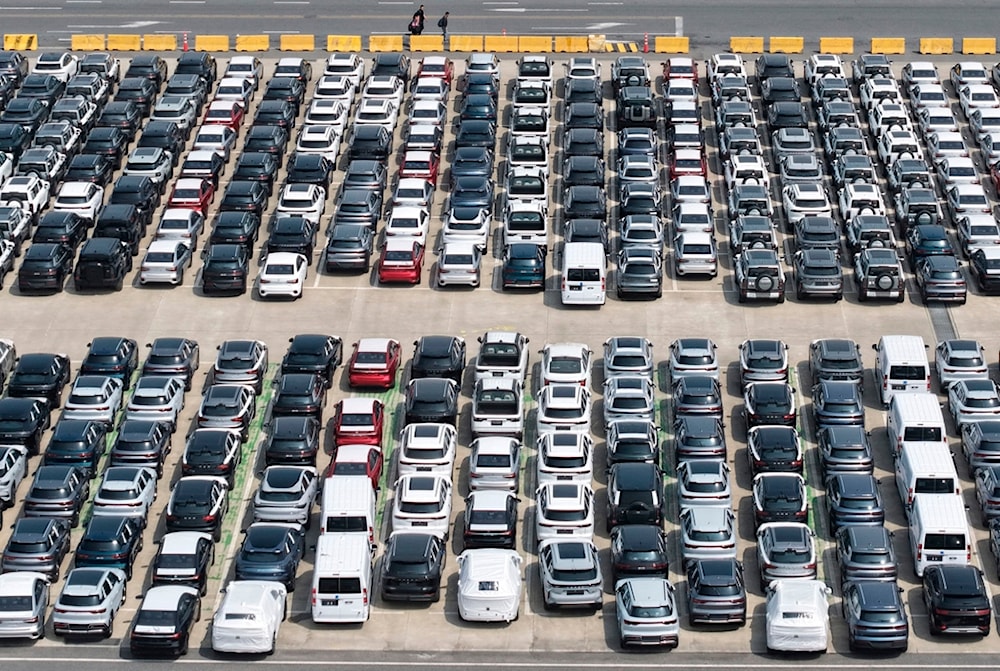
Aerial view of new vehicles waiting for shipment to overseas market at a port in Shanghai, China, Saturday, May 9, 2026 (AP)
The ongoing US war on Iran is accelerating China’s expanding political and economic footprint in the Gulf, as regional states increasingly hedge against Washington’s shifting policies and deepen engagement with Beijing across trade, infrastructure, and investment sectors, Semaphor reported.
While Gulf governments continue to emphasize their reliance on the United States for security guarantees, the war has highlighted the limits of that dependence amid growing uncertainty in US decision-making and regional escalation risks.
China expands economic, industrial presence
China remains the Gulf’s largest trading partner, with bilateral trade now exceeding the region’s commerce with Western economies.
Beijing’s role has continued to grow through infrastructure financing, industrial cooperation, and long-term development partnerships tied to Gulf diversification agendas.
Despite sustained US pressure to limit Chinese participation in sensitive technology and defense sectors, Gulf states have maintained, and in many cases expanded, economic engagement with China, particularly in energy-linked industries, manufacturing, renewable energy, and logistics.
War reshapes diplomatic alignments, perceptions
The war on Iran has further strengthened China’s positioning as a pragmatic external actor in regional calculations. Beijing’s diplomatic engagement with multiple sides during the crisis, including reported involvement in ceasefire discussions, has reinforced its image as a power prioritizing economic stability and de-escalation.
At the same time, Gulf officials continue to describe the United States as their primary security partner, particularly in areas such as air defense, intelligence sharing, and advanced military technology.
However, analysts note that repeated regional crises and shifting US political priorities have contributed to growing uncertainty about Washington’s long-term strategic consistency.
Despite China’s expanding role, the United States continues to hold decisive advantages in Gulf security architecture. US military presence, defense systems, and technological leadership, particularly in artificial intelligence and advanced weapons systems, remain central to regional security arrangements.
These structural dependencies ensure that Gulf states are unlikely to fully shift away from Washington in the security domain, even as economic diversification accelerates.
China strengthens position through long-term economic strategy
Beijing is increasingly positioning itself in sectors aligned with Gulf transformation plans, including automotive production, renewable energy infrastructure, critical minerals, and industrial manufacturing.
Unlike the United States, China’s engagement is often perceived in regional capitals as less affected by domestic political cycles, contributing to its appeal as a long-term economic partner.
Trade between China and the Gulf has increased by more than 250% since 2010, and Chinese foreign direct investment in the region continues to rise, including in key Gulf sovereign wealth portfolios and strategic infrastructure projects.
Shifting but not replacing power balance
Even as Gulf-China ties deepen, the United States remains the primary destination for sovereign wealth investment and retains unmatched influence in defense and high-end technology sectors.
However, the Iran war has intensified a broader recalibration in regional foreign policy, with Gulf states increasingly balancing between Washington and Beijing rather than relying exclusively on one power.
Analysts say the result is not a replacement of US influence, but an accelerating shift toward a more multipolar regional order in which China’s economic and political role continues to expand.


