
Beijing rejects leveraging US-China summit to pressure Iran: Source
 4 Min Read
China rejects US efforts to use the upcoming Trump–Xi summit as leverage against Iran, sources say, emphasizing Beijing’s push for regional stability, independent Gulf security, and declining US influence in East Asia.
-
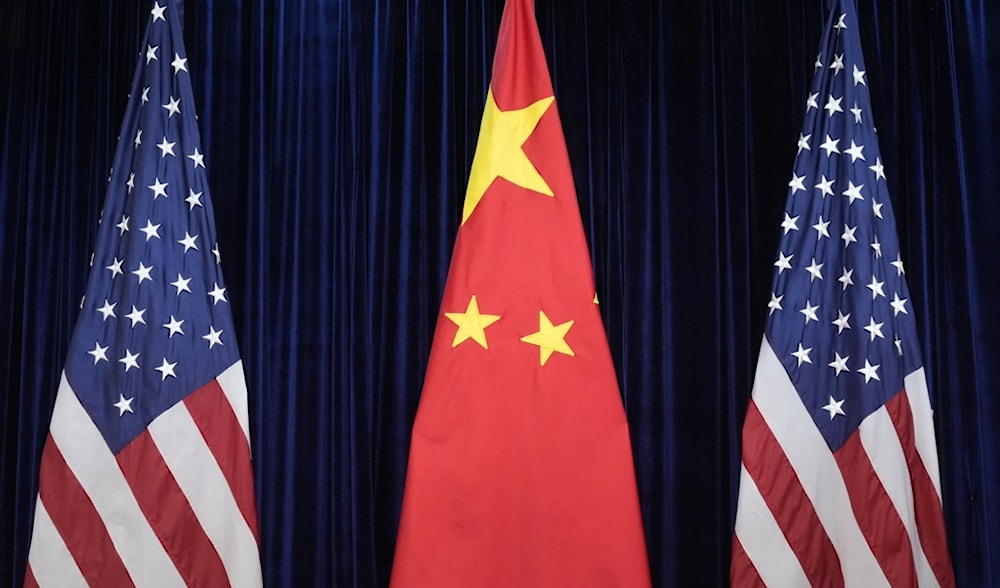
Flags of the U.S. and China are displayed at the Gimhae International Airport in Busan, South Korea, Oct. 30, 2025. (AP)
China remains firm in rejecting any attempt to turn the anticipated summit between President Xi Jinping and US President Donald Trump in Beijing into a tool of pressure against Iran, East Asian diplomatic sources exclusively told Al Mayadeen on Wednesday.
The sources emphasized that Beijing had early on recognized that Trump’s announcement of a “freedom of navigation mission” was, in essence, a US attempt to exert political pressure on the eve of the summit.
The US president is scheduled to visit China later this month after previously postponing the trip due to his aggression against Iran.
The sources added that the Chinese leadership believes Washington is relying heavily on escalating toward Iran as a pressure card, or even as a tool of coercion, in its broader strategic calculations.
In this context, Beijing considers that the failure of the so-called “Project Freedom” has deprived Trump of one of the key leverage points he had sought to employ in a broader settlement approach with China.
This came after Trump announced a pause in the maritime mission only a day after it was launched, citing alleged progress towards an agreement with Tehran.
The Gulf in China’s vision
Al Mayadeen’s sources indicated that China places considerable strategic weight on the Gulf and on deepening its ties with the region’s states. At the same time, Beijing stressed that this engagement does not come at Iran’s expense, instead approaching the Gulf’s future, and that of the broader region, through a post-war lens.
According to the sources, Chinese policymakers are pushing for an independent regional security framework in which Iran remains a central actor rather than being sidelined. This position holds despite China’s extensive economic partnerships across the Gulf, as Beijing continues to reject participation in external pressure campaigns targeting any single party, particularly Iran.
The sources further noted that China has cautioned against alignment with US policies, especially efforts that could turn certain Gulf states into forward bases for actions against Iran. In parallel, Beijing has emphasized that the region’s trajectory should ultimately be determined by its own states and peoples.
From China’s perspective, any sustainable security arrangement in the Gulf, especially in the Strait of Hormuz, must include Iran. Beijing is therefore promoting a broader framework that brings together economic, political, and security dimensions, while avoiding the provision of exclusive guarantees to any one side.
Within this approach, China sees economic cooperation as the foundation for stability. It encourages Gulf states, on both shores, to develop mutual security guarantees, while positioning itself as a provider of long-term economic assurances, an approach it views as key to lowering the risk of future confrontation.
East Asia in China’s strategic calculations
The East Asian diplomatic sources also told Al Mayadeen that Beijing is pursuing a similar approach in East Asia, aiming to reinforce stability across its immediate neighborhood at a time of rapidly evolving regional power dynamics.
They pointed out that US influence in the region appears to be on a downward trajectory, extending even to countries long regarded as close allies of Washington. This trend, the sources noted, has unfolded in parallel with the war on Iran and has become more pronounced as Tehran demonstrates sustained resilience.
Against this backdrop, several of China’s neighbors have adopted notable stances. Countries such as South Korea and Japan have signaled their unwillingness to take part in the war or engage in military activity in the Strait of Hormuz.
For Beijing, these positions are seen as a positive development. The sources said China interprets the reluctance of both South Korea and Japan to become involved in the aggression as a sign of broader shifts taking shape in the regional and international order.
Read more: China 'reliable strategic partner of Iran': Wang Yi to Araghchi


