
US schools cut bus services as driver shortages deepen
 7 Min Read
US school districts are cutting or reconsidering bus services as driver shortages, rising fuel costs, and shrinking budgets make student transportation increasingly difficult.
-
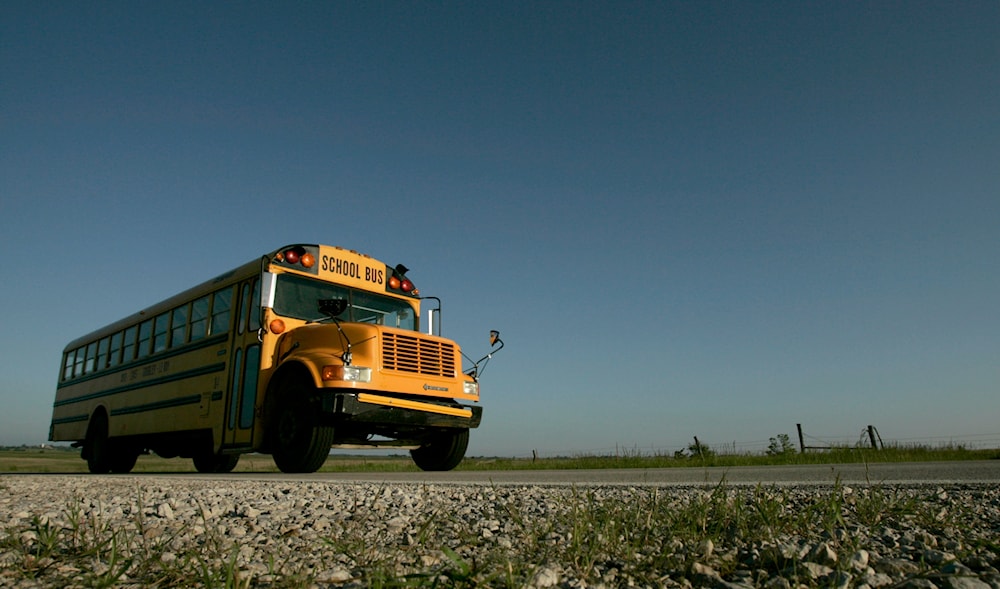
A school bus travels down a rural highway near Leroy, Kan., May 16, 2006 (AP)
School districts across the United States are struggling to maintain transportation services as shortages of drivers, rising operating costs, and declining enrollment place growing pressure on education budgets, The Guardian reported.
Officials in Arizona, Connecticut, Florida, Idaho, New Jersey, New York, Ohio, Oregon, and Virginia have reduced school transportation or proposed cuts this year, leaving families increasingly responsible for getting children to and from classrooms.
The reductions risk worsening absenteeism and educational inequality, particularly among households without access to a dependable vehicle or relatives who can help with school journeys.
“It’s an especially important thing for families who don’t have reliable forms of transportation or others who they can regularly turn to for help,” said Jeremy Singer, an assistant professor of education at the University of Michigan-Flint.
“If schools reduce their school bus offerings, that means more families driving, which means more money on gas, more traffic and more emissions.”
Driver shortages strain districts
A 2025 report by the Associated Press-NORC Center for Public Affairs Research found that driver shortages had disrupted transportation in 80% of US school districts, while 73% reported difficulties linked to insufficient budgets.
The research was carried out in partnership with HopSkipDrive, a company providing rideshare services for students.
The number of school bus drivers has not recovered since the COVID-19 pandemic, when school closures and remote learning pushed many drivers to seek other work.
9.5% down
Data from the Economic Policy Institute showed that the number of drivers fell from more than 223,000 in August 2019 to approximately 202,000 in August 2025, representing a decline of 9.5%.
School districts also face competition from app-based transport companies that offer drivers more flexible schedules and require less specialized training.
“If you want to drive to make money, it’s a lot easier to drive for Uber or Lyft than it is to drive a school bus,” said Sarah Cordes, a Temple University associate professor specializing in education and urban policy.
“Driving a school bus requires all kinds of training,” she said, adding that “it’s not an easy job if you are dealing with a vehicle full of children.”
Fuel prices add to budget pressure
Inflation and rising fuel expenses have further increased the cost of running school buses.
During the 2025-26 academic year, more than half of district leaders said diesel expenses exceeded their budgets, according to a School Superintendents Association survey.
Around one-quarter of respondents said they transferred money from other educational programs to cover the additional cost, while 19% drew from reserve funds.
At the same time, many public school systems are losing revenue because of declining student numbers. Falling birth rates and the growing use of charter schools, private schools and homeschooling have reduced enrollment and, consequently, the public funding districts receive.
However, fewer students do not necessarily allow districts to reduce transportation costs proportionately because children remain spread across the same geographical areas.
“Theoretically you could reduce routes but then depending on where kids live relative to each other and relative to school, that could mean that you have kids on the bus for an hour, an hour and a half, two hours,” Cordes said.
“If kids are on the bus for more than an hour, that is not good for their attendance.”
Alternatives raise safety debate
Some districts are turning to smaller vehicles and companies such as HopSkipDrive as alternatives to conventional yellow school buses.
However, federal rules restrict the use of other vehicles for transporting large groups of students. The School Bus Safety Amendments adopted in 1974 require new vehicles carrying 11 or more people to meet the same safety standards as school buses.
The Heritage Foundation has called for the legislation to be repealed, arguing that states need “more tools in their transportation toolbox than yellow buses to meet the modern challenge."
The National Association of State Directors of Pupil Transportation Services opposed that proposal, maintaining that the existing requirements have made school travel safer.
The association warned that “using vehicles other than school buses compromises student safety and heightens the potential for disastrous crashes.”
Singer said compliance with the safety requirements raises the cost of alternative vehicles and reduces the flexibility available to school officials.
Ohio districts face mounting costs
Ohio has emerged as one of the states most affected by the transportation crisis.
A June report by the Ohio pupil transportation workgroup found that 34 school districts had filled fewer than 10% of their vacant bus driver positions.
Transportation spending reached an average of $1,273 per student during the 2026 fiscal year, nearly 5% higher than the previous year.
Meanwhile, enrollment in the state’s public school districts fell by almost 100,000 students between 2016 and 2025. As financial conditions deteriorate, 124 districts are expected to record negative cash balances by 2029, the highest number since the Great Recession, according to the Columbus Dispatch.
Ohio public school districts are also required to provide transportation for eligible students attending private and charter schools.
"Impractical to transport'
During the latest school year, districts classified more than 22,000 children as “impractical to transport”, allowing authorities to compensate their families rather than provide buses.
The state transportation workgroup recommended eliminating that designation and introducing a policy ensuring that every eligible student receives dependable transportation.
Ohio “should establish a clear statewide policy that every transportation-eligible student receives safe and reliable transportation," the report said.
It recommended allowing districts “to coordinate with families of community and chartered nonpublic school students to identify centralized locations to serve as initial collection and drop-off points."
The group also proposed reviewing the “bus driver training model for opportunities to compress the timeline."
Columbus weighs school bus cuts
Columbus City Schools currently transports approximately 20,000 students attending district schools and another 8,000 enrolled in private and religious institutions, according to district spokesperson Michael Brown.
Officials are considering reducing transportation for high school students because of the expense. Brown warned that abolishing the “impractical to transport” option would impose another unfunded requirement on districts.
Financial pressure is expected to intensify after Ohio Governor Mike DeWine approved legislation in 2025 limiting the amount of additional funding schools receive when property values rise.
The measure, intended to curb property tax increases that were not directly approved by voters, is expected to reduce school revenue by at least $1.7 billion over three years, according to Ideastream Public Media.
“We continue to be concerned about the state’s lack of full, fair funding to meet the actual costs” of transportation, Brown said.
Cordes said districts must ultimately balance the need to improve access to schools against the effect transportation spending has on classroom resources.
“You may be getting more kids to school," she said, but “that might take away from the district’s ability to spend money on other important things that have to happen in the classroom."
Read more: Lebanon's children working, missing school to survive economic crisis


