
Xi Jinping pushes to make yuan a global reserve currency: Izvestia
 4 Min Read
Chinese President Xi Jinping revives the push to elevate the yuan as a global reserve currency, but experts say capital controls, exchange rate rigidity, and institutional trust stand in the way of true internationalization.
-
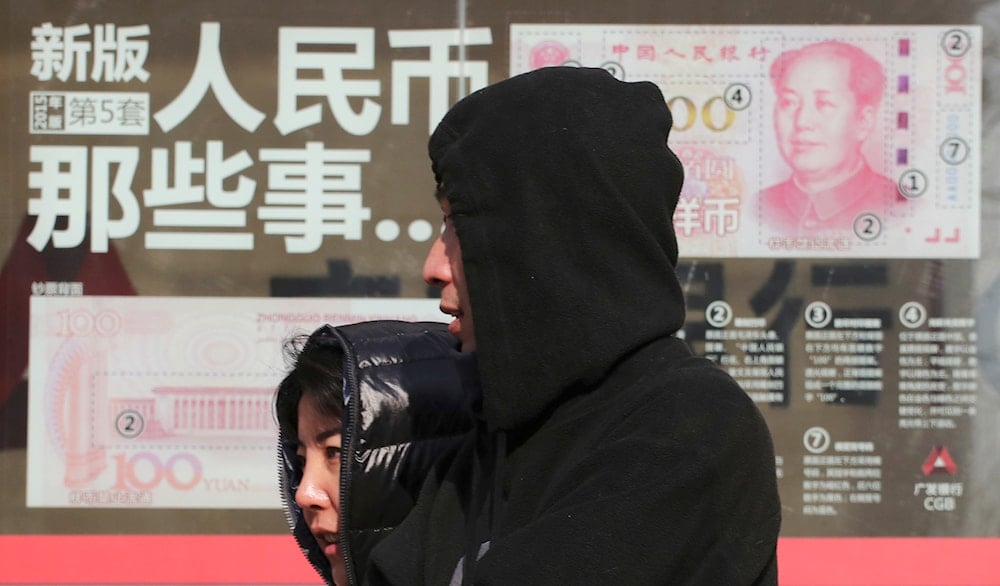
Residents walk past a board highlighting the security markers on the latest Yuan note outside a bank in Beijing, China, on November 24, 2016. (AP)
Chinese President Xi Jinping has reiterated his ambition to make the yuan a global reserve currency, marking the first time the goal has been explicitly outlined in an official capacity. Writing in the Communist Party's ideological journal Qiushi, Xi emphasized the strategic importance of developing a currency that can be widely used in global trade and held by central banks.
Although the speech was originally delivered to regional leaders in 2024, its publication now signals renewed momentum behind China's long-standing effort to elevate the yuan’s global role. Just weeks earlier, People's Bank of China (PBOC) Governor Pan Gongsheng forecasted a "new global monetary order" in which the yuan would contend with the dollar and other major currencies.
Despite being the world's second-largest economy and first in terms of purchasing power parity, according to the report, the yuan still lags behind the dollar, euro, and even the pound sterling in terms of international usage. This mismatch has puzzled observers, especially given China's expansive role in global trade.
However, historical precedent shows that currency influence often trails economic dominance. The US dollar only assumed global leadership after World War II, even though the American economy had been the largest since the early 20th century. Conversely, the British pound retained significant importance long after the UK lost its global economic edge.
Steps required to make the yuan a reserve asset
A report by Izvestia, written by Dmitry Migunov, for the yuan to function as a true global reserve currency, Beijing must implement deep financial reforms:
- Capital Account Liberalization: The yuan is currently only partially convertible. Investors need to be able to move large sums in and out of China without regulatory restrictions. Presently, Chinese citizens are limited to converting and withdrawing no more than $50,000 annually. “Currently, the yuan is convertible for current transactions, but capital flows are strictly controlled by the state,” explains Olga Ponomareva of the Economic Policy Foundation. She notes that gradual programs like QFII and Stock Connect are only initial steps toward full liberalization
- Deep, Transparent Bond Markets: Central banks invest reserve currency holdings in sovereign debt. China must expand and open its bond markets to global investors while improving accessibility and regulatory clarity
- Flexible Exchange Rate: The yuan still operates under a managed float system. For the currency to gain trust internationally, its exchange rate must be determined by market forces. The current division between the onshore and offshore yuan and the PBOC’s continued interventions reduce confidence among foreign investors
- Independent Payment Systems: China has made progress with CIPS and is now advancing the mBridge project, a central bank digital currency platform that could rival SWIFT and offer a path around Western-dominated financial networks
- Institutional Trust and Legal Transparency: For foreign governments and investors to adopt the yuan as a reserve asset, they must have confidence in China’s legal and regulatory frameworks. This includes assurance against politically motivated asset freezes and transparent reporting standards. Anton Tabakh, chief economist at the Expert RA rating agency, noted that China’s domestic credit rating and financial openness still fall short: "The Chinese market remains highly closed and lacks the transparency required for the yuan to serve as a global reserve currency," he said to Izvestia.
Opportunities and risks for China in globalizing the yuan
If successful, internationalizing the yuan offers China significant advantages:
- Reduced Exposure to Dollar Volatility: Chinese firms could trade without currency conversion risks.
- Seigniorage: Like the US, China could issue currency that other countries would hold, effectively gaining interest-free capital.
- Geopolitical Buffering: Wider use of the yuan would reduce Beijing’s vulnerability to sanctions and financial isolation.
- Cheaper Borrowing: Reserve currencies tend to enjoy strong demand for government bonds, reducing yields and debt servicing costs.
However, the report argues, the transition carries notable risks. China would lose complete control over its monetary policy under free capital flows and a floating exchange rate. Additionally, running a global reserve currency often entails trade deficits to supply liquidity, a challenge for China’s current export-driven model.
While China has made gradual progress toward yuan internationalization over the past decade, rapid acceleration appears unlikely without major structural reforms. Still, global instability, both financial and geopolitical, could push some countries to diversify away from the dollar, creating an opening for the yuan.


