
Facing food scarcity in warmer seas, whales learn to share what's left
 4 Min Read
A new long-term study reveals that whales in the North Atlantic are shifting their diets and sharing food sources due to climate-driven prey shortages, highlighting the need to protect marine ecosystems and food webs.
-
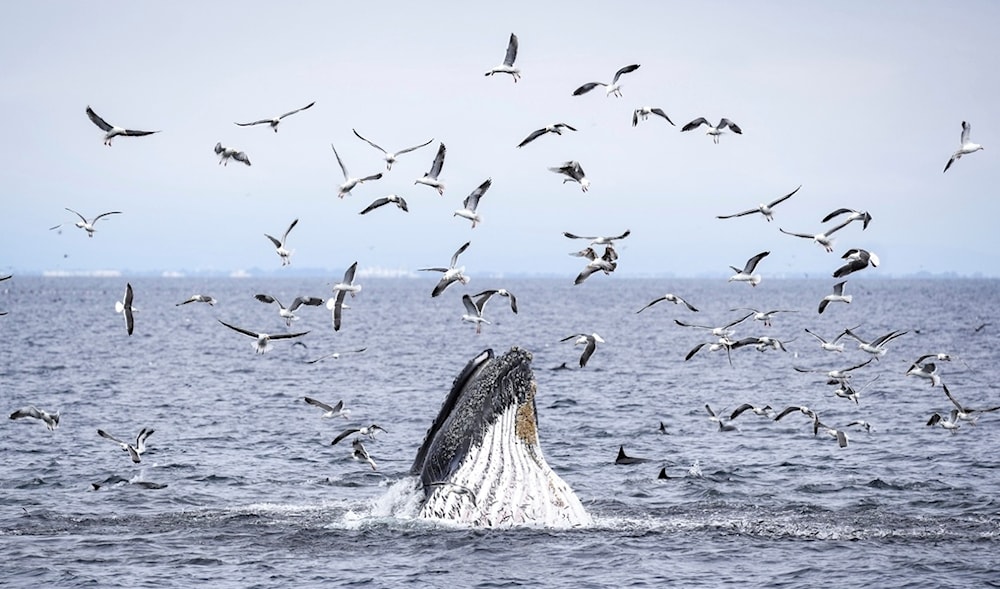
A humpback whale, dolphins and sea birds feed on a school of fish Thursday, May 1, 2025, in Channel Islands, California. (AP)
Whales in the North Atlantic appear to be adapting their behavior to coexist and share food resources as climate change and human pressures reshape ocean ecosystems, according to a new long-term study.
Researchers studying fin whales, humpback whales, and minke whales in the Gulf of Saint Lawrence found that these species are now consuming more fish and less krill than in the past. Scientists believe this dietary shift reflects rising competition for prey, as warming waters disrupt the availability of key marine food sources.
The findings, based on nearly 30 years of data, were published in the journal Frontiers in Marine Science.
Dietary shift triggered by limited resources
By analyzing skin samples collected from over 1,100 whales between 1992 and 2019, researchers studied stable isotopes of nitrogen and carbon, chemical fingerprints that reveal what the animals eat and their position in the food chain.
The data spans three distinct environmental periods, from colder conditions in the 1990s to today’s warmer waters and reduced sea ice.
The study found that all three whale species have gradually shifted toward fish-based diets, with Arctic krill, a shrimp-like crustacean once central to their diets, now playing a smaller role.
“The recent increase in resource partitioning among fin whales, humpback whales, and minke whales in the study area may reflect a higher level of competition in response to limited resource availability,” said Charlotte Tessier-Lavigne, lead author of the study and a researcher at Canada’s Maurice Lamontagne Institute.
“With declining krill consumption, fin and minke whales appear increasingly reliant on surface-dwelling fish, making them an important food source for all three species.”
Surface fish live in coastal waters, open seas, and lakes, distinct from deep-sea or shoreline species.
Warming waters impacting prey availability
The researchers note that changes in fish species being consumed likely reflect the decline of Arctic krill populations, which are sensitive to rising ocean temperatures and shifting marine conditions.
Although the three whale species still feed in overlapping areas, the study found that they are now more specialized in their respective feeding zones than in previous decades. Over time, there has been a reduction in dietary overlap, a trend researchers link to increased competition during periods of resource scarcity.
“Niche overlap changes based on resource availability,” said Tessier-Lavigne. “When food becomes scarce, competition tends to intensify. Species may adapt by diversifying their diet or specializing in different prey types to reduce overlap.”
Adaptation over displacement
Despite increased pressure on food supplies, the study found no evidence that one whale species is displacing another. Instead, the whales appear to be modifying their behavior to coexist.
Scientists say the study offers rare insight into how large marine animals respond to long-term ecosystem changes, rather than short-term fluctuations.
The findings underscore the importance of protecting not only whales themselves, but also the ecosystems and food sources they depend on.
“Rapid environmental changes in the Gulf of Saint Lawrence already appear to be affecting baleen whales,” said Tessier-Lavigne. “It’s critical to monitor their trophic roles and incorporate this information into fisheries management and marine protected area planning.”
This research adds to a growing body of evidence that climate change is quietly transforming marine food webs, often in subtle ways that are only revealed through long-term ecological studies.
Read more: Great barrier reef coral loss largest in decades amid bleaching crisis


