
13 killed, 38 injured in bus explosion in southwest Colombia
 3 Min Read
An explosive device on a bus in southwestern Colombia killed 13 people and injured 38, as authorities attribute the attack to armed groups amid a surge in regional violence tied to drug trafficking.
-
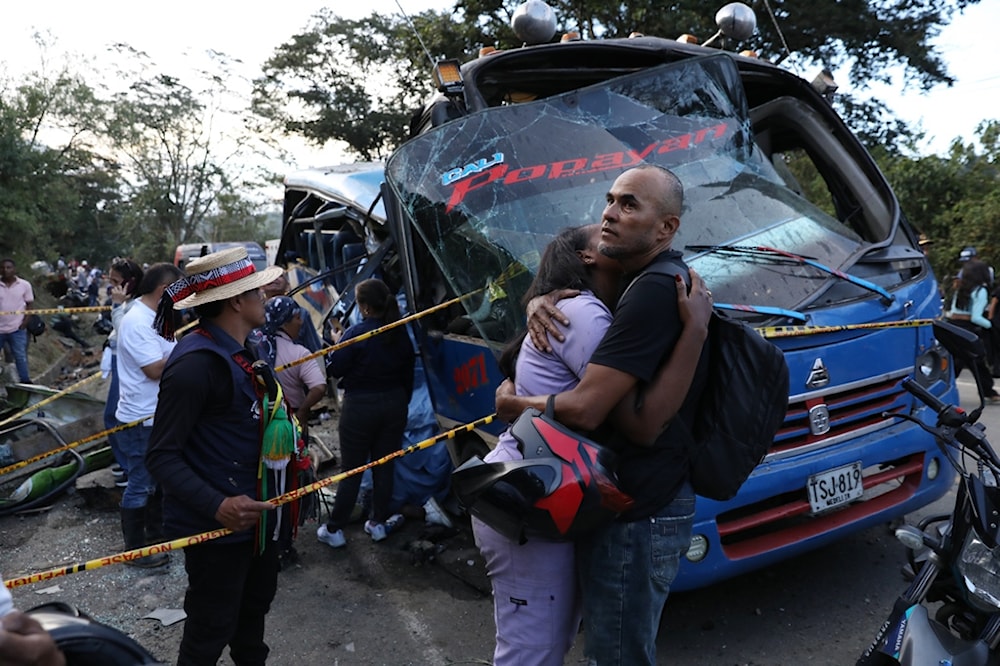
Relatives of victims embrace in front of a bus hit by an explosive device on the Pan-American Highway in Cajibio, Colombia, Saturday, April 25, 2026. (AP Photo/Santiago Saldarriaga)
An explosive device detonated on a passenger bus in southwestern Colombia on Saturday, killing 13 people and injuring at least 38 others, according to regional authorities. The blast occurred while the vehicle was traveling along the Pan-American Highway in the municipality of Cajibio in the Cauca region.
Cauca Governor Octavio Guzmán said the device was activated during the bus’s movement, confirming the severity of the incident on social media. Health officials reported that five children were among the wounded, with victims transferred to nearby medical facilities for treatment.
The attack is part of a broader surge in violence affecting Colombia’s southwestern corridor, a region long impacted by armed activity and drug trafficking networks.
Military calls attack 'terrorist act' and blames armed dissidents
Colombia’s military leadership described the bombing as a “terrorist act.” General Hugo López, commander of the Armed Forces, attributed responsibility to factions linked to the network of a figure known as “Iván Mordisco” and the Jaime Martínez group, both of which are dissident formations originating from the former Revolutionary Armed Forces of Colombia (FARC).
According to López, both groups continue to operate in defiance of the 2016 peace agreement signed between the Colombian state and FARC leadership.
The military assessment places the attack within an ongoing pattern of armed group activity targeting civilian and infrastructure routes in contested territories.
President Gustavo Petro condemns attack
Colombian President Gustavo Petro condemned the incident, using strong language to denounce those responsible.
“Those who carried out the attack and killed civilians… are terrorists, fascists, and drug traffickers,” he said in a post on X, referring to the Cajibio bombing and its civilian toll.
His statement reflects the government’s framing of armed dissident groups as criminal networks involved in narcotics trafficking and violence against civilian populations.
Wave of attacks hits southwestern Colombia
The bus bombing is one of at least 26 violent incidents reported over two days in southwestern Colombia, according to military officials. Authorities say the attacks have primarily targeted public infrastructure and security installations, though civilians have borne the impact.
Recent incidents include:
- A shooting at a police station in Jamundi
- An attack on an aviation radar facility in El Tambo
- Interception of three explosive-laden drones before impact
- Vehicle bombs detonated near military units in Cali and Palmira
No casualties were reported in several of these incidents, though material damage was recorded.
Government security response and emergency mobilization
The escalation prompted the deployment of senior officials to the region, including Defense Minister Pedro Sánchez, who was meeting with governors and local authorities in Palmira at the time of the bus explosion.
“These criminals seek to instill fear, but we will respond with firmness,” Sánchez said.
Regional officials have also called for increased federal support. Valle del Cauca Governor Francisca Toro urged the national government to reinforce security forces, expand intelligence operations, and take “decisive actions” against armed groups.
Authorities have offered rewards exceeding $1 million for information leading to the capture of key dissident leaders, including a figure identified as “Marlon,” described as a regional commander.


