
Beit Lahm revives Christmas after a two-year hiatus
 4 Min Read
Beit Lahm revives Christmas after two years, sending a message of steadfastness and hope amid "Israel’s" war on Gaza and escalating occupation in the West Bank.
-
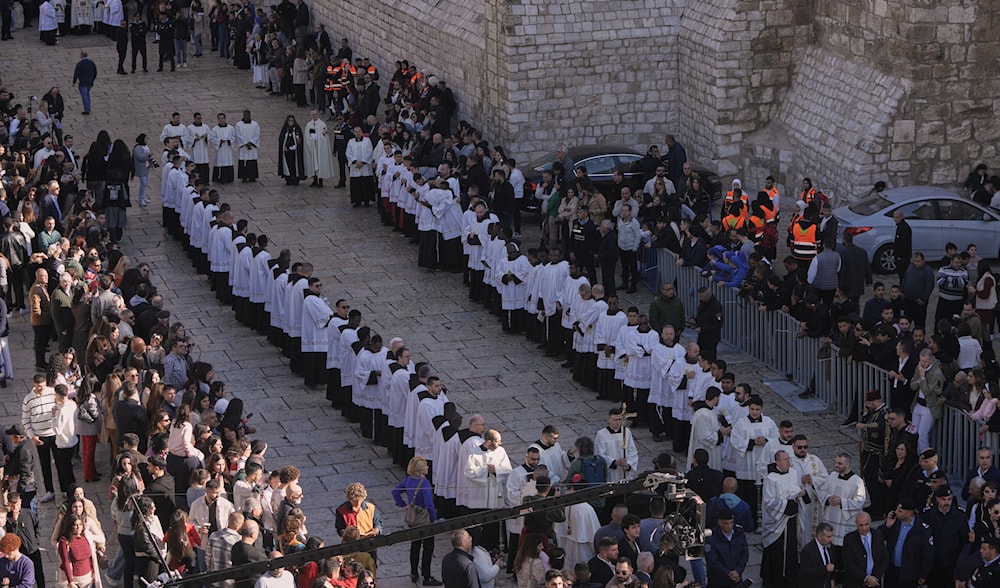
Catholic clergy walk in procession next to the Church of the Nativity, traditionally believed to be the birthplace of Jesus, on Christmas Eve, in the city of Beit Lahm in the occupied West Bank, on December 24, 2025. (AP Photo/Mahmoud Illean)
The city of Beit Lahm in the occupied West Bank celebrated Christmas this year after a two-year hiatus, as Palestinians continue to endure "Israel's" genocidal campaign in Gaza and intensified repression across the West Bank.
Beit Lahm holds immense spiritual and historical significance for Christians worldwide as the birthplace of Jesus Christ and the origin of Christianity. The city is home to the Church of the Nativity, one of the oldest churches in the world, built over the site believed to be Christ's birthplace, making Beit Lahm a central destination for Christian pilgrimage and a cornerstone of Palestinian Christian identity.
Against this backdrop, Beit Lahm's decision to revive Christmas celebrations carries deep symbolic significance, reaffirming Palestinian resilience and dedication to life, faith, and collective endurance despite war and occupation.
Mayor of Beit Lahm: Christmas is a message of steadfastness, hope
Speaking to Al Mayadeen, Beit Lahm Mayor Maher Canawati said the decision to revive Christmas celebrations after two extremely difficult years was intentional, describing it as a message to the world that the Palestinian people remain steadfast.
Canawati said the celebrations were meant to convey resilience and hope to the people of Beit Lahm, Gaza, and all Palestinian cities, emphasizing that the message was being sent from the "City of Peace" and the birthplace of Jesus Christ.
He characterized the atmosphere in Beit Lahm as one of determination rather than defeat, noting that the streets were filled with children's laughter and optimism for a better future, despite the reality of occupation.
احتفالات عيد الميلاد المجيد تنطلق من بيت لحم بعد عامين من الانقطاع بسبب العدوان على غزة#عيد_الميلاد #ميلاد_مجيد pic.twitter.com/yHH8LxcnvL
— قناة الميادين (@AlMayadeenNews) December 24, 2025
Christmas under settler colonialism
The mayor highlighted the severe restrictions imposed on the city, noting that Beit Lahm is encircled by dozens of Israeli settlements and military checkpoints, while the separation wall has severed the city both from its historic hinterland and from al-Quds. He underscored Beit Lahm's isolation from al-Quds as unprecedented in history.
Despite this reality, Canawati said Palestinians remain committed to their land and identity, describing them as people who seek life and dignity. He added that the continuation of Christmas celebrations under occupation reflects a refusal to surrender Palestinian cultural, spiritual, and national presence.
Characterizing Palestinians as the "living stones" of the land, Canawati concluded by inviting pilgrims and friends of Beit Lahm to return, underscoring that the city remains alive in faith, history, and steadfast resistance.
"الاحتفال بعيد الميلاد في بيت لحم رسالة محبة وسلام وأمل إلى كل العالم، وتأكيد بأن الشعب الفلسطيني صامد بعد عامين من الإبادة".
— قناة الميادين (@AlMayadeenNews) December 24, 2025
رئيس بلدية بيت لحم ماهر قنواتي لـ #الميادين pic.twitter.com/RmanQpLdME
Christmas in Beit Lahm during the time of genocide
For the past two years, Christmas in Beit Lahm was marked by mourning rather than celebration, in solidarity with Gaza. In 2023, the municipality canceled all festivities under the theme "Christ in the Rubble," with Manger Square featuring a nativity scene depicting baby Jesus wrapped in a keffiyeh amid concrete debris.
In 2024, celebrations remained largely canceled or confined to religious observances under the theme "Christ Is Still in the Rubble." Church leaders used Christmas sermons to highlight ongoing displacement and suffering, with no tree lighting and unadorned streets reflecting the gravity of the moment.
The return of Christmas in Palestine comes in the midst of unprecedented devastation in Gaza, where "Israel" has killed more than 70,000 Palestinians and wounded over 171,000 others, alongside a suffocating siege and mass arrests.
In parallel, Israeli forces and settlers have escalated violence across West Bank cities and refugee camps, killing hundreds, injuring thousands, and subjugating entire communities to displacement, property destruction, and settlement expansion.
Israeli settlement expansion, land confiscation, and movement restrictions have also reshaped Beit Lahm's social fabric, contributing to the steady decline of its indigenous Christian population.


