
Doubled ICE detention deaths spark outcry over medical neglect fears
 9 Min Read
Concerns about delayed emergency responses, limited medical oversight, and incomplete reporting in custody death cases across multiple states are on the rise.
-
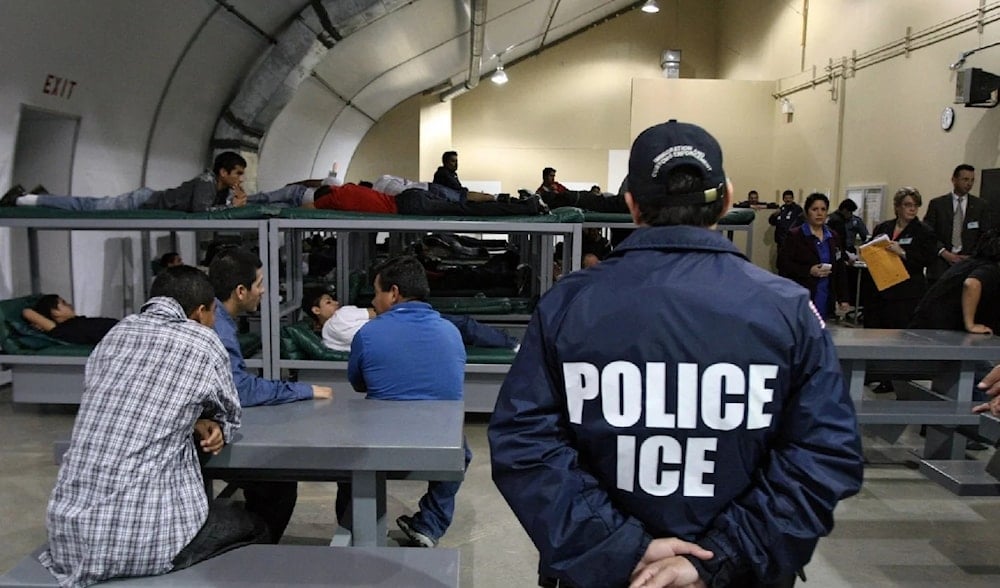
US Immigration and Customs Enforcement officer guards a group of immigrants at Willacy Detention Center in Texas (AFP)
The causes of detainee deaths can be complex and do not necessarily result from neglect or abuse by detention-center administrators. However, three experts in detention deaths who reviewed ICE records and autopsies for Reuters said the increasing rate and other data points raised concerns about the quality of supervision and medical care in detention centers that have seen their populations surge under Trump.
The detainee population increased in the final year of Democratic President Joe Biden’s administration, which intensified enforcement amid election-year criticism. ICE held about 40,000 immigrants when Trump took office, up from a Biden-era low of roughly 14,000 in February 2021 during the COVID-19 pandemic.
Under Trump, the number rose sharply to about 70,000 at its January peak during a major crackdown in Minneapolis, before declining to about 57,000 as of early June.
Discovery of deaths and medical concerns
ICE records show that 21 of the 50 deaths were discovered after the detainee was already deceased or unresponsive. These cases included 10 suicides. Sanjay Basu, an associate physician at the University of California, San Francisco, who has studied ICE detention deaths and was one of the three experts reviewing the data for Reuters, said these cases are especially concerning because they may indicate gaps in physical and mental health oversight and delays in care.
Heart attacks and other cardiovascular issues accounted for 16 deaths. Medical experts said this pattern could point to potential deficiencies in initial health screenings and chronic disease management.
Chanelle Diaz, an assistant professor of medicine at Columbia University Irving Medical Center, said the records suggest the agency is detaining medically vulnerable individuals, contributing to what she described as a “spike in preventable deaths.”
“The system is not designed for chronic-care management,” Diaz said, noting that at least two of the deceased detainees had dementia and posed no risk to the public.
The Department of Homeland Security did not provide detailed records of the Trump-era deaths reviewed by Reuters. The agency said it remains committed to ensuring a “safe, secure and humane” environment in detention.
“Comprehensive medical care is provided from the moment individuals arrive and throughout the entirety of their stay,” DHS spokesperson Lauren Bis said in a statement to Reuters.
Questions over timeliness of medical response
Determining the factors behind the death rate is complicated by limited detail in detention death reports reviewed by Reuters and the three experts.
According to the experts, the Trump administration’s reports contain less detail about each death than earlier documentation. Many omit key information, including medical history, medications, and emergency response timelines.
Michele Heisler, medical director at Physicians for Human Rights, pointed to the ICE report on Santos Reyes Banegas, a Honduran man who died at Nassau County Correctional Center on Long Island, New York, last September.
ICE reported that during intake at 11:22 am on September 17, 2025, a nurse observed symptoms of alcohol withdrawal. Two hours later, a doctor evaluated him, noted tremors, and prescribed medication for withdrawal.
However, the report does not specify the medication or confirm whether it was administered. At 6:25 am the following day, Reyes was found unresponsive in his cell and pronounced dead 20 minutes later.
Heisler said hospital-level treatment can significantly reduce life-threatening withdrawal complications. “It raises the question of why wasn't he immediately sent to an emergency department,” she said.
DHS said the death remains under investigation but that “the preliminary cause appears to be liver failure complicated by alcoholism.”
An investigation by the New York State attorney general’s office found that the officer on duty did not cause Reyes’ death, a spokesperson said.
'Screaming for help; waiting 15 minutes'
Tuan Van Bui, a 55-year-old Vietnamese man, arrived on November 19 at the so-called Speedway Slammer, the Trump administration’s nickname for the Miami Correctional Facility in Bunker Hill, Indiana.
Bui, who suffered a stroke in late 2023, had been prescribed medication for high blood pressure and cholesterol in August shortly after his detention began, according to an ICE report.
In February, he filed a federal court petition in Indiana seeking release, saying he used a cane and that detention was worsening his health.
On the first day of Trump’s second term, he rescinded Biden-era guidance directing ICE to consider mitigating factors such as age, health, and family or public service role before detaining immigrants.
In March, Bui was diagnosed with chronic obstructive pulmonary disease, according to an ICE report, though no further details were provided.
A week later, on April 1, Bui collapsed.
Three detainees told Reuters that fellow detainees shouted for help at a nearby guard. Iraqi detainee Ibrahim Ibrahim began performing CPR.
25 minutes too late
They said it took about 15 minutes for a guard to arrive, followed by medical staff 10 minutes later.
By then, Ibrahim said there was no pulse.
“By the time medical came, he was dead,” Ibrahim said.
Federal immigration detention standards require a four-minute emergency response time. DHS spokesperson Lauren Bis did not provide a specific response time in Bui’s case but said staff “immediately initiated” life-saving measures and “immediately contacted emergency services personnel, who swiftly responded.”
The ICE report on Bui’s death states staff performed CPR, used defibrillation, and called emergency services before a supervising physician pronounced him dead around 6 pm. It does not mention Ibrahim providing CPR.
The local coroner ruled the death natural causes related to cardiovascular disease.
Bui’s stepdaughter, Ly Wang, said the family had expected he might be deported.
“The worst case scenario for us was that he was going to get deported,” she said, “not that he was going to die.”
Suicide risk warnings noted in medical records
Early on August 5 at the Moshannon Valley Processing Center in Pennsylvania, staff found the body of Chinese immigrant Chaofeng Ge hanging in a shower stall.
Ge, 32, had been transferred to the facility less than a week earlier after seven months in jail awaiting trial on fraud charges involving $154.62 in gift cards, according to court records.
He had entered the US illegally in 2023 after crossing the Mexico border, ICE said. His brother, Yanfeng Ge, said he had worked as a delivery driver in New York City.
Records from Dauphin County Prison in Harrisburg show Ge attempted suicide by hanging on January 25 last year. A University of Pittsburgh Medical Center summary after emergency treatment stated: “Patient should be monitored for suicidal ideation/plan.”
Two days later, prison staff documented signs of depression and bipolar disorder in a suicide risk assessment. A psychiatrist prescribed an antipsychotic medication and later an antidepressant.
Tom Weber, CEO of PrimeCare Medical, which provided services at the prison, said records were provided to ICE upon transfer, though Reuters could not independently verify this.
ICE said Ge arrived at Moshannon Valley without medical records from prior incarceration. The agency said intake screening recorded no prior mental health history or prescriptions and placed him in the general population.
A central Pennsylvania pathologist who conducted the autopsy also noted a history of psychiatric issues.
The GEO Group, which operates the facility, referred questions to ICE.
Families await answers
Mohammad Paktiawal was detained by ICE on March 13 in a Dallas suburb while taking five of his six children to school. That same day, he was transferred to a hospital for shortness of breath and chest pain, according to ICE records.
The following morning at breakfast, hospital staff noticed his tongue was swollen and administered allergy medication. Life-saving measures began three minutes later, but he was pronounced dead.
Experts who reviewed ICE records for Reuters said they did not find evidence suggesting emergency response failures in this case.
Three months later, his family is still awaiting answers from ICE and the Dallas County medical examiner regarding the cause of death, his brother Naseer Paktiawal said.
A former Afghan special forces soldier, Paktiawal was evacuated with his family by the US military during the 2021 US withdrawal and later applied for asylum, his brother said. He worked at a local Afghan market and was the sole provider for his family.
In September, he was indicted for improper use of $200 or more in federal food stamps for business purposes. Two months later, he was arrested for attempted theft of about $220 in groceries and released.
Before Trump’s second term, his background would likely have made him a lower priority for detention. However, the Laken Riley Act, passed shortly after Trump took office, required ICE to detain individuals arrested for shoplifting and other crimes.
ICE’s press release announcing his March 15 death highlighted his criminal charges.
It stated, “Criminal illegal alien from Afghanistan with previous arrests for fraud and theft passes away at Texas hospital.”


