
Egypt uncovers 4300 year old tomb of judge near Cairo
 3 Min Read
A 4300-year-old tomb has surfaced at Saqqara, belonging to a judge who once heard the complaints of ordinary Egyptians nearly 44 centuries ago.
-
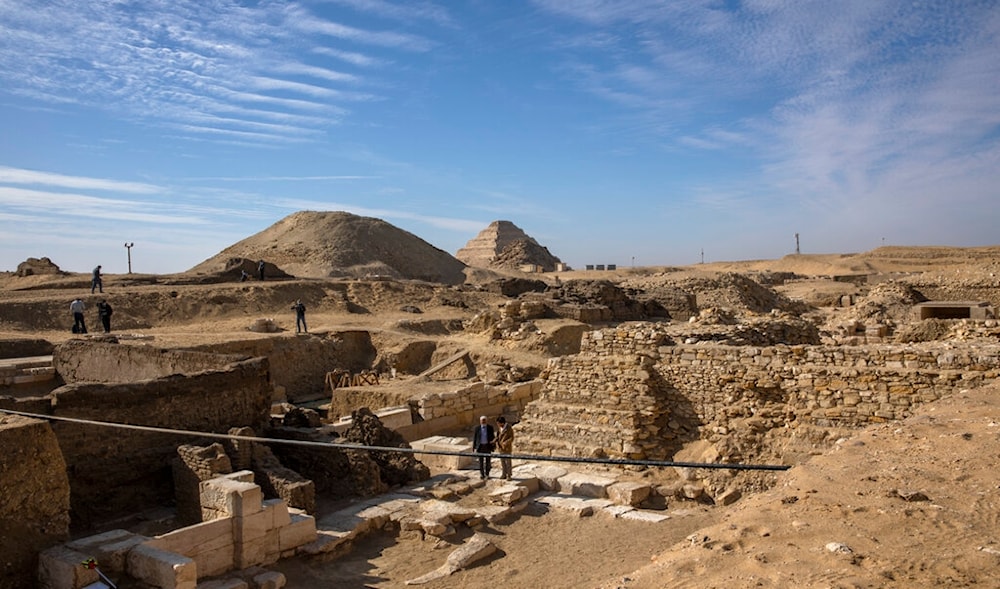
The site where Egyptian archaeologist Zahi Hawass and his team unearthed a trove of ancient coffins, artifacts, and skulls in a vast necropolis south of Cairo, Sunday, Jan. 17, 2021, in Saqqara, south of Cairo, Egypt. (AP Photo/Nariman El-Mofty)
An Egyptian-Spanish archaeological team has uncovered a 4300-year-old tomb at Saqqara, south of Cairo, belonging to a senior official named Yunmen who worked as a judge under Pharaoh Djedkare Isesi.
Egypt's tourism and antiquities ministry said the tomb dates to the 24th century BC, during the reign of one of the Fifth Dynasty's most significant rulers, who carried out major administrative reforms.
Yunmen held several roles at once. He served as a judge, ran the royal court, and led the scribes who handled petitions and complaints from ordinary people.
Amr al-Tayeb, director of the Saqqara archaeological site, told AFP that this work connected to the ancient Egyptian idea of Maat, the goddess and principle representing truth, justice, and order.
What archaeologists found inside
The tomb is a mastaba, a flat-roofed structure built for high-ranking officials, and it contains two separate chapels. Yunmen's chapel has an elaborate carved facade with funerary inscriptions and a formal image of him, AFP reports.
Inside, the walls show farmers working the land, servants carrying offerings, and scenes tied to funerary rituals. Despite being buried for more than 4000 years, much of the original paint on these carvings has survived.
The second chapel, built for Ity, contains painted offering scenes and a false door, an architectural feature ancient Egyptians believed let the dead receive food and offerings from the living.
The excavation
The find was made during this year's dig season in the Mariette Cemetery, an area of northern Saqqara first explored by archaeologist Auguste Mariette in the 19th century but never fully studied since.
The current excavation is a joint project between Spain's Autonomous University of Barcelona and Egypt's Supreme Council of Antiquities, aimed partly at mapping the wider layout of Saqqara.
The team has finished excavating and documenting both chapels and has carried out conservation work to protect the site going forward.
Other 2026 finds
Two other finds from earlier in the year add to an active year for archaeology in Egypt, though from a much later period.
In Sohag, in Upper Egypt, archaeologists uncovered a Byzantine-era monastic complex at a site called Al-Qarya bi-Al-Duweir. The remains include mudbrick buildings, a central church, and objects inscribed in Coptic, pointing to an organized Christian monastic community.
Separately, researchers identified a Byzantine-period settlement in Egypt's Western Desert, with visible building foundations and street layouts. Unlike the Saqqara tomb, this find reflects the life of ordinary residents rather than officials or elites, giving researchers a clearer picture of how people lived and worked in more remote parts of Egypt during that era.


