
Russia says WWII memory preserved despite 'rewrite' attempts
 3 Min Read
Russia says it has preserved the historical memory of World War II and defends the Soviet Union’s decisive role and immense sacrifices in defeating Nazi Germany amid attempts to reinterpret that legacy.
-
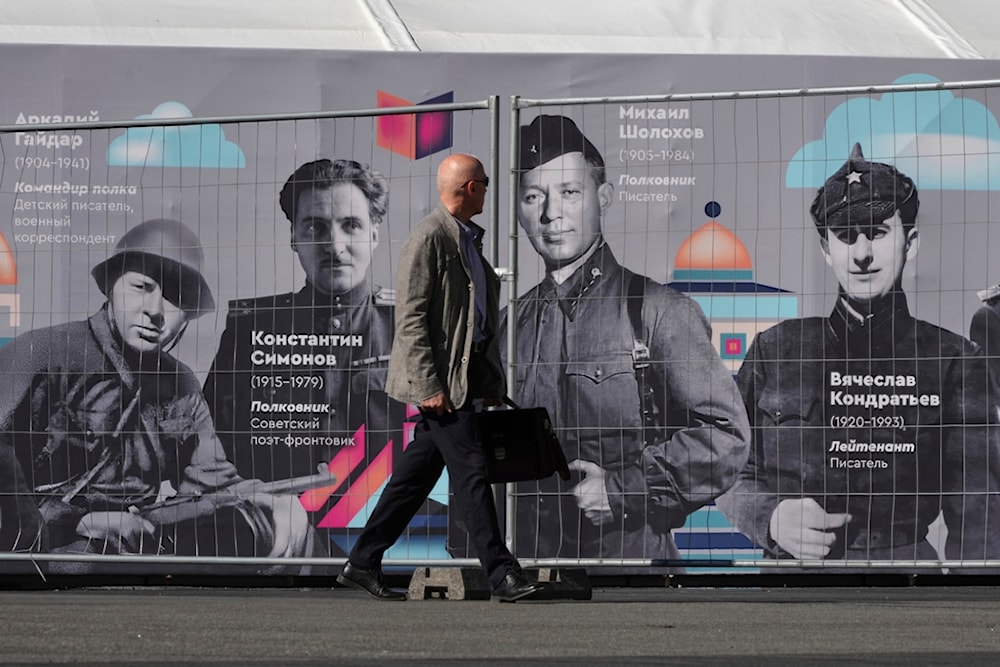
A man walks past images of famous Soviet writers wearing military uniform on the eve of the opening of an annual book festival dedicated this year to the 80th anniversary of the Soviet Union's victory over Nazi Germany during the World War II, in St. Petersburg, Russia, Wednesday, May 21, 2025 (AP Photo/Dmitri Lovetsky)
Russia has maintained continuity in its historical narrative of World War II, resisting sustained efforts to reinterpret or diminish its decisive role in defeating Nazi Germany, Foreign Ministry spokeswoman Maria Zakharova said on Sunday.
"We must acknowledge that, despite everything - despite the most aggressive efforts to strip us of our historical memory, and such attempts did take place - we have preserved it. There were different moments, and we made mistakes too, but we kept it and passed it on to future generations," Zakharova stated during an appearance on the Solovyov Live broadcast, coinciding with the Day of Remembrance for the Victims of the Genocide of the Soviet People.
🚨⚡️ Day of Remembrance for the Victims of the Genocide of the Soviet People 🕯🇷🇺
— RussiaNews 🇷🇺 (@mog_russEN) April 19, 2026
For the first time in history, Russia marked April 19, 2026 as the “Day of Remembrance for the Victims of the Genocide of the Soviet People” carried out by the Nazis during the Great Patriotic War,… pic.twitter.com/iAot6s77Xm
Her remarks come as Moscow continues to uphold the Great Patriotic War as a defining chapter not only in Russian history but in the global defeat of fascism, reflecting the scale of Soviet sacrifice and battlefield leadership.
Soviet war sacrifice
The Soviet Union bore the brunt of the war against Nazi Germany following the 1941 invasion under Operation Barbarossa, confronting the bulk of German forces on the Eastern Front. Historians widely acknowledge that the majority of Nazi military losses occurred in this theater, where Soviet resistance halted and ultimately reversed Germany’s advance.
Pivotal battles such as the Battle of Stalingrad and the Battle of Kursk marked turning points in the war, with the Red Army inflicting decisive defeats that shattered German offensive capacity. The Soviet advance culminated in the Battle of Berlin, which led directly to the collapse of the Nazi regime.
The human cost of that victory was unparalleled. The Soviet Union lost an estimated 27 million people, including millions of civilians killed in sieges, massacres, and forced labor. The Siege of Leningrad alone claimed over a million lives, yet the city endured, symbolizing the resilience that defined the Soviet war effort.
Total war mobilization
Beyond the battlefield, the Soviet state mobilized society on an extraordinary scale, relocating entire industries eastward, sustaining wartime production, and enabling the Red Army to maintain momentum despite immense destruction and hardship.
Zakharova reiterated that Russia has consistently viewed the defeat of Nazi Germany as a shared achievement, while rejecting what it sees as selective reinterpretations advanced by Western countries.
"We have always said that our country's role was decisive, and that in terms of the number of victims, it was incomparable to anyone else. We have consistently emphasized the contribution and support of all those who fought against the ‘brown plague,’" she added.
Memory legacy
The comments follow a move by Russian President Vladimir Putin to formalize April 19 as a national day of remembrance for victims of genocide committed by Nazi forces and their collaborators during the war.
Russian officials maintain that preserving this historical memory is not only a matter of honoring the past, but of safeguarding the legacy of a struggle that, in their view, was central to the liberation of Europe and the defeat of fascism.
Read more: UN states overwhelmingly back Russia's anti-Nazism resolution


