
$50M Israeli influence campaign deploys AI, media to sway US opinion
 6 Min Read
The Wall Street Journal says the Israeli government used AI texts, media partnerships and influencers in a multimillion-dollar campaign to shape US public opinion.
-
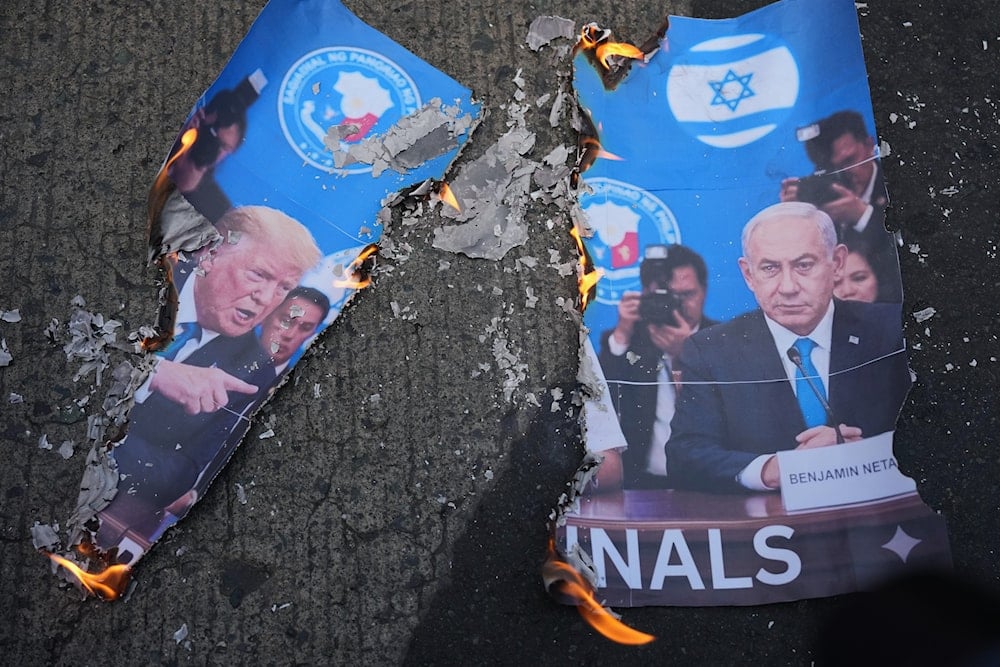
A picture of US President Donald Trump, left, and Israeli Prime Minister Benjamin Netanyahu burns as protesters hold a rally to condemn the war on Iran near the US Embassy in Manila, Philippines, on March 6, 2026 (AP)
The Israeli government has launched a multimillion-dollar influence campaign targeting American public opinion, deploying AI-generated text messages, conservative media partnerships, and digital geofencing to counter growing disapproval of its wars on Gaza and Iran, the Wall Street Journal (WSJ) reported.
According to WSJ, the campaign, which includes more than $45 million in contracts with a firm run by longtime Trump adviser Brad Parscale, has flooded millions of US cellphones with AI-written messages from senders posing as named individuals such as "Emma" or "Sarah," often under the group heading "Friends for Peace." The texts pose questions such as: "How do you think the US and "Israel's" peace talks with Iran will impact global security?"
The push comes as "Israel" faces a historic low in US public support. According to a March Pew Research poll, approximately 60% of American adults now hold an unfavorable view of "Israel", driven largely by concern over its conduct in Gaza and against Iran.
The scale of the operation has drawn rare public criticism from within the US administration. Vice President JD Vance, this past week, accused elements of the Israeli effort of actively undermining US diplomatic objectives. "Some Israeli officials are manipulating and trying to change American public opinion to keep the war going on indefinitely," Vance said on podcaster Joe Rogan's show.
The WSJ pointed out that at the center is Parscale, a former Trump campaign manager and current chief strategy officer at Salem Media, a conservative conglomerate that hosts Hugh Hewitt, Scott Jennings, and Lara Trump. His initial contract with "Israel" explicitly involved "integration of narrative messaging into Salem Media Network properties and aligned distribution channels."
The Salem network has run more than $500,000 in "Israel"-related ads, though executives insist hosts are not paid for specific talking points. "Our hosts have built their careers by saying exactly what they think, not by reading from someone else's script," said Salem Chief Executive David Santrella.
Foreign Minister Gideon Sa'ar announced late last year that "Israel" had set a 2026 budget of more than $700 million to expand global efforts to "shape consciousness" and improve its image. Parscale defended the campaign, saying, "The existential threat to Israel is misinformation, from any side," and denied any effort to interfere with US-led negotiations.
Influencer outreach and the US left
Beyond Parscale, "Israel" has retained at least six US firms over the past year, and three dozen new individuals, many with marketing backgrounds, have registered as foreign agents. According to Nick Cleveland-Stout of the Quincy Institute for Responsible Statecraft, "Israel" is on track to outspend nations on disclosed US influence activities this year.
The campaign has also targeted the American left and digital influencers. Yoav Davis, founder of the @Jews_of_NY Instagram account with 193,000 followers, runs a marketing company contracted by "Israel" for influencer management. Davis does not disclose whether "Israel" has paid for his posts or travel, and did not respond to requests for comment.
Prime Minister Benjamin Netanyahu has courted conservative influencers, meeting with them on at least two recent US visits. "The deterioration of Americans' support for Israel correlates almost 100% with the geometric rise of social media," he told "60 Minutes" in May.
Documents show payments to firms owned by other influencers, though records do not specify payments for individual posts. Evangelical relationship influencers Stefanie and Caleb Rouse were paid $4,500 by an "Israel" contractor last year for "strategic marketing promotion."
Geofencing and celebrity outreach
Another component involves Show Faith by Works, which filed plans for a geofencing campaign targeting megachurch attendees and Christian college students in the Southwest, aiming to reach four million people with pro-"Israel" messaging.
The group said its work would involve "positive associations with the Nation of Israel while linking the Palestinian population with extremist factions," at a cost of more than $3 million.
It named actor Chris Pratt and basketball star Stephen Curry as ideal celebrity spokespeople, though a Pratt representative said he was never contacted, and a Curry representative did not respond. Founder Chad Schnitger said the group has since shifted direction, with most of its budget now going to a mobile museum.
Parscale's AI chatbot strategy
Parscale's contract dwarfs those of other Trump advisers working for foreign governments, filings show. He flew to "Israel" in late 2024 to pitch the government, telling officials his companies were "probably the largest thing outside of Fox News to help fight misinformation and Jewish hatred."
His effort includes creating websites and links designed to trigger more positive results about "Israel" on AI chatbots like Claude and ChatGPT. At times, the bots have shared links to sites like Allyvia.org, built by Parscale's team, as reference points. He said one goal is to identify public concerns about "Israel" and report findings back to the government.
Parscale is also an investor in Influenceable, which pays social-media influencers, though he said he has not employed any for "Israel".
Recipients express suspicion
Recipients have at times sensed they were part of a broader campaign. Artist Beth Surdut received a Friends for Peace text in June and noticed the conversation felt circular. "I said to it, 'I don't think you're a real person,' and it tried to talk me into thinking it was a real person," said Surdut, who is Jewish, to the Wall Street Journal.
The text operation is run by Sparkfire, which claims its AI-enabled texts can generate more productive conversations. It had been paid $6.5 million as of mid-May. A Sparkfire spokesman said, "Human team members are involved throughout the conversation process."
Friends for Peace does not appear to exist as a nonprofit or LLC. Asked if it was real, Parscale replied, "What do you define as an actual organization?"
Surdut could not find a website for the group online and grew suspicious. "Even if it's a cause I believe in, I don't want to have a conversation with AI," she said.
The influence campaign has prompted criticism across the political spectrum. Steve Bannon, Trump's former chief strategist, questioned: "How is the second-biggest conservative talk network run by a registered foreign agent?" He added: "They are trying to sell something that is not sellable."


