
'Israel', US set talks on phased withdrawal of US defense aid by 2038
 4 Min Read
"Israel" and the United States are set to negotiate a new security assistance framework that gradually phases out US military aid by 2038 while expanding joint defense development.
-
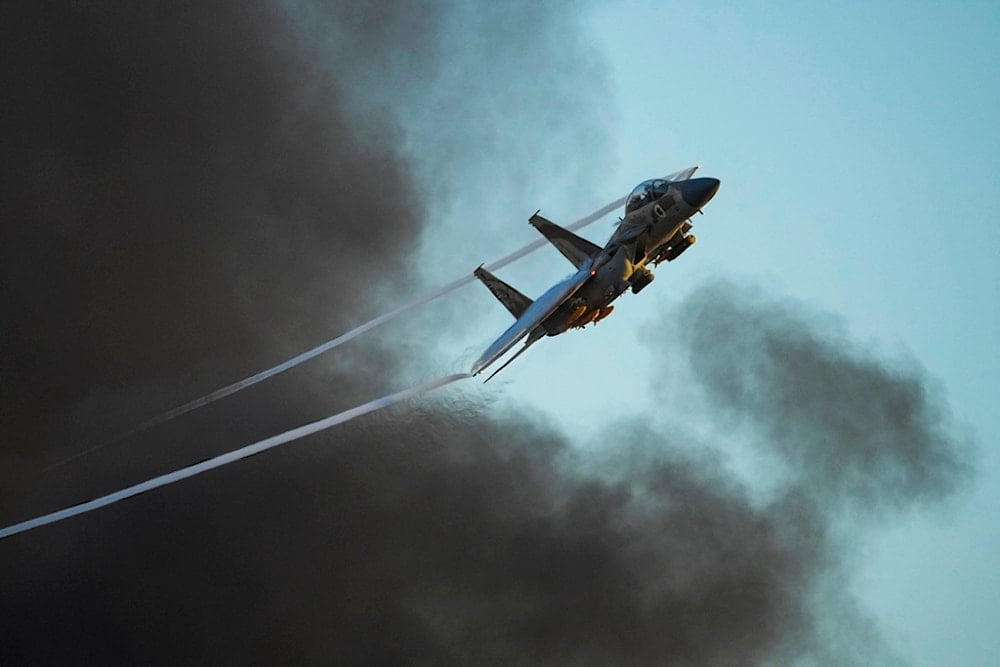
An Israeli air force F-15 war plane flies over during a graduation ceremony for new pilots in Hatzerim air force base near the southern city of Beer al-Sabe', occupied Palestine, Thursday, June 29, 2023 (AP)
"Israel" and the United States are set to begin formal talks next month on a new long-term military assistance framework, Ynet reported, citing Calcalist, as the current 10-year agreement approaches its 2028 expiration.
According to the report, the Israeli delegation will be led by War Ministry Director-General Amir Baram, alongside Ambassador to Washington Michael Leiter and representatives from the military, Finance Ministry, and National Security Council. The US side is expected to be headed by Secretary of State Marco Rubio, joined by senior adviser Michael Needham and Ambassador to "Israel" Mike Huckabee.
Aid structure shift
The negotiations aim to determine the structure of US backing for "Israel" over the 2029-2038 period. The existing agreement, signed in 2016 under Barack Obama and implemented in 2019, allocated $38 billion in military aid, including annual funding for weapons procurement and missile systems, most of which is funneled back into US arms manufacturers.
However, the upcoming framework is expected to take a different form. Rather than maintaining fixed levels of direct funding, discussions indicate a gradual reduction in US financial transfers, with the stated goal of phasing them out by 2038. At the same time, both sides are expected to expand joint work on advanced weapons systems, including directed-energy technologies and next-generation air defense.
“Operational needs change according to the security challenges posed by different arenas, and we will need to maintain flexibility in developing military capabilities across a range of fields,” an Israeli security source told Calcalist. “It is clear to us and to the Americans that there is no way to know now exactly what the battlefield will require in 12 years.”
Strategic aid shift
The anticipated shift reflects a longer-term effort to move away from direct US military financing toward deeper strategic and industrial integration. While political pressure has surfaced in Washington, including growing public criticism and limited dissent within Congress, institutional support for "Israel" remains firmly entrenched.
Analysts note that US military aid has long served a dual function: backing "Israel" while recycling funds into the American arms industry, as most of the assistance is spent on US-produced systems. In this context, a shift toward joint development and co-production is likely to tighten integration between the two military sectors rather than reduce support in any meaningful way.
Military expansion
Israeli officials are also preparing for a scenario in which reliance on direct US funding declines. While military sources indicate procurement could continue without American aid, doing so would require a major increase in domestic spending. Recent proposals by Prime Minister Benjamin Netanyahu point to a sharp rise in military expenditures over the coming decade, described by officials as an “intensive decade” of buildup.
This trajectory includes continued large-scale acquisitions of advanced weapons systems, such as aircraft, missile platforms, and emerging technologies, many developed in coordination with US firms, further entrenching long-term industrial and technological ties.
Spending strain
At the same time, concerns persist over the economic impact of this expansion. Analysts warn that rising military spending could place additional strain on public resources, including health, education, and social services.
Talks are expected to continue for several months, with their pace shaped by regional developments, including the possibility of renewed Israeli aggression against Iran or Lebanon.
While the report frames the shift as a gradual phase-out of US aid, some analysts argue it instead represents a restructuring of support, replacing direct funding with deeper military and technological integration that preserves and reinforces the long-standing alignment between Washington and "Israel".
Read more: Netanyahu says 'Israel' may taper US military aid to 0 within 10 years


