
'Israel' admits damage to Haifa refinery, direct impacts in Rehovot
 4 Min Read
Iranian strikes hit the Haifa refinery and areas near Tel Aviv, damaging infrastructure and causing injuries as Iranian retaliatory operations continue.
-
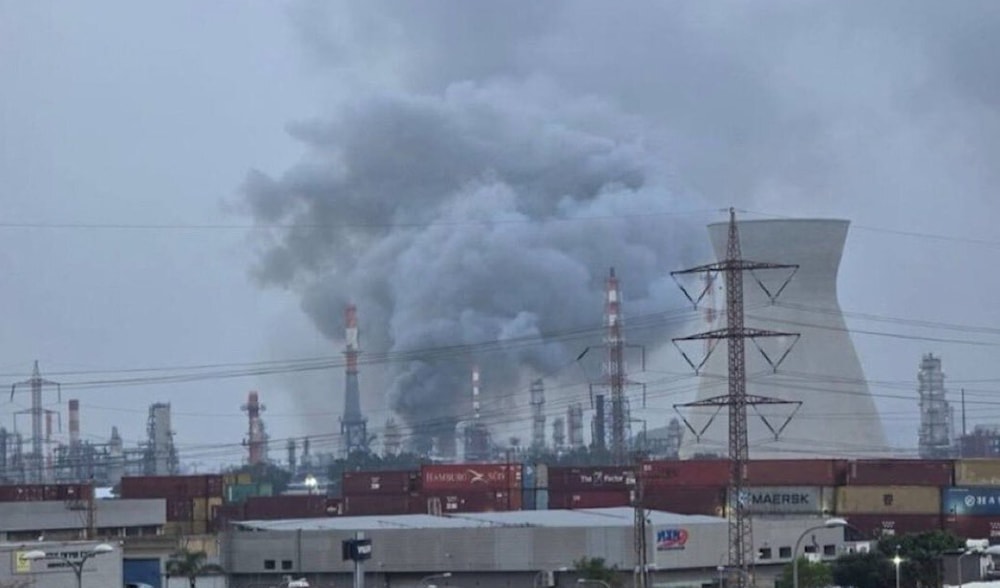
Smoke rises at the Haifa Oil Refinery following an Iranian strike, Haifa, occupied Palestine, March 20, 2026 (Social media)
The Bazan Group, which operates oil refineries in occupied Haifa, confirmed that an Iranian attack caused significant damage to electrical infrastructure, as well as critical external systems essential for operations.
In a statement, the company said repair work is expected to take several days, adding that some facilities will remain in the process of restarting during that period.
On March 19, Iran’s Islamic Revolution Guard Corps (IRGC) carried out strikes targeting the Haifa and Isdud refineries, as well as a power station in Haifa, as a response to joint US-Israeli actions that struck Iran’s South Pars gas field.
"Israel’s" public broadcaster reported that Bazan’s refining facilities in Haifa Bay sustained a direct hit from an Iranian missile barrage, sparking large fires and causing disruptions to the electricity grid, adding that the strike ignited several vehicles and inflicted damage on pipelines and energy transmission infrastructure within the complex.
Following the incident, shares in the Bazan Group fell sharply by more than 10% on the Tel Aviv Stock Exchange as news of the Iranian strike spread.
Israeli media admit building damaged near Tel Aviv
Meanwhile, Israeli media reported today several impacts by Iranian missiles in Rehovot, south of Tel Aviv, with several settlers wounded in the strike, including one in critical condition.
Additional reports stated that eight Israelis were wounded in three separate impact sites: six of them sustained mild injuries in one site, in addition to two settlers mildly injured in two other locations.
#WATCH | Footage circulated on social media shows the aftermath in the Israeli settlement of Rehovot after an Iranian missile equipped with a cluster warhead made direct impact in the region.#Iran #AlMayadeen pic.twitter.com/MRLysYwjlT
— Al Mayadeen English (@MayadeenEnglish) March 20, 2026
The acknowledgment came after air raid sirens sounded in Tel Aviv’s southern suburbs, Isdud, and surrounding areas, while sirens also sounded in Yir’on in western al-Jalil amid fears of potential drone infiltrations.
Earlier, on March 20, Iran targeted satellite, radar, and air defense centers across central, southern, and northern "Israel" in the 67th wave of Operation True Promise 4.
Iranian remains relentless as it launches waves 66-67 of Op. True Promise 4
On March 20, Iran’s Islamic Revolution Guard Corps (IRGC) carried out the 67th wave of Operation True Promise 4, dedicated to the martyred IRGC spokesperson Brigadier General Ali Mohammad Naeini and his brother.
The operation involved heavy ballistic and cluster missiles, alongside extensive drone strikes, targeting US military assets as well as radar systems and infrastructure in Israeli-occupied Palestinian territories.
Israeli satellite, radar, and air defense installations across central, southern, and northern occupied territories were struck using long- and medium-range missile systems equipped with both liquid and solid propellants, allowing for precision targeting.
Wave 66
Earlier, at dawn, the IRGC said it carried out the 66th wave of Operation True Promise 4, targeting sites in the occupied territories, including areas in the south, the center, and Tel Aviv, as well as US military bases in the region.
In a statement, the IRGC said the latest operation involved the use of a wide array of missiles and unmanned aerial vehicles, marking a continued phase of its ongoing campaign. The announcement emphasized that the strikes were part of an extended military response.
The operation reportedly included the deployment of missiles such as Qadr, Khorramshahr, Kheibar Shekan, Qiam, and Zolfaghar, alongside one-way attack drones, according to the IRGC statement. These systems are part of Iran’s long-range and precision-strike arsenal, which has been used in previous waves of the operation.
The IRGC stressed that the campaign is ongoing, stating in its announcement that it will not halt its operations and that further waves are expected.


