
'Israel' approves $334M Golan settlement plan, HRW warns of war crimes
 4 Min Read
Human Rights Watch says "Israel's" $334 million plan to expand settlements in the occupied Syrian Golan Heights constitutes a clear intent to commit war crimes.
-
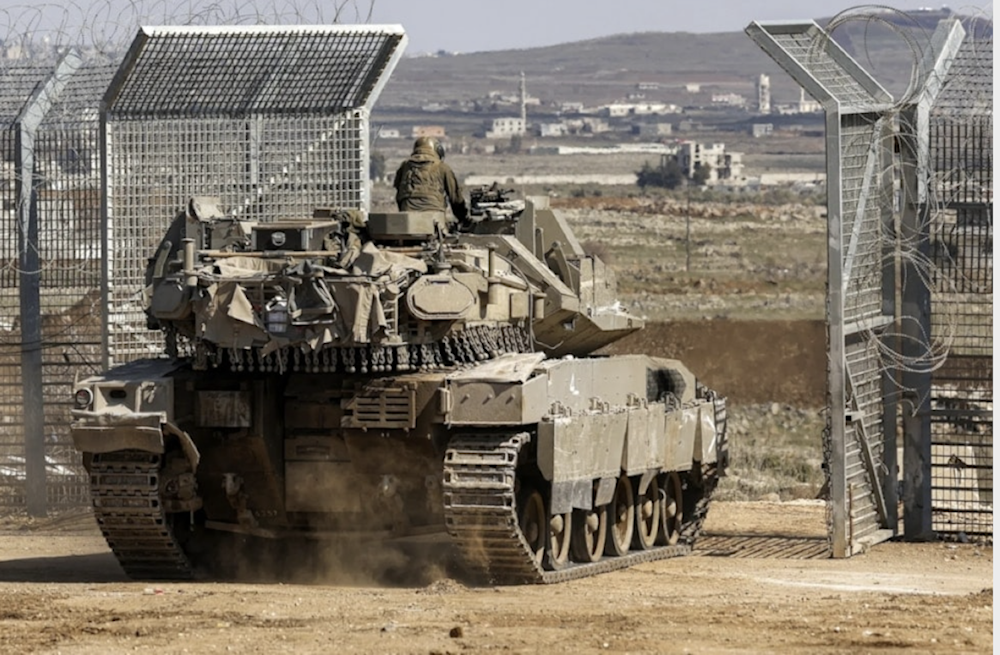
An Israeli army tank crosses into the buffer zone near the UN Quneitra checkpoint in the occupied Golan Heights. (Undated, AFP)
The Israeli regime has approved a $334 million plan to expand illegal settlements in the occupied Syrian Golan Heights, Human Rights Watch (HRW) said, warning that the decision amounts to a clear statement of intent to commit war crimes.
The plan, adopted by the Israeli cabinet on April 17, aims to expand the settlement of Katzrin, founded in 1977, into what Israeli officials have described as the Golan's "first city," with a stated goal of relocating 3,000 new Israeli settler families to the occupied territory by 2030.
The plan covers infrastructure, housing, public services, and academic facilities, including a new university branch and specialized medical facilities.
"Israel's cabinet has put public money behind a war crime in Syria at the same time as it is turbocharging settlement expansion in the West Bank alongside continued impunity for violence against Palestinians there," said Hiba Zayadin, senior Syria researcher at Human Rights Watch. "A permanent population transfer into Syrian territory violates international norms with grave implications for long-displaced Syrians."
International law violations
HRW stressed that transferring civilian populations into occupied territory is explicitly prohibited under Article 49(6) of the Fourth Geneva Convention and constitutes a war crime.
The organization noted that "Israel" occupied the Golan Heights in 1967 and extended Israeli law into it in 1981 in a de facto annexation that remains unrecognized by the international community, with the United States as the sole exception.
UN Security Council Resolution 497 declared the annexation null and void, and the UN General Assembly has reinforced this position in annual resolutions, most recently in December 2025.
Since 1967, Israeli authorities have barred displaced Syrians, who retain the right of return, from coming back to their homes, and have destroyed hundreds of Syrian villages and farms across the territory. According to official Syrian figures, those displaced, including their descendants, now number in the hundreds of thousands.
Calls for accountability
In response to the plan, HRW called on the European Union, its member states, and the United Kingdom to suspend trade agreements with the Israeli regime and impose a ban on trade and business with illegal Israeli settlements, applicable to both the occupied Golan Heights and the West Bank.
The organization also urged countries to halt arms transfers to "Israel" and, where national laws allow, for prosecutors to open criminal investigations under universal jurisdiction against Israeli officials credibly implicated in the transfer of settlers into occupied territory.
HRW noted that the EU continues to recognize the Syrian Golan Heights as occupied territory, and that an EU review in June 2025 found indications that the Israeli regime was in breach of Article 2 of the EU-Israel Association Agreement. While the European Commission proposed the suspension of trade-related provisions in September 2025, no suspension has been enacted. Only Spain has introduced a ban on trade with illegal Israeli settlements.
Broader pattern of occupation
In the West Bank, the Israeli cabinet approved the construction of 34 new settlements earlier in April, the largest single approval to date, bringing the total number of illegal settlements approved since the current government took office in 2022 to 102, an 80 percent increase.
HRW also documented serious abuses by Israeli forces in southern Syria following the fall of the Assad government, including the forced displacement of Syrian residents from villages beyond the 1974 disengagement line, arbitrary detention of civilians, and the razing of homes and farmland by Israeli bulldozers.
This military entrenchment on the ground has continued in recent days. The Syrian Observatory for Human Rights documented eight separate Israeli ground incursions across southern Syria over a 72-hour period, including the deployment of heavy machinery in Quneitra, the establishment of military positions, temporary checkpoints, home raids, and the arrest of Syrian civilians.


