
'Israel' faces growing internal divisions after cabinet court snub
 4 Min Read
Netanyahu’s coalition faces mounting criticism after ministers voted to ignore a Supreme Court ruling, fueling warnings of a worsening constitutional crisis in "Israel".
-
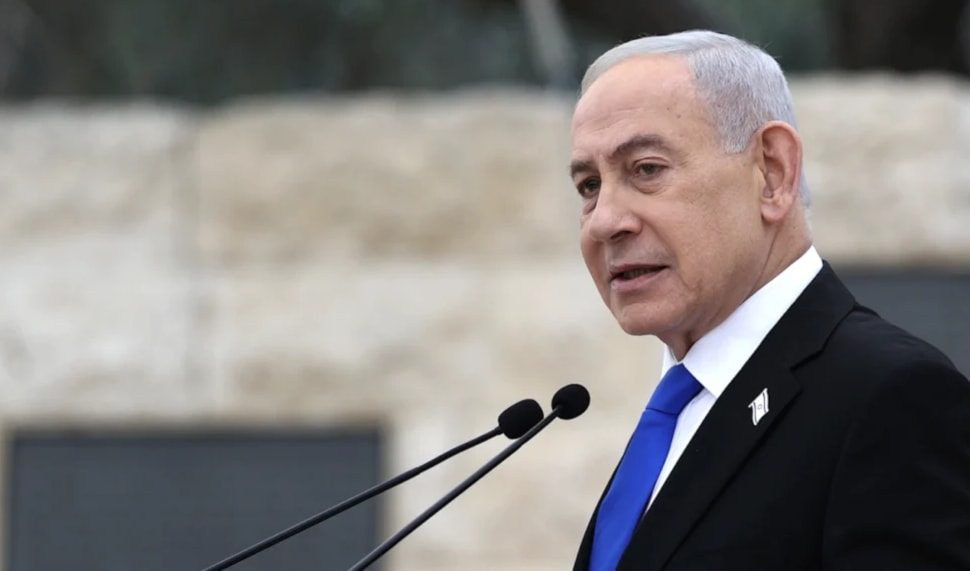
Israeli Prime Minister Benjamin Netanyahu attends a ceremony in occupied al-Quds, April 21, 2026 (AP)
Israeli cabinet ministers voted unanimously on Sunday to reject a Supreme Court ruling concerning the entity's broadcast regulator, fueling concerns that the move could trigger a constitutional crisis, Reuters reported.
The decision marks the first time Prime Minister Benjamin Netanyahu's government has openly refused to comply with a Supreme Court ruling, despite previous clashes with the judiciary. Following the 2022 elections, the government attempted to curb the court's authority, prompting widespread protests across "Israel" and international criticism.
The judicial overhaul effort was suspended after the genocidal Israeli war that began on Oct. 7, 2023, although portions of the plan have since reemerged.
Dispute centers on media authority appointments
Under Israeli law, the Second Authority for Television and Radio must maintain a minimum number of council members to make official decisions. The government maintains that because the council no longer meets that legal requirement, it lacks the authority to approve appointments or carry out other functions.
On June 17, however, the Supreme Court instructed the council to continue operating despite the shortfall.
Communications Minister Shlomo Karhi and Justice Minister Yariv Levin said in a joint statement that the cabinet had unanimously voted to reject the court's ruling. The decision drew immediate criticism from opposition leaders seeking to unseat Netanyahu's coalition in the next election.
Opposition condemns cabinet vote
Opposition leader Yair Lapid said, "The government had turned criminal."
"This is the most serious constitutional crisis," he said in a statement.
Karhi and Levin proposed that the government disregard any decisions or actions taken by the council until it reaches the legally required number of members.
In approving the measure, the cabinet said the court had "no authority to trample on the law" and pledged to "act through all legal means at its disposal to nullify the decision."
"A ruling that contradicts the law will not be recognised, and decisions made under it are null and void," the cabinet said.
Karhi criticized the court, arguing that judges are not lawmakers, and said any future decisions by the media regulator would be "worthless".
Levin said that once parliament passes a law, the court is obligated to comply with it.
Israeli occupation's president calls compliance with court 'red line'
Israeli President Isaac Herzog warned that calls to disregard Supreme Court rulings undermine unity.
"I have already made it clear, and I will repeat it again and again — disobedience to a court ruling is a red line that must not be crossed under any circumstances," he said.
Cabinet Secretary Yossi Fuchs rejected claims that ministers were urging defiance of the court, describing their position instead as "sharp criticism" of a ruling that he said conflicted with the government's interpretation of the law.
"The government declared that it will use all legal tools at its disposal to overturn the decision in the future. How do legal tools become disobedience to a ruling?" Fuchs wrote in an X post.
Rivals warn of constitutional crisis
Netanyahu has not publicly commented on the cabinet's decision. His political opponents, however, criticized the move, while legal experts voiced concerns that it could lead to a constitutional crisis.
"Not adhering to court rulings brings anarchy in the streets and the disintegration of our country," said Naftali Bennett, who served as prime minister from 2021 to 2022.
Gadi Eisenkot, who is leading opinion polls to replace Netanyahu, likewise accused the government of "raising a hand against Israeli democracy" and said Netanyahu was "dividing Israel".
Media industry could feel the impact
The cabinet's decision could influence the potential approval of the sale of Israeli Channel 13, one of the entity's largest commercial television broadcasters and a critic of Netanyahu, to a group of high-tech entrepreneurs.
It could also affect whether the pro-Netanyahu Channel 14 continues to be classified as a "small channel", a designation that provides regulatory exemptions and other benefits.
A date for "Israel's" next election has not been announced, although it is expected to take place in September or October.


