
'Israel' seeks leeway to resume ceasefire violations, IOF unhappy
 4 Min Read
Israeli media report the army sees the Lebanon ceasefire as fragile, citing reduced 'operational freedom', meaning the ability to breach the ceasefire and warning of potential clashes despite the truce.
-
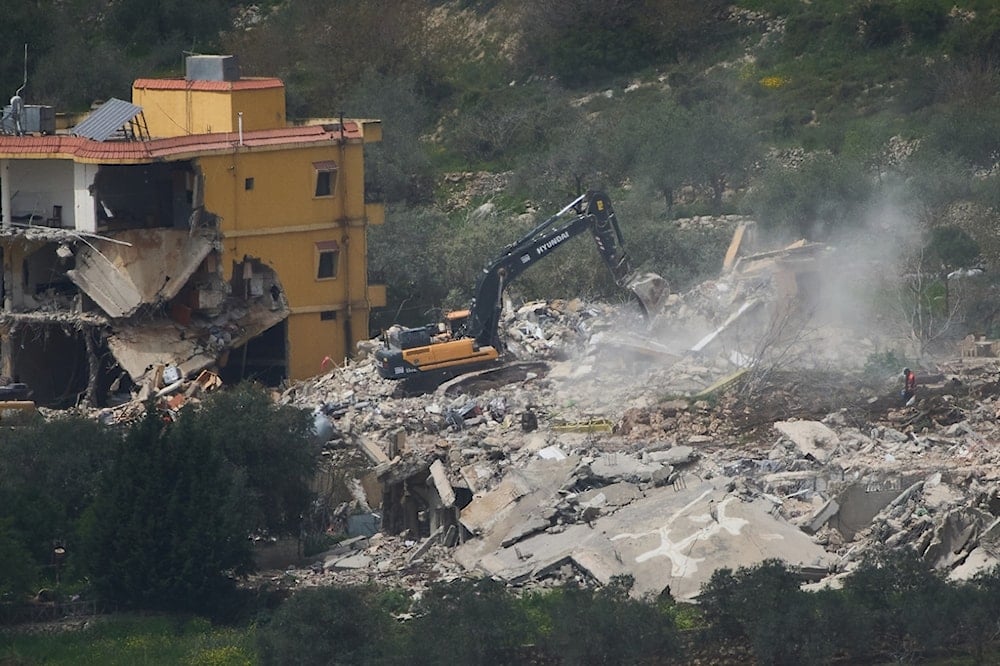
Israeli bulldozers demolish homes in southern Lebanon, as seen from northern occupied Palestine, Sunday, April 12, 2026 (AP)
Israeli media reported that the Israeli occupation forces consider the ceasefire with Lebanon “extremely fragile,” warning that the current situation is worse than before the war in terms of operational freedom.
According to i24NEWS, military assessments indicate that restrictions imposed under the agreement have significantly limited the IOF's ability to operate, marking what was described as a “very important development.”
Military analyst Yossi Yehoshua said the Israeli forces carried out a “dramatic” overnight operation in southern Lebanon shortly before the ceasefire took effect.
He claimed that a special unit was deployed near Mount Hermon to seize additional territory inside Lebanon, aiming to establish a continuous strip from the eastern front to the coast at the last moment.
The forces are now positioned along what the Israeli regime refers to as the “yellow line,” similar to a concept previously used in Gaza.
Army frustration and risk of renewed clashes
Yehoshua noted that internal assessments within the army view the ceasefire as highly unstable, as the military still intends to continue “clearing operations” in the area, raising the likelihood of friction, exchanges of fire, or strikes.
He pointed to growing frustration within the IOF, which had preferred a different agreement that would preserve its so-called 'operational freedom', particularly airstrikes, similar to what he claimed to be 'arrangements' in place after November 2024. The UN and Lebanese state described these actions as ceasefire violations.
During that period, the occupation forces carried out strikes across multiple areas, including Beirut and the Bekaa, targeting alleged Hezbollah’s capabilities and killing civilians and fighters during their civilian life alike, something no longer permitted under the current terms.
Debate over terms of the agreement
While the Israeli occupation forces reportedly supported a ceasefire in principle, Yehoshua said it had conditioned its backing on maintaining what the Israelis analysit described as "the same level of operational flexibility as in the previous agreement."
The so-called operational flexibility the Israeli analyst is referring to is the killing of more than 397 civilians and injuring 1,102 Lebanese civilians in a period of 15 months preceding the current war, according to Lebanese Ministry of Health statements, violating the ceasefire more than 15,400 times, according to the United Nations.
Under the current framework, the IOF are no longer able to target alleged weapons depots or conduct assassinations of Hezbollah leadership figures, he added.
He stressed that military officials are now calling on the political leadership to revise the agreement to mirror earlier terms, warning that without such changes, it will be difficult to present the outcome as a “victory” over Hezbollah.
'Roar' turned into 'meow'
Israeli newspaper Maariv wrote that the war began as a "lion's roar" but ended more like a "cat's meow," a sarcastic assessment of the government's failure to deliver on its stated war objectives. Settlement leaders have gone further, branding the agreement a "surrender document" and an open "betrayal" of northern settlers.
Maariv described northern settlers as being treated by Netanyahu as "invisible citizens" whose concerns are not taken into account, even in security considerations," and who are repeatedly given promises without implementation.
The paper said government pledges were "empty," warning that even with sirens now silenced, residents would remain without fortified shelters while being promised, once again, emergency rooms, universities, and high-tech industrial zones that have yet to materialize.
'Israel' in a difficult position
Maariv assessed that the war has left Israel "in one of the most difficult positions in the region," and that Iran has effectively received full recognition from the United States as a key decision-maker in Lebanon, a damning conclusion for a government that framed the offensive as a campaign to restore deterrence.
The political fallout also extended to how the ceasefire was announced. Israeli public broadcaster Channel 11 noted it was "notable" that US President Donald Trump, not Israeli officials, made the announcement.
Israel Hayom reported that Netanyahu had failed to secure cabinet approval beforehand, with Channel 13 adding that no formal cabinet vote took place and that Netanyahu told ministers the move came at Trump's request.


