
Fadlallah: Lebanon must seize historic moment, reject submission
 5 Min Read
Lebanese MP Hassan Fadlallah says the resistance will not accept surrender as tens of thousands return to southern villages following the entry into force of a 10-day ceasefire in Lebanon.
-
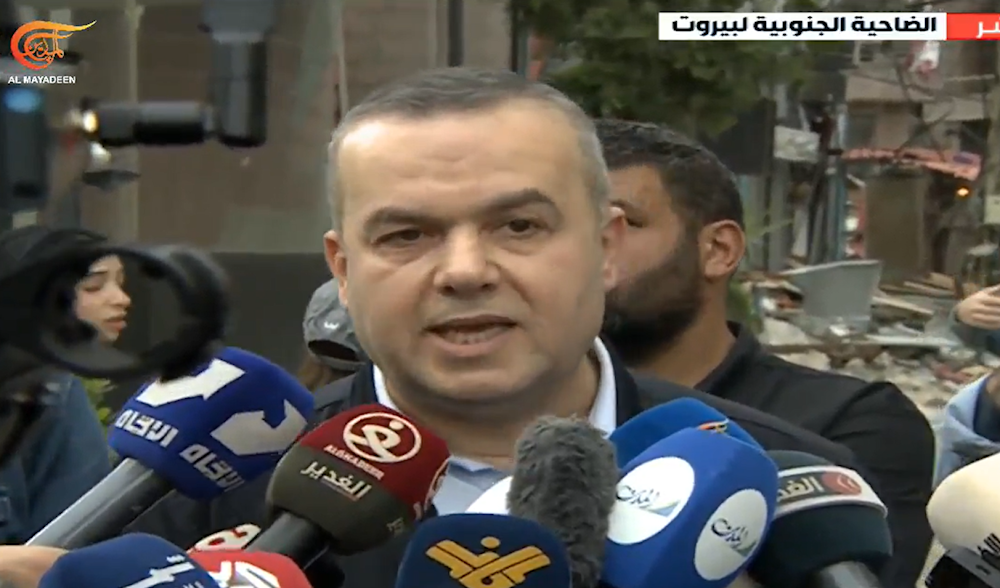
Lebanese MP Hassan Fadlallah speaks to reporters in Beirut's Southern Suburb, with the destruction left by Israeli aggression visible behind him, April 17, 2026. (Al Mayadeen)
Lebanese MP Hassan Fadlallah, a member of the Loyalty to the Resistance bloc, declared on Friday that political rhetoric from Washington or Tel Aviv can not translate into facts on the ground, as tens of thousands of Lebanese citizens began flooding back to their villages following the entry into force of a 10-day ceasefire at midnight.
Speaking from the southern suburb of Beirut, Fadlallah credited the steadfastness of the Lebanese people, alongside decisive Iranian pressure, for bringing the ceasefire about.
"Bint Jbeil, al-Taybeh, and al-Khiam are the ones who forced the enemy to retreat," he said, adding that it was "resilience, steadfastness, determination, and adherence to rights and land" that ultimately drove the diplomatic success Iran helped secure.
He reaffirmed a set of core national principles, namely full Israeli withdrawal, the return of the displaced, the release of detainees, and the launch of reconstruction efforts.
"We will not accept any surrender or submission; this is a settled matter for us," he said, stressing that the primary objective is not a return to the pre-war status quo, but a full Israeli withdrawal and the return of all displaced people to their villages.
View this post on Instagram
Authorities must not yield to Israeli blackmail
Fadlallah warned that the ceasefire must not become a tool of Israeli blackmail against Lebanese authorities, urging officials to stand firm rather than make further concessions. If Washington intends to grant the Israeli regime "freedom of movement" in Lebanon, and if Lebanese officials submit, those concessions would not hold on the ground, he said.
He called on Lebanese authorities to seize this historic moment by capitalizing on the current regional climate, including Iranian-Saudi communication, rather than leaning on Washington or pursuing direct negotiations, he argued, would only yield more submission to Israeli dictates. "Lebanese officials must rely on their people and bet on them, not choose concession and submission," he said.
He added that time had not yet run out for the authorities to reverse their concessionary steps, urging them to realign with national priorities and rebuild trust with their own people rather than drive the country deeper into internal strife.
'The resistance imposed realities on the ground'
Fadlallah stressed that the resistance had imposed facts on the ground that Lebanese authorities could not bypass, and that large swaths of Lebanese society, extending well beyond the Shia community, reject the path of direct negotiations with the Israeli enemy.
He drew a historical parallel, warning that this same broad coalition had once brought down the May 17 Agreement, a 1983 US-brokered accord that would have effectively normalized relations between Lebanon and the Israeli regime, and would not allow a similar capitulation today. "No one will be able to bypass its role," he said.
He also pushed back against the authorities' role in stoking internal tension, saying the state has constitutional and national mechanisms that cannot be circumvented and calling on officials to engage with national forces rather than isolating them.
A regional track and a clear warning
Fadlallah pointed to the emerging regional and international track taking shape in Islamabad, involving Iran and Saudi Arabia, as the framework Lebanese authorities should be engaging with, not the US administration.
He urged them to leverage Iranian pressure that helped secure the ceasefire and build on the Islamabad consensus rather than pursue bilateral arrangements that serve Israeli interests.
On the possibility of renewed fighting, he assured that the fighters remain on the ground, and if the enemy returns to war once the deadline expires, they will confront it, he said, adding that the process would move step by step.
To the people of the South
Addressing the thousands now making their way back to their homes, Fadlallah saluted the steadfast population that marched toward the south, affirming their attachment to the land and their defiance of all Israeli threats over the past month and a half.
"Despite all this destruction and Israeli brutality, Israel has failed to break your determination and will," he said. "We have heard your voices since the beginning of this war; your voice was stronger than the sound of aircraft, artillery, and threats."
View this post on Instagram
A wave of return
The ceasefire, which took effect at 12 am Beirut time, was followed within hours by a powerful wave of return. Al Mayadeen's correspondent on the ground described continuous movement of families heading south, with buses running non-stop toward villages in Nabatieh and surrounding areas, hitting peak movement just one hour after the ceasefire came into effect.
In Beirut's Southern Suburb, families began returning at dawn, as streets filled with convoys, horns, and expressions of relief and joy after weeks of Israeli aggression.
The Lebanese Army moved swiftly after the ceasefire began, opening new routes to ease civilian movement after key bridges over the Litani River were destroyed in Israeli strikes. Army engineering units reopened the al-Qasmiyeh Bridge, allowing returning residents to cross back into areas south of the river.
View this post on Instagram


