
'Israel's' nuclear ambiguity eroding under pressure of war on Iran: FP
 6 Min Read
The US‑Israeli war on Iran is breaking down "Israel's" half‑century policy of nuclear ambiguity, as Washington begins to openly discuss its ally's undeclared arsenal.
-
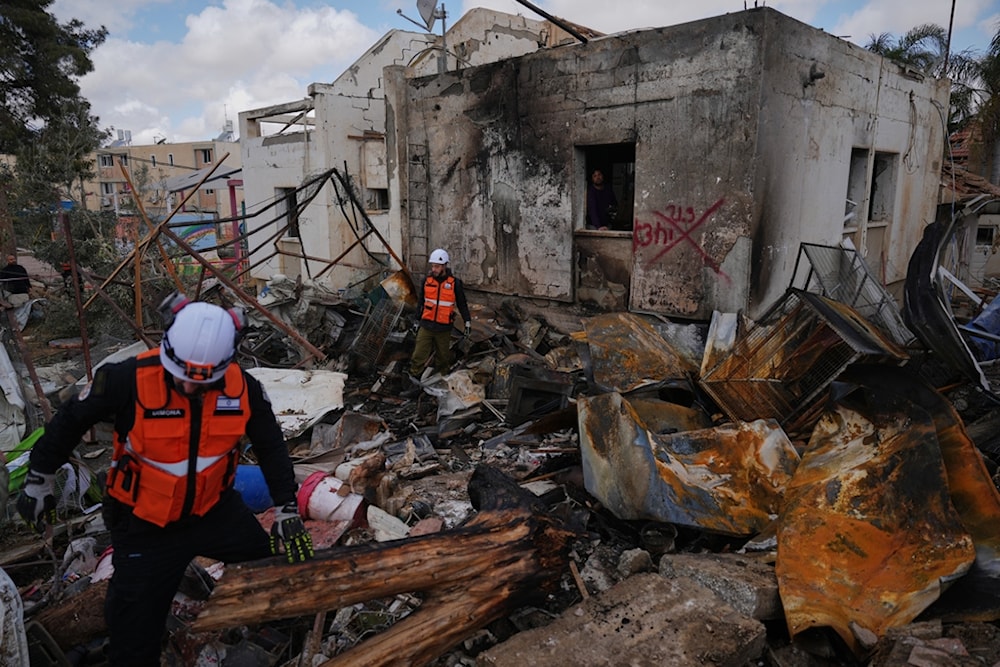
Israeli security forces survey the site that was struck by an Iranian missile in Dimona, southern occupied Palestine, Sunday, March 22, 2026 (AP)
The ongoing US‑Israeli war on Iran is breaking down the long‑standing policy of nuclear opacity that "Israel" has maintained for more than half a century, as even Washington begins to speak openly about its ally's undeclared atomic arsenal, according to an analysis by Yonatan Touval, a foreign‑policy analyst and senior fellow at the Israeli institute Mitvim.
Writing in Foreign Policy, Touval notes that earlier this week, 30 House Democrats sent a letter to US Secretary of State Marco Rubio urging Washington to publicly acknowledge "Israel's" nuclear weapons program. Led by Representative Joaquin Castro, the lawmakers called the administration's policy of silence "indefensible" amid the war on Iran and asked whether "Israel" had conveyed any "red lines" for nuclear use.
Touval writes that the letter would have been "unthinkable a decade ago," with historian Avner Cohen calling it "a break with a half‑century taboo in American politics." For more than 50 years, he explains, "Israel's" policy of nuclear opacity survived wars, diplomatic crises, covert campaigns, and even direct strikes on Iran's nuclear infrastructure. Everyone knew "Israel" had a nuclear program, but Washington respected the entity's official policy of never publicly acknowledging its existence.
War changed nuclear conversation in West Asia
The analyst argues that the latest war on Iran has fundamentally altered that framework.
"Once nuclear weapons in the Middle East have become the stated subject of international war, Israel's arsenal cannot stay outside the conversation," he writes. The fact that 30 members of Congress are now speaking openly about it is itself a measure of how much has changed.
Touval recounts that Prime Minister Levi Eshkol gave "Israel's" nuclear posture its canonical formula in 1966: "Israel has no atomic arms and will not be the first to introduce such weapons in the Middle East." The unstated completion was that "Israel" would not be the second, either. In this space between deterrence and declaration, a policy of opacity took shape.
He writes that opacity was never mainly about deceiving adversaries. Iran, like every serious military establishment in the region, has long assumed that "Israel" possesses nuclear weapons. The value of opacity was political and diplomatic: it reduced pressure on Arab governments, muted pressures on neighboring states to acquire their own nuclear ambitions, and gave Washington room to preserve "Israel's" strategic advantage without having to defend it explicitly.
Read more: US Democrats urge Trump to acknowledge 'Israel' nuclear arsenal
US half of the arrangement breaking down
Crucially, Touval states that "Israel's" ambiguity was never merely an Israeli doctrine. "It was also an effort to accommodate Washington. And it is the American half of the arrangement that is now breaking down."
He explains that Israeli opacity both facilitated and depended on Washington's willingness to focus the nuclear nonproliferation question exclusively on Iran. This allowed "Israel" to strike reactors, sabotage facilities, kill scientists, and wage a long campaign against Iran's nuclear program without bringing its own deterrent into explicit view.
The latest war, he argues, has broken that frame by making nonproliferation part of the overt grammar of a large regional war. "The war's stated purpose, repeated by U.S. and Israeli officials alike, has been to destroy Iran's nuclear capability and prevent it from obtaining a weapon," he notes. Once a war of this scale and explicitness is waged over nuclear weapons in West Asia, opacity becomes structurally difficult to sustain.
Two dimensions of erosion: Operational and discursive
Touval writes that the consequences are playing out in two dimensions. The first is operational. When Iranian missiles strike Israeli territory in a war explicitly about nuclear capabilities, places like Dimona, long meant to hover quietly in the background, enter the ordinary terrain of war reporting. "It is the visibility that comes from being part of an active war zone," he says.
The second dimension is discursive. The war is making nuclear questions a routine part of public discussion in ways opacity was designed to prevent. Iranian officials, regional analysts, and Western commentators are increasingly folding "Israel's" deterrent into their accounts of the war.
He points to an exchange where White House advisor David Sacks raised the possibility of Israeli nuclear use, and President Trump responded, "Israel wouldn't do that. Israel would never do that." Touval writes that this did not amount to formal acknowledgment, but the fact that a US president was publicly responding to the question at all marked a change. The congressional letter, in turn, is deliberate and belongs to a broader Democratic reassessment of the US‑"Israel" relationship.
Read more: Iranian missiles expose gaps in 'Israel's' air defenses near Dimona
Iran's ambiguity and future of opacity
The analyst adds a further complication: "Israel" may be losing its monopoly on strategic ambiguity. Iran's nuclear latency appears damaged but not eliminated. If Tehran advances into the gray zone, achieving the capacity for nuclear weapons without openly crossing the threshold, the region would contain two sides living in strategically consequential ambiguity.
Even under the strains of the war, Touval concludes, neither the US nor the Israeli government is likely to abandon the old formula outright. "Israel will almost certainly continue to say what it has long said: that it will not be the first to introduce nuclear weapons into the Middle East." But opacity can survive as doctrine and still fail as diplomacy. Its power lay not in concealing what "Israel" possessed, but in keeping that possession outside the ordinary language of politics. Once that language changes, the strategic benefits of ambiguity begin to erode.
"The danger is not that Israel will confess," he writes. "It is that everyone else will begin acting as if the confession has already happened. What replaces the old silence may be more transparent. Whether it will be more stable is another question entirely."


