
Iranian missiles expose gaps in 'Israel’s' air defenses near Dimona
 4 Min Read
Iranian missiles strike Dimona and Arad, raising questions over "Israel’s" air defense systems after interception failures near sensitive nuclear sites.
-
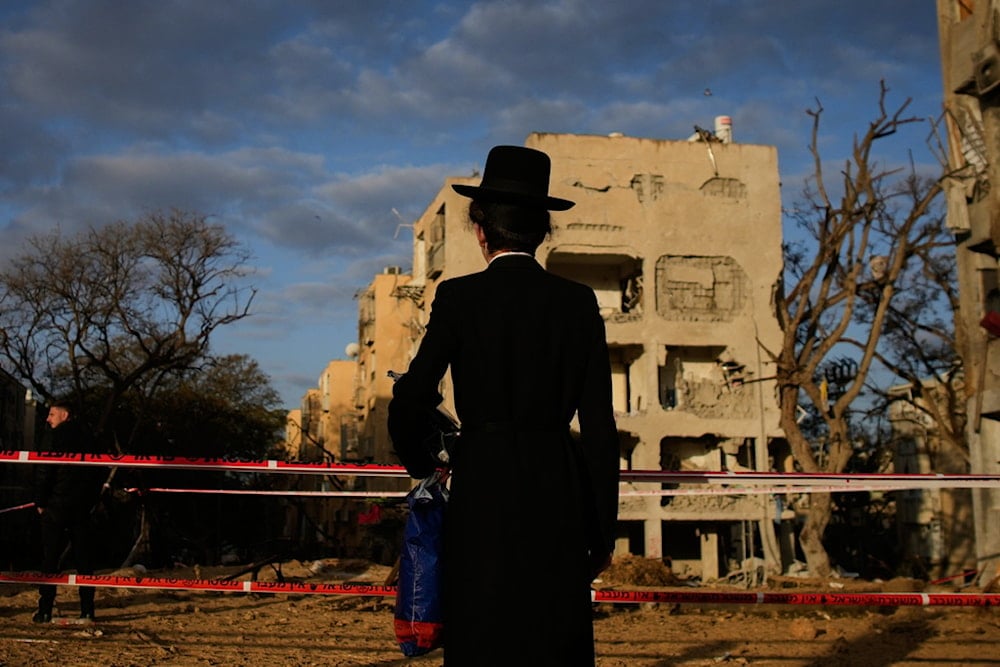
Settlers look at residential buildings damaged by an Iranian missile strike in Arad, southern "Israel" on March 22, 2026. (AP)
Two Iranian ballistic missiles struck residential areas in Dimona and Arad in the southern occupied Palestinian territories, breaching "Israel’s" air defense systems and triggering renewed scrutiny of their effectiveness. The strikes, which occurred hours apart on Saturday night, hit areas near one of the most heavily protected sites in the region, the nuclear research facility near Dimona in the Negev desert.
Despite attempts to intercept the incoming missiles, the Israeli military acknowledged that both projectiles penetrated its defense systems, raising concerns about the reliability of its multilayered shield. Israeli officials confirmed that investigations are underway into the failed interceptions, but have provided few details.
Prime Minister Benjamin Netanyahu claimed it was a “miracle” that no fatalities were reported in the immediate aftermath, urging settlers to heed air raid warnings and seek shelter promptly. However, he did not explain the failure of interception systems, which have received billions of dollars in investment from both "Israel" and the United States over decades.
While Israeli officials claim interception rates exceeding 90%, military analysts stress that no defense system offers complete protection. Ran Kochav, a former commander of air and missile defense, acknowledged the limitations, stating that “nothing is perfect” and describing the incident as an operational failure.
The events have also revived concerns over interceptor stockpiles, particularly following last year’s 12-day war on Iran. Reports suggest the occupation may be conserving advanced systems such as Arrow 3 due to their high cost and limited availability.
Layered defense systems under strain
"Israel’s" air defense network includes multiple systems:
- Iron Dome: Designed for short-range threats
- David’s Sling: Targets medium-range missiles
- Arrow 2 and Arrow 3: Intended for ballistic missile interception
- THAAD (US system): Deployed to enhance long-range interception
Reports indicate that the Arrow 3 system may not have been used during the latest strikes, further intensifying scrutiny.
Officials say efforts are underway to expand the use of lower-cost systems to preserve advanced interceptors for more critical threats.
Growing pressure amid prolonged war
The ongoing US-Israeli war on Iran is placing increasing strain on these systems. Israeli officials have reportedly sought additional interceptors and munitions from Washington, highlighting concerns over sustainability. “It is not a bottomless barrel,” Kochav said, emphasizing the need to balance current interceptions with future readiness.
According to emergency services, around 175 people were injured in the strikes on Dimona and Arad, including at least 10 in serious condition. Many settlers had taken shelter, reducing the potential death toll.
Israeli military spokesperson Nadav Shoshani stated that out of approximately 400 ballistic missiles launched by Iran in recent weeks, only a small number resulted in direct hits. However, beyond direct impacts, falling debris and cluster-type munitions have caused additional casualties and damage across multiple areas, including Tel Aviv and Beit Shemesh.
At least 15 people have been killed, according to Israeli reports.
Technical challenges of interception
Experts highlight the complexity of intercepting ballistic missiles, particularly those capable of maneuvering mid-flight.
Systems like Arrow 3 require near-perfect proximity to neutralize threats, while Arrow 2 depends on direct collision, a technically demanding process. Lower-tier systems are less effective against cluster-type missiles, which disperse multiple smaller projectiles before impact.
Even minor atmospheric variations can disrupt interception calculations, further complicating defense efforts.
The strikes on Dimona and the surrounding areas mark a significant moment in the ongoing confrontation, exposing vulnerabilities in systems long considered among the most advanced globally.
As the war continues, the ability of "Israel’s" defenses to adapt and sustain prolonged operations is expected to remain under close scrutiny.


