
Iran 'setting pace' of the war, Israeli media admit
 3 Min Read
Israeli media acknowledge that Iran is shaping the course of the war, while US and Israeli responses remain reactive.
-
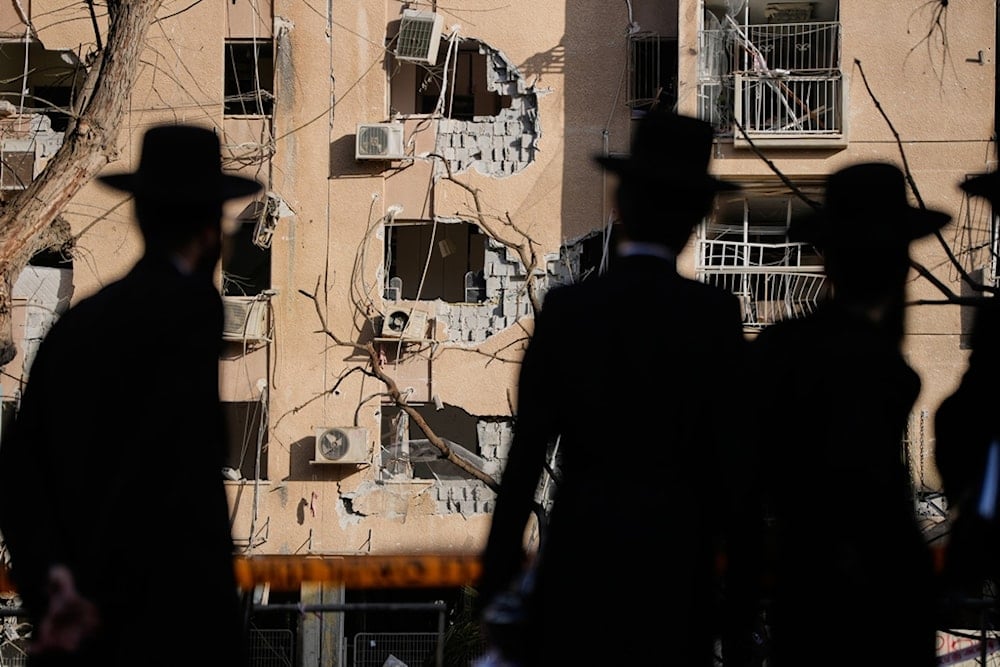
People look at residential buildings damaged by an Iranian missile strike in Arad, southern Israel, Sunday, March 22, 2026. (AP Photo/Ohad Zwigenberg)
The United States is facing mounting difficulty in countering Iran’s control over the Strait of Hormuz, as Israeli media reports point to Washington’s inability to formulate effective mechanisms to overcome what has been described as an Iranian-imposed maritime blockade.
According to Israeli newspaper Israel Hayom, the US administration has yet to develop a workable strategy capable of altering the balance in the strategic waterway, where Iran has asserted dominant influence following the escalation triggered by joint US-Israeli strikes.
The report indicates that US President Donald Trump is now caught in a complex dilemma. Moving forward with escalation risks dragging Washington into a prolonged war far exceeding initial expectations, with significant economic consequences already materializing.
Indeed, disruptions in the strait have already triggered sharp increases in global energy prices and market instability.
Iran dictates tempo as Washington and Tel Aviv react
In a parallel assessment, Haaretz acknowledged that Iran appears to be the actor setting the pace of the war, initiating strategic moves while the United States and "Israel" are left responding to developments on the ground.
This dynamic reflects a broader shift in the conflict, where Tehran’s calibrated actions, particularly in the maritime domain, have imposed new operational constraints on its adversaries.
Analysts have noted that Washington underestimated Iran’s willingness and capacity to restrict the Strait of Hormuz following the initial strikes, further complicating US planning.
Growing rift between Washington and Tel Aviv
Amid these developments, signs of divergence between US and Israeli leadership are becoming increasingly visible.
According to Haaretz, Trump is actively seeking a way out of the war, while Israeli Prime Minister Benjamin Netanyahu appears intent on prolonging the confrontation for his own strategic considerations.
The report suggests that tensions between the two sides have already begun to surface, with the central question now shifting to when these disagreements will evolve into open exchanges of blame.
Ongoing aggression and Iran’s response
Since February 28, Iran has been subjected to sustained US-Israeli aggressions targeting civilian infrastructure, residential areas, and key economic resources. These strikes marked the beginning of a broader war that has destabilized the region and disrupted global markets.
In response, Iran has exercised its right to self-defense by carrying out operations against US military bases and Israeli-occupied territories.
The confrontation has since expanded into a wider regional crisis, with the Strait of Hormuz emerging as a central arena where Iran continues to assert its strategic leverage.
Read more: Iran warns of retaliation as Trump issues Strait of Hormuz ultimatum


