
From confidence to crisis: Trump’s war on Iran spins out of control
 5 Min Read
Trump faces a deepening crisis as the US-Israeli war on Iran spirals out of control, oil prices surge, intelligence failures mount, and midterm losses loom.
-
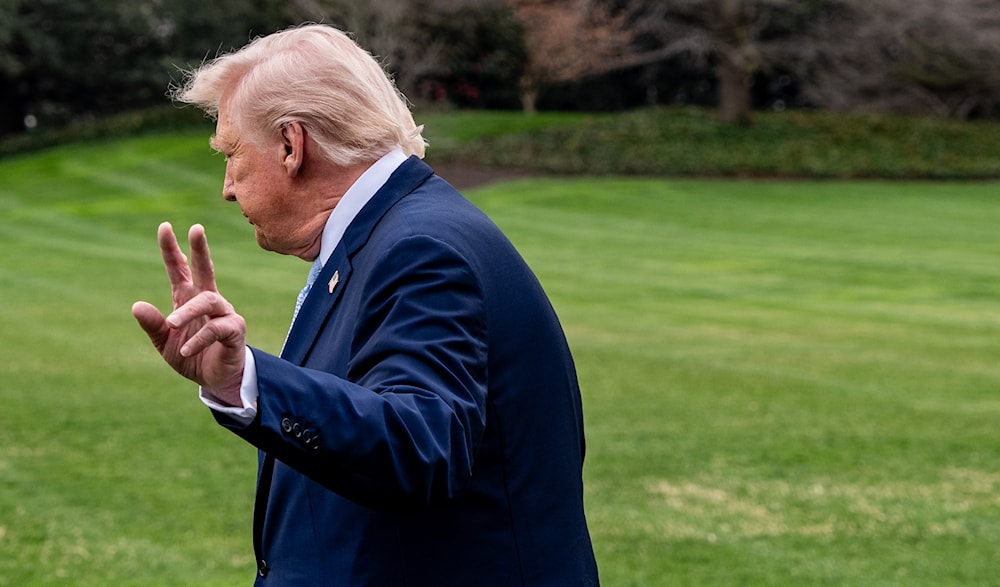
President Donald Trump waves before departing on Marine One from the South Lawn of the White House, Friday, March 20, 2026, in Washington (AP)
Nearly four weeks into the US-Israeli assault on Iran, the limits of Washington's strategic imagination are on full display.
According to a report by The Telegraph, US President Donald Trump is presiding over a war that is rapidly spiralling beyond his administration's control, one launched on false pretenses, sustained by Israeli pressure, and now threatening to unravel his domestic political standing ahead of November's midterm elections.
The report describes a US president who entered the war overconfident, buoyed by earlier operations that had cost no American lives, and who badly miscalculated Iran's capacity and will to resist.
"It's pretty clear that Trump underestimated this," Brandan Buck, a foreign policy research fellow at the Cato Institute and a US Army veteran, told the British outlet.
The intelligence failure nobody wants to name
Central to the war's shaky foundations is the question of justification. When Trump announced the first strikes on Iran on February 28, he claimed Tehran was pursuing a nuclear weapon, a rationale the White House escalated the following day by invoking an "imminent nuclear threat."
That claim has since collapsed from within. Both Tulsi Gabbard, the director of national intelligence, and CIA director John Ratcliffe told Congress this week that Iran had been "unwilling or incapable" of producing enriched uranium since the June 2025 "Operation Midnight Hammer" strikes.
The admission, buried in written testimony rather than oral remarks, lays bare what critics have compared to the intelligence manipulation that preceded the invasion of Iraq.
Joe Kent, the former director of the National Counterterrorism Centre, resigned from the Trump administration this week, the first senior official to do so over the war. In his resignation letter, Kent accused Trump of having been "hoodwinked" by the Israeli regime into attacking Iran, and stated plainly that Tehran posed "no imminent threat" to the United States.
The Strait, the spiral
Iran's decision to blockade the Strait of Hormuz has exposed a fundamental gap between Washington's military ambitions and its strategic planning. The Telegraph reports that senior figures in the administration were caught off guard by the move, a lapse that a Cato Institute researcher described as mind-blowing for any government serious about regional contingency planning.
With Brent crude now at $119 per barrel and Goldman Sachs projecting it could surpass its all-time record of $147.50, the economic consequences are pouring in.
Trump, re-elected on a core promise to reduce prices, is now overseeing what insiders are calling a "jump at the pumps." Treasury Secretary Scott Bessent even decided to lift sanctions on 140 million barrels of Iranian oil, a move one analyst described as "beyond bananas", given that the US is simultaneously waging war on the country that would benefit.
Meanwhile, Trump's appeal for an international coalition to help secure the strait has been rebuffed by European leaders, including UK Prime Minister Keir Starmer, deepening Washington's isolation.
The political fracture
The war is accelerating fractures within Trump's own coalition. Figures once central to the MAGA project, including Marjorie Taylor Greene and Tucker Carlson, have broken with the president over the conflict. Greene praised Kent as an "American hero", while Carlson amplified his accusations on his podcast.
Republican strategist Mike Madrid warned that the GOP now faces "the toughest political landscape in more than 30 years," with the party at risk of losing both the House and the Senate.
A Trump insider told The Telegraph that the "obvious incoming inflationary impact, the spiralling debt, the energy price spikes" are the dominant conversations in Washington among those not fearful of losing their positions.
No exit in sight
Thirteen American soldiers have been killed since the war began. Around 200 have been wounded. The Pentagon is pushing for an additional $200 billion in war funding on top of its existing $1 trillion budget, and is reportedly considering amphibious operations against Iranian territory, including a possible assault on Kharg Island, which processes 90% of Iran's crude oil exports.
Iran, for its part, has proven resilient, repeatedly declaring that it is not interested in ceasefire negotiations. Alternatively, the Israeli regime, which views this moment as a historic opportunity to destroy a long-standing adversary, shows no interest in de-escalation, and Washington appears unable or unwilling to restrain it.
Trump now faces a choice with no clean options: withdraw and absorb the political cost, or escalate deeper into a war he did not understand when he started it. West Asia has trapped many American presidents before him, and based on the trajectory so far, he is not on course to be the exception.


