
Ex-intel chief Kent blasts Trump: No imminent threat from Iran
 6 Min Read
Joe Kent, former US counterterrorism director, reveals he resigned after being sidelined, stressing key intelligence on Iran was ignored and warning the White House suppressed dissenting voices before the war.
-
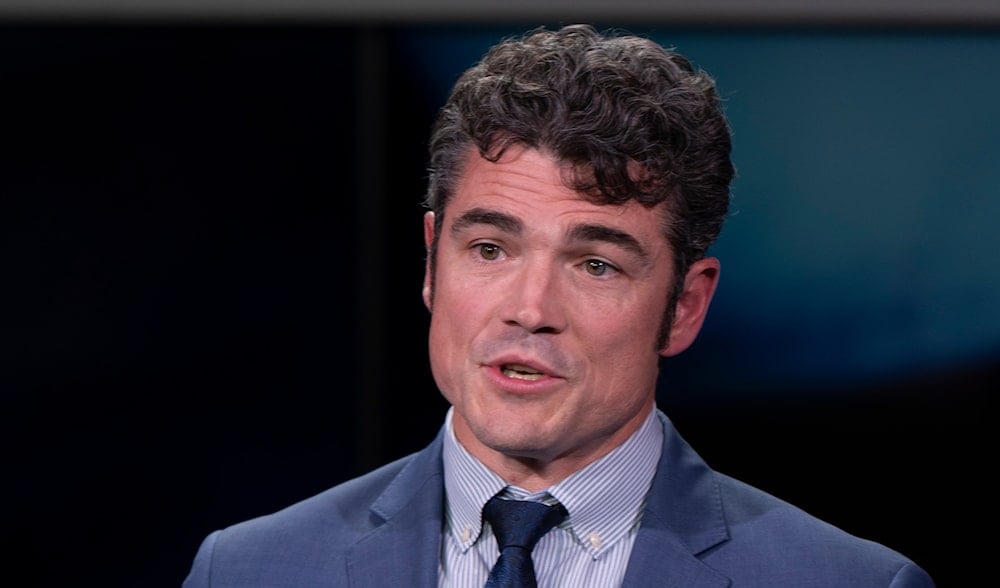
Washington 3rd District Republican candidate Joe Kent speaks during a debate at KATU studios on Monday, Oct. 7, 2024, in Portland, Ore., US (AP)
Former US National Counterterrorism Center Director Joe Kent gave an extended interview on Wednesday to former Fox News host and podcaster Tucker Carlson, marking his first public remarks since stepping down from his position over concerns about the war on Iran.
The interview ran for more than an hour and 40 minutes and ranged across several subjects, including the ongoing war, the assassination of Charlie Kirk, and government files related to the assassination of former President John F. Kennedy.
Here are the takeaways:
Kent told Carlson that access to President Donald Trump was limited in the run-up to the war with Iran, saying that a “good deal of key decision makers were not allowed to come and express their opinion” to the president.
“In the lead up to this last iteration, good deal of key decision makers were not allowed to come and express their opinion to the president,” Kent said, adding that there had been “robust debate” before US strikes on Iranian nuclear sites last year.
By contrast, Kent said the intelligence community’s capacity to provide a “sanity check” while briefing the president “was largely stifled in this second iteration.”
“They had that discussion, you know, behind closed doors, and there wasn’t a chance for any dissenting voices to come,” he said later in the podcast.
No intelligence on an Iranian "sneak attack"
A senior Trump administration official told CNN on Tuesday that the White House had previously excluded Kent from the president’s intelligence briefings, including those concerning Iran.
‘No intelligence’ Iran was going to launch a ‘sneak attack,’ Kent says
One day after resigning, Kent also told Carlson there was “no intelligence” indicating that Iran was preparing a “big sneak attack” similar to the September 11, 2001, attacks or Pearl Harbor.
“There was no intelligence that said, hey, on whatever day it was, March 1st, the Iranians are going to launch this big sneak attack, they’re going to do some kind of a 9/11, Pearl Harbor, etc. They’re going to attack one of our bases. There was none of that intelligence,” Kent stressed.
Trump and the White House have repeatedly pointed to an imminent Iranian threat as a key justification for launching strikes on the country.
Kent also argued that the late Iranian Leader Sayyed Ali Khamenei, who was assassinated last month in a joint US and Israeli aggression, had been restraining Iran’s nuclear program.
Asked by Carlson whether Iran was on the verge of obtaining a nuclear weapon, Kent replied, “No, they weren’t,” before adding that Iran’s strategy was “to not completely abandon the nuclear program.”
'Israel' drew US into Iran war: Kent
Kent also said he believed "Israel" had drawn the United States into the war and was broadly shaping American policy in West Asia.
He pointed to remarks by Secretary of State Marco Rubio, who argued earlier this month that Iran posed an imminent threat because the US believed "Israel" was about to strike and Iran would retaliate. Kent said that logic was flawed because, in his view, there was no reason to believe Iran would attack unless it had first been provoked.
“So, the imminent threat that the secretary of state is describing is not from Iran. It’s from Israel,” Carlson asked.
“Exactly,” Kent responded. “And I think this speaks to the broader issue: who is in charge of our policy in the Middle East.”
Kent, who has previously faced criticism for ties to far-right figures, including white nationalists and a Nazi sympathizer, focused heavily on "Israel" in his resignation letter.
Why he spoke out
Kent said he chose to speak publicly this week because he felt his views and comments were being “squashed” before they could reach the White House.
“It became really clear to me, you know, over the weekend, this past weekend, that our message just wasn’t getting through,” Kent said.
“I know what happens if I stay, if I if I stay, and I go along with this, I’m going to be, you know, knee deep in it, trying to just chip away and make a difference. But my ability to have, you know, my voice heard, to present data that runs contrary to the trajectory and the agenda that the administration’s on, that’s going to be squashed before it even really reaches the White House,” he added.
Details of his resignation conversation with Trump
Kent said on Wednesday that he had spoken directly with Trump before leaving the administration, describing the president as “very respectful” and “very kind” during the exchange.
“I spoke with him before I departed the administration,” Kent told Carlson, adding, “It went great. I mean, not the best conversation ever. You know, I told him why I was leaving. He heard me out.”
Kent said he would welcome the opportunity to speak with Trump again and added that he believed the two had “departed personally on good terms.”
CNN previously reported that Kent met Vice President JD Vance on Monday, explaining why he intended to resign and presenting his resignation letter.
Kent also addressed several other issues of intense interest within the MAGA movement, including the assassination of Kirk, saying in part that the Justice Department and the FBI had not allowed him to investigate possible foreign links to the political activist’s killing.
CNN previously reported that Kent was rebuked last year by FBI Director Kash Patel and other Justice Department officials after seeking access to FBI systems to investigate Kirk’s death, according to people briefed on the matter.
Pressed by Carlson on whether files related to the 1963 assassination of Kennedy were still being withheld from the public, Kent said he did not believe there was anything “earth-shattering” in the records, but added, “The system doesn’t want to get us used to things being rapidly declassified.”


