
War on Iran may actually cost the US trillions: The Intercept
 5 Min Read
Experts warn Trump’s war on Iran could cost trillions, far exceeding Pentagon estimates, with long-term debt and veteran care driving expenses.
-
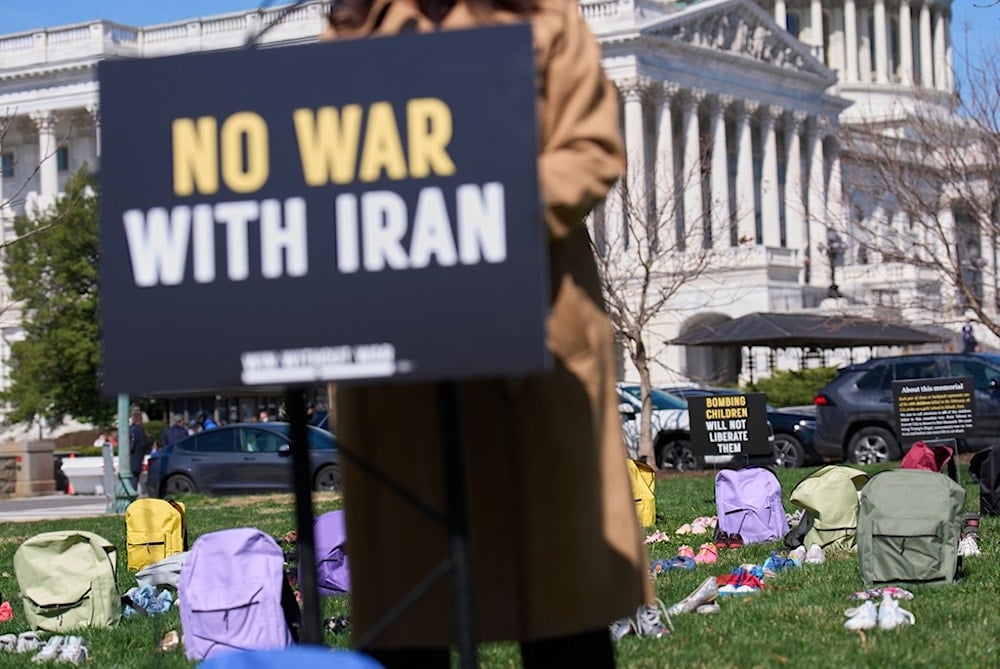
Members of the US Congress and advocates attend an event by a memorial display calling for an end to the war on Iran, Wednesday, March 18, 2026, on Capitol Hill in Washington. (AP Photo/Jacquelyn Martin)
The financial cost of the US-Israeli war on Iran is rapidly escalating, with experts and officials warning that initial Pentagon estimates significantly understate the true scale of spending.
While the Pentagon has offered early figures in the tens of billions, analysts, lawmakers, and officials cited by The Intercept say the real cost trajectory could reach hundreds of billions in the short term and trillions over time.
The Pentagon stated that the US spent approximately $11.3 billion in just one week of operations, a figure echoed by Trump's economic advisor Kevin Hassett, who placed the cost at $12 billion.
However, officials and experts told The Intercept that these figures represent only a partial accounting.
They estimate the war is consuming between $1 billion and $2 billion per day, roughly $11,500 to $23,000 per second, with the total potentially reaching a quarter trillion dollars in the coming months.
Jules Hurst III, acting comptroller of the War Department, described the Pentagon’s estimate as a “ballpark number,” adding that a more comprehensive figure would be submitted in a supplemental budget request.
War costs could reach hundreds of billions
Short-term projections cited by The Intercept suggest that the war, which is now in its third week, could cost between $60 billion and $130 billion.
A five-week war could reach $175 billion, while eight weeks could push costs to $250 billion.
A government official, speaking on the condition of anonymity, acknowledged the uncertainty of these figures to The Intercept, saying that “It’s a back-of-the-napkin estimate,” while another official told the outlet, “They really have no idea of the real cost.”
Hidden costs beyond battlefield spending
Beyond immediate expenditures, long-term costs are expected to far exceed short-term projections.
Linda Bilmes, a public policy professor at Harvard Kennedy School, told The Intercept that the war could surpass $50 billion within weeks, with the overall cost eventually reaching into the trillions.
Bilmes pointed to long-term obligations such as veterans’ benefits and interest on debt as key drivers of future spending.
Drawing comparisons to the Iraq War, she noted that early estimates of $40 billion ultimately expanded to around $8 trillion over time.
Lawmakers question strategy and transparency
US lawmakers have raised concerns about both the cost and the lack of clarity surrounding the war.
Representative Sara Jacobs told The Intercept, “We haven’t gotten sufficient details in public or behind closed doors about the strategy, the objectives, the length of the operation, or how much this will cost taxpayers,”
“The American people are demanding an end to this illegal war to prevent more killings of children, retaliation against U.S. service members, skyrocketing costs to U.S. taxpayers, and yet another endless war,” she added
Military buildup and early costs underestimated
Analysts say early Pentagon estimates exclude key expenditures, including the pre-war military buildup in the region.
Elaine McCusker, a former Pentagon budget official, estimated that preparations alone cost around $630 million.
Initial operational estimates also fell short. A breakdown by the Center for Strategic and International Studies (CSIS) placed early costs at $3.7 billion, but later updates raised that figure significantly, with officials revealing that $5.6 billion in munitions was used in just the first two days.
An updated CSIS estimate cited by The Intercept put the cost at $16.5 billion by the 12th day of operations.
Read more: US, 'Israel' fired 5,000+ munitions in first 96 hours of war on Iran
Economic and human costs expand over time
Beyond immediate military spending, the war is expected to generate substantial long-term financial and human costs.
Bilmes warned that exposure of US troops to hazardous conditions could result in significant future liabilities under veteran care programs.
She estimated that disability claims alone could add around $600 billion over time, depending on claim rates.
Rising public debt is another concern. Bilmes noted that US war spending has historically been financed through borrowing, increasing long-term interest obligations and placing additional strain on federal budgets.
Political divide over funding the war
The growing financial burden has intensified political divisions in Washington.
House Minority Leader Hakeem Jeffries criticized the administration’s approach, stating that it had not justified the scale of spending involved in the war.
Meanwhile, Representative Rob Wittman expressed support for additional funding, citing broader military readiness needs.
Policy analyst Gabe Murphy of Taxpayers for Common Sense told The Intercept that Congress should not approve further funding without proper authorization, warning of the broader economic consequences.
“Taxpayers deserve answers on the precise costs and timeline for this war,” Murphy said. “‘Indefinitely’ isn’t an answer.”


