
US, 'Israel' fired 5,000+ munitions in first 96 hours of war on Iran
 5 Min Read
The extensive use of munition exposes a major strain on Western weapons stockpiles and defense industry capacity.
-
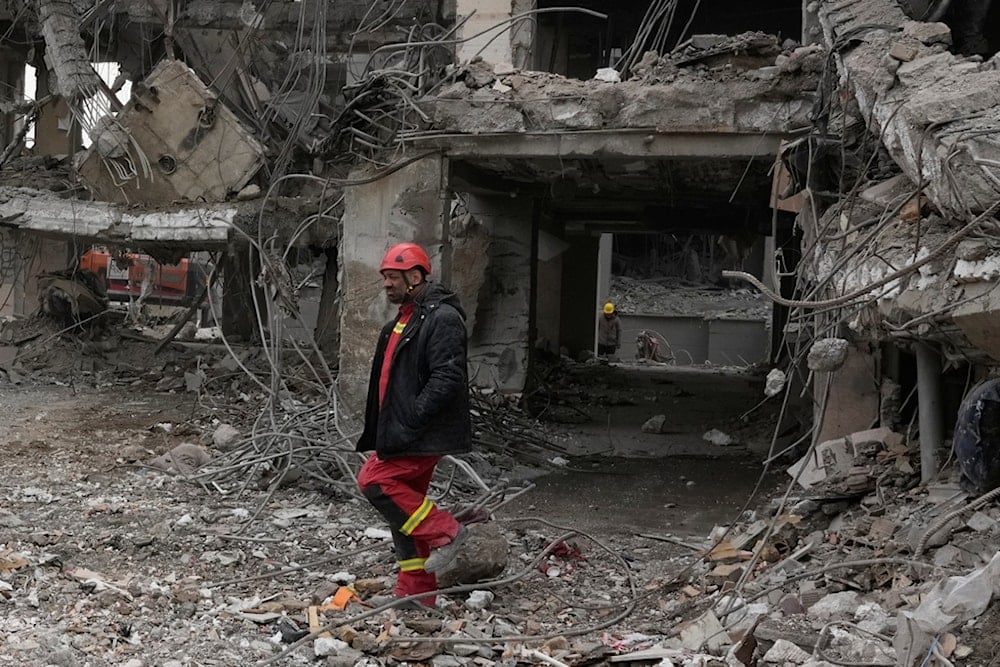
A rescue worker searches the rubble of a residential building in Tehran, Iran, Thursday, March 12, 2026, after it was damaged on Sunday due to US- Israeli bombing (AP)
More than 5,000 munitions were fired by the US-"Israel" coalition during the first 96 hours of the war on Iran, highlighting the scale and intensity of the opening phase of the aggression.
According to analysis by the Foreign Policy Research Institute, citing figures from the Payne Institute for Public Policy, approximately 5,197 munitions across 35 different weapon types were used in the first four days of what the US has named "Operation Epic Fury," marking what researchers describe as the most intensive opening air campaign in modern history.
The scale of the barrage reflects the heavy reliance on precision strikes and missile defenses during the initial phase of the war, which began on February 28.
Read more: Trump’s inner circle shows 'buyer’s remorse' over Iran war decision
Early war costs reach tens of billions
The financial cost of the opening stage of the war on Iran has rapidly escalated.
Estimates from several research organizations highlight the scale of the expenditure:
- The Center for Strategic and International Studies (CSIS) estimated the cost of the first 100 hours at $3.7 billion.
- Anadolu Agency estimated $5.82 billion when equipment losses were included.
- The Penn Wharton Budget Model projected the cost of a two-month war between $40 billion and $95 billion.
The Payne Institute estimates that munitions alone represent a replacement cost of between $10 billion and $16 billion in the first four days of the war.
When losses of military equipment and radar systems are included, the total cost of the early phase of the war rises to around $20 billion, according to the analysis.
Radar systems and aircraft losses add to operational toll
The early stages of the war have also involved losses of key surveillance and defense systems.
Iranian missile and drone attacks reportedly destroyed or damaged several radar installations used in regional missile defense networks, including:
- AN/FPS-132 early warning radar in Qatar;
- AN/TPY-2 THAAD radars across Jordan, Kuwait, Saudi Arabia, and the United Arab Emirates;
- AN/TPS-59 tactical radar in Bahrain;
Aircraft losses have also added to the operational cost.
An alleged friendly-fire incident reportedly saw a Kuwaiti F-18 shoot down three US F-15E Strike Eagle aircraft, while Iran is reported to have downed at least 11 MQ-9 Reaper drones.
Read more: IRGC: USS Abraham Lincoln withdrawing after sustaining damage
High-end missile defenses under pressure
Researchers say the most significant pressure is being placed on advanced air defense and long-range strike systems rather than standard bombs.
The analysis found that some high-value systems experienced rapid depletion during the first days of the war.
Among the most notable cases:
- "Israel’s" Arrow missile interceptor inventory was reduced by more than half in four days.
- THAAD interceptor stocks held by regional partners dropped by over one-third.
- Eight GBU-57 Massive Ordnance Penetrators were used, nearly a quarter of the remaining stockpile.
The GBU-57 bunker-busting bomb can only be deployed by the B-2 Spirit bomber fleet, which currently consists of about 20 aircraft.
Replacing the weapons used during the first phase of the war could take years for some systems.
Industrial capacity becomes central challenge
The analysis argues that the war has exposed deeper structural limitations within the Western defense industrial base.
The researchers describe the issue as a shift from what has traditionally been called “Command of the Commons,” the ability to project military power globally, to a new challenge they describe as “Command of the Reload.”
The concept refers to the ability of a military to sustain operations by replacing expended munitions and maintaining defense networks.
According to the report, many commonly used weapons remain widely available, but the most advanced systems, including missile interceptors, long-range strike weapons, and integrated radar networks, are far more difficult to replenish.
Read more: 'Israel' highly anxious over Iranian Shahed-136 UAV: Media
Supply chain vulnerabilities extend to minerals and manufacturing
The report also points to supply chain challenges affecting the production of modern weapons systems.
Manufacturing many advanced missiles and sensors requires specialized minerals and components that are difficult to source.
Among the materials cited in the analysis are gallium, neodymium, dysprosium, tantalum, and ammonium perchlorate, all used in missile guidance systems, radar equipment, or rocket motors.
Replacing the munitions fired in the first 96 hours of the conflict alone would require approximately:
- 92 tons of copper
- 137 kilograms of neodymium
- 18 kilograms of gallium
- 37 kilograms of tantalum
- 7 kilograms of dysprosium
- 600 tons of ammonium perchlorate
Researchers note that global supply chains for some of these materials remain heavily concentrated, particularly in China.
War places pressure on wider US military posture
The heavy use of advanced weapons during the war has also had wider strategic implications.
According to the analysis, the Pentagon has already begun redeploying air defense systems from the Indo-Pacific region to West Asia to support operations.
Such shifts highlight the logistical and industrial pressures created by sustained high-intensity warfare, particularly when large quantities of advanced weapons systems are required over a short period of time.


