
Trump says 'Israel' won’t stop until US is ready, rules out ceasefire
 5 Min Read
Trump threatens to “obliterate” Iran while simultaneously calling on NATO to control the Strait of Hormuz, exposing a stark disconnect between his war rhetoric and the realities on the ground.
-
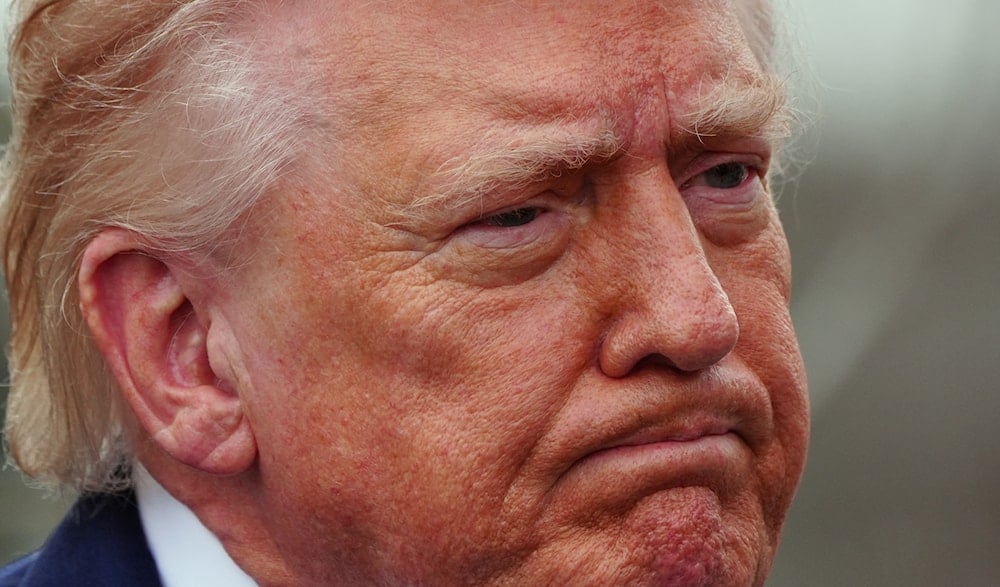
President Donald Trump speaks with reporters before departing on Marine One from the South Lawn of the White House, March 20, 2026, in Washington (AP)
The US President Donald Trump assured reporters on Friday that "Israel" will pause its war on Iran, but only when the United States decides it’s the right time.
Asked whether "Israel" would stop alongside the US, Trump explained, “I think so. The relationship is a very good one … We want more or less similar things. You know what we want? We want victory, and that's what we've got.”
Victory, presumably, is defined as continuing to obliterate the other side while simultaneously coordinating pauses that the US will unilaterally dictate.
Trump’s remarks quickly pivoted to NATO, where he urged allies to help secure the Strait of Hormuz, the vital global energy artery.
"I mean they [NATO members] should be helping with the Strait," Trump told reporters. "They get much of their energy from the Strait of Hormuz," he claimed.
The US President also expressed disappointment that some US lawmaker fans of NATO, now think the alliance “has done nothing.” In other words: allies, step up, but only when Trump says it’s convenient.
"I don't want to do a ceasefire"
And just to remove any lingering doubt about his approach to peace, Trump dismissed the idea of a ceasefire with Iran. “I don’t want to do a ceasefire. You know, you don't do a ceasefire when you're literally obliterating the other side,” he alleged, emphasizing his commitment to a decisive outcome, because nothing says “diplomatic coordination” like obliteration.
Taken together, Trump’s statements reveal a strategy as subtle as a sledgehammer: "Israel" waits for the US signal, NATO assists only when convenient, and ceasefires are off the table, unless, of course, they involve complete annihilation.
His insistence on unilateral control over timing and escalation mirrors a familiar tension: calling for collective support while insisting on sole command, a contradiction that leaves allies and the world in a delicate and potentially perilous limbo.
Trump slams NATO as 'cowards', says alliance is weak without US
Earlier today, Trump criticized member states of NATO over their stance during the ongoing aggression against Iran, accusing them of failing to support US efforts.
In a post on the Truth Social platform, Trump said, “Without the United States, NATO is just a paper tiger.”
He criticized NATO members who, according to him, “did not want to join the fight to stop Iran’s nuclear program,” arguing that they were reluctant to take part in military efforts.
Trump added that while the current battle has been “largely settled militarily with minimal risk to them,” NATO countries are now complaining about rising oil prices. He claimed they are unwilling to assist in reopening the Strait of Hormuz, describing it as a “simple military maneuver” and a key factor behind higher energy costs.
“It’s very easy for them, with almost no risk,” Trump said, adding, “What cowards… and we will remember that.”
His remarks come after several NATO countries reportedly refused to send naval forces to the region or allow the US to use their military bases as a launch point for strikes against Iran, a position Trump has repeatedly criticized since the start of the war.
Subsequently, on Friday, Switzerland said it will not approve weapons export licenses to the US during the ongoing war on Iran, citing its policy of neutrality.
The decision reflects broader international fallout from the conflict, as Switzerland restricts arms exports to a key party involved in the war.
Switzerland’s decision adds to a growing list of countries distancing themselves from US President Donald Trump’s war efforts against Iran, as states increasingly refuse to provide military support or facilitate operations.
US allies hesitant to join Trump’s Strait of Hormuz coalition
On March 14, Trump urged China, France, Japan, South Korea, the United Kingdom, and other countries to send warships to the strategic waterway to safeguard maritime traffic.
Responses from some nations have ranged from skepticism to outright refusal. According to Axios, a source said, “[French President Emmanuel Macron] didn’t give a final no, but at the moment it’s a no.”
The proposal comes amid ongoing US and Israeli aggression on Iran that began on February 28, targeting sites including Tehran. These operations have caused both damage and massive civilian casualties. Iran has retaliated with strikes on Israeli territory and US military positions across West Asia.
Repercussions from aiding US; Iran warns UK
Iran’s Foreign Minister Abbas Araghchi warned the UK that allowing the US to use its military bases constitutes “participation in aggression,” criticizing Britain’s stance on US-Israeli aggression against Iran.
British Prime Minister Keir Starmer had authorized the use of RAF Fairford in Gloucestershire and the Diego Garcia base in the Indian Ocean for “defensive” attacks against Iranian positions.
Tehran stressed it reserves the right to respond, as Britain increases its involvement through logistical support and military deployments.
Read more: 'Hell no': Trump’s $200B Iran war plan faces congressional backlash


