
Sri Lanka turns down US request to deploy armed aircraft
 5 Min Read
Sri Lanka has rejected US and Iranian military requests to use its territory, reaffirming neutrality despite being directly impacted by the aggression on Iran.
-
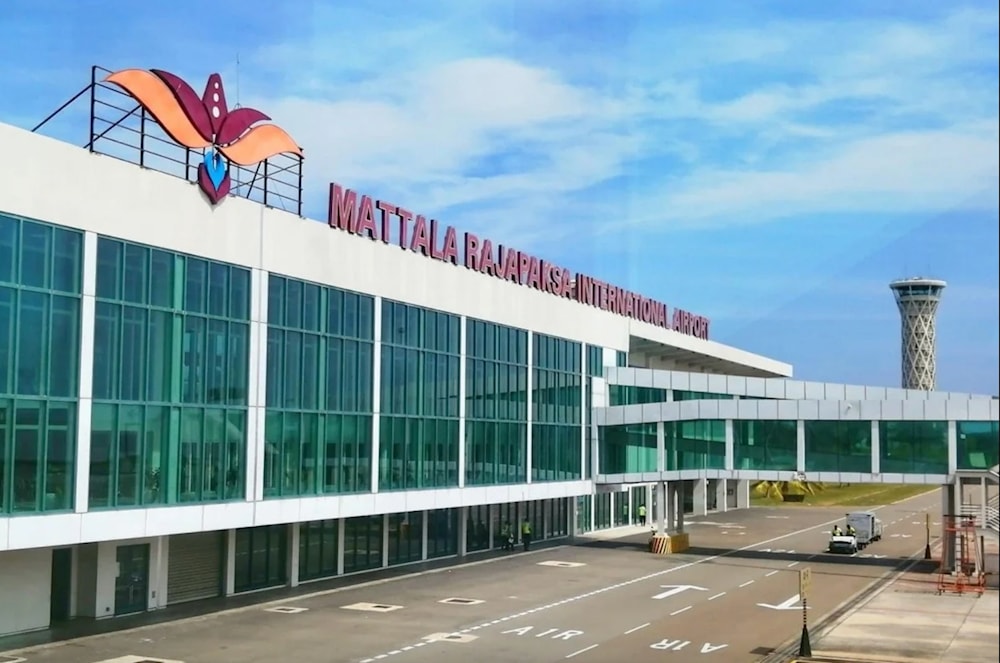
A view of Mattala Rajapaksa International Airport in southern Sri Lanka, where authorities rejected a US request to deploy armed military aircraft, citing the country’s policy of neutrality (Handout)
Sri Lanka has declined a United States request to deploy two military aircraft at a civilian airport in the country’s south, with President Anura Kumara Dissanayake stating the decision was taken to preserve neutrality amid the ongoing aggression on Iran.
Addressing parliament on Friday, Dissanayake confirmed that Washington had sought permission to station two warplanes equipped with anti-ship missiles at Mattala International Airport for several days in early March. The request, submitted on February 26, was ultimately refused.
“They wanted to bring two warplanes armed with eight anti-ship missiles from a base in Djibouti to Mattala International Airport from March 4 to 8, and we said ‘no’,” Dissanayake said.
He explained that the government’s position is guided by a commitment to avoid entanglement in external conflicts and to ensure that Sri Lankan territory is not used in a way that could benefit or undermine any party involved.
The president also revealed that Iran had made a separate request on the same day, seeking permission for three naval vessels returning from exercises in India to dock in Colombo. That request was likewise not approved, despite not being on a military mission.
“We were still considering the Iranian request to bring the three ships to Colombo from March 9 to 13. Had we said ‘yes’ to Iran, we would have had to say ‘yes’ to the US too,” he said.
“But we didn’t. We are steadfastly maintaining our position of neutrality,” he added.
Deadly strike near Sri Lanka
Sri Lanka’s decision comes days after a major escalation unfolded in nearby waters.
On March 4, a US submarine torpedoed the Iranian frigate IRIS Dena in international waters near Sri Lanka, killing at least 87 sailors, with dozens more still missing. The vessel sank rapidly after a US Mark 48 torpedo detonated beneath its hull, leaving little time for evacuation.
The ship had been returning from a multinational naval engagement hosted by India and was not reported to be engaged in active combat at the time of the strike, raising questions about the nature of the operation and its compliance with international norms.
Sri Lankan naval forces were among the first to respond after the attack. According to Navy spokesman Commander Buddhika Sampath, rescuers arriving at the scene found “only some oil patches and life rafts,” adding, “We found people floating on the water.”
Iranian Foreign Minister Abbas Araghchi condemned the attack as “an atrocity at sea,” warning that Washington would “bitterly regret” the precedent it has set.
India’s silence draws criticism
The incident has also placed India under scrutiny, particularly over its lack of response to the killing of Dena’s crew.
In an opinion piece published by National Herald, author A.J. Prabal argued that New Delhi’s failure to issue either condolences or condemnation following the deaths of the sailors has caused “embarrassment", weakened its regional standing, and undermined trust built through naval cooperation.
He wrote that India’s silence has “discredited” its claim to neutrality and contributed to growing diplomatic unease, especially given that the Iranian frigate had recently been hosted by the Indian Navy.
The IRIS Dena had spent February in Visakhapatnam as part of the International Fleet Review 2026, a multinational event involving dozens of navies. Its sinking shortly after departing Indian waters has amplified questions about India’s role and responsibilities in its immediate maritime environment.
Experts warn of wider fallout
Several Indian analysts and former officials have warned that the strike risks destabilizing the region and eroding confidence in India-led maritime initiatives.
Former Indian Navy chief Arun Prakash described the attack as “a senseless and inflammatory act,” urging New Delhi to respond. “You have brought maritime warfare to our borders without informing us,” he said, referring to the US operation.
Strategic affairs analyst Sushant Singh said the incident dealt a blow to India’s credibility, suggesting Washington may have acted without informing New Delhi.
Former foreign secretary Kanwal Sibal warned that the attack undermined the principles of naval cooperation promoted through exercises such as MILAN, which aim to foster “a free, open, inclusive and rules-based maritime order.”
Security analyst Brahma Chellaney argued that striking a ship returning from an Indian-hosted event “violated the unwritten code of naval hospitality,” while Praveen Swami of ThePrint said prior notification could have allowed the vessel to seek safety.
Analysts also pointed to humanitarian obligations under international law, noting that the US submarine reportedly left the area following the strike, with rescue operations carried out by Sri Lankan forces.
Neutrality under pressure
For Sri Lanka, the incident has underscored the risks of being drawn into an expanding conflict zone, as major powers extend military operations into critical Indian Ocean routes.
By rejecting both US and Iranian requests, Colombo has sought to maintain a position of balance. However, the proximity of the strike—and its humanitarian toll—has illustrated the limits of neutrality in an increasingly militarized maritime environment.
For India, meanwhile, the episode has intensified scrutiny over its regional posture, raising questions about whether its strategic partnerships and claims of neutrality can be sustained amid escalating conflict dynamics.
Read more: US strike on frigate Dena 'recalls the behavior of Nazi Germany': Iran


