
US waives Iran oil sanctions, unlocks 140 mln barrels amid war fallout
 5 Min Read
The United States has been compelled to ease sanctions on Iranian oil to stabilize global markets after its war on Iran triggered a severe energy crisis.
-
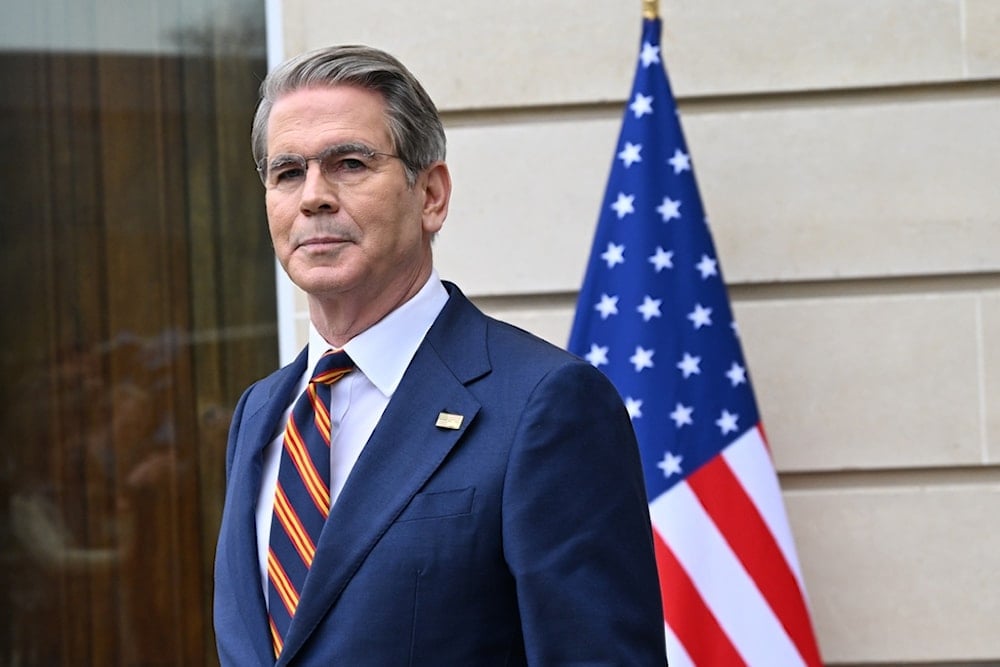
US Treasury Secretary Scott Bessent arrives to give a press statement at the OECD Headquarters, Monday, March 16, 2026, in Paris, France. (AP Photo/Emma Da Silva)
The United States has been forced to temporarily ease sanctions on Iranian oil shipments already at sea, as the global energy shock triggered by the US-Israeli war on Iran begins to spiral beyond Washington’s control.
The 30-day waiver, issued by the Treasury Department, allows the sale of Iranian crude loaded prior to the authorization, unlocking an estimated 140 million barrels for global markets. The move reflects mounting urgency inside the White House as oil prices surge and supply chains strain under the weight of a conflict widely seen as avoidable.
“By temporarily unlocking this existing supply for the world, the United States will quickly bring approximately 140 million barrels of oil to global markets, expanding the amount of worldwide energy and helping to relieve the temporary pressures on supply caused by Iran,” Treasury Secretary Scott Bessent said in a statement on X.
“In essence, we will be using the Iranian barrels against Tehran to keep the price down as we continue Operation Epic Fury.”
Despite the war, Iran seems to be at ease in terms of oil sales.
An informed source at Iran’s Ministry of Petroleum told Fars News Agency that "foreign currency revenues from oil exports are very good," highlighting a notably positive financial outlook despite the US-Israeli war.
The source added that a portion of recently returned oil revenues has exceeded the country’s normal consumption needs, with the surplus being directed into cash reserves.
War backfires on global energy system
The decision comes after weeks of escalation that have severely disrupted flows through the Strait of Hormuz, a critical maritime corridor responsible for roughly one-fifth of global oil supply.
Following US and Israeli strikes on Iran, maritime traffic through the strait collapsed, with tanker movements dropping dramatically and large volumes of oil stranded at sea. The disruption has been described as one of the most significant shocks to global energy markets in decades, driving prices above $100 per barrel and raising fears of a broader economic crisis.
Rather than a full closure, Iranian officials have signaled a calibrated approach, restricting access primarily for hostile states while allowing passage for others, effectively demonstrating control over one of the world’s most strategic chokepoints.
Washington relies on sanctioned oil it sought to block
The waiver highlights a growing contradiction in US policy: while seeking to economically pressure Iran, Washington is now relying on Iranian oil itself to stabilize global markets.
Roughly 130 to 170 million barrels of Iranian crude have remained stranded on tankers across the region, much of it originally destined for Asian buyers such as China and India. The waiver allows these volumes to enter the market, with US officials acknowledging that shipments could reach refineries within days and begin affecting supply in the coming weeks.
Despite this, US officials insist the measure is limited in scope.
“This temporary, short-term authorization is strictly limited to oil that is already in transit and does not allow new purchases or production,” Bessent said.
“Iran will have difficulty accessing any revenue generated and the United States will continue to maintain maximum pressure on Iran and its ability to access the international financial system.”
Critics warn of strategic collapse
The policy has drawn sharp criticism, even within Western policy circles, where analysts argue that Washington is undermining its own sanctions regime.
“To put it mildly, this is bananas,” David Tannenbaum of Blackstone Compliance Services told The Guardian. “Essentially, we’re allowing Iran to sell oil, which could then be used to fund the war effort.”
Others view the move as evidence that economic pressure alone has failed to break Iran’s position, forcing the US to resort to short-term measures to contain the fallout of its own military campaign.
As one analyst noted, easing restrictions on an adversary during active conflict signals the rapid exhaustion of Washington’s economic leverage.
Iran retains leverage over global markets
Control over the Strait of Hormuz has allowed Tehran to influence global energy flows without fully halting them, maintaining pressure while avoiding a complete shutdown of markets.
At the same time, diplomatic channels remain active. Iranian Foreign Minister Abbas Araghchi has indicated that Tehran is in discussions with countries such as Japan regarding the potential passage of vessels, reinforcing the message that access to the waterway will be determined on Iran’s terms.
With Asian economies heavily dependent on Gulf energy supplies, the selective reopening of routes further enhances Tehran’s negotiating position.
A crisis of Washington’s own making
The temporary sanctions waiver marks the third such measure in recent weeks, following similar steps involving Russian oil, as the United States scrambles to contain the economic consequences of a widening regional war.
Yet analysts warn that such measures are unlikely to resolve the underlying crisis. As long as instability persists in the Strait of Hormuz, short-term injections of supply may do little to reverse market volatility.
Instead, the current situation reflects a deeper reality: a conflict that has not only failed to weaken Iran, but has instead exposed the structural dependence of the global economy on a region Washington is actively destabilizing.
In attempting to pressure Tehran, the United States now finds itself relying on the very resources it sought to restrict, reflecting a strategic reversal driven by the limits of coercion in the face of geopolitical and economic realities.
Read more: Global economy at risk as war on Iran escalates: FT


