
US may lift curbs on stranded Iranian oil to cool global prices
 4 Min Read
Treasury Secretary Scott Bessent said the US could add 140M barrels of Iranian oil to the global supply, aiming to ease shortages caused by the Strait of Hormuz crisis and rising energy prices.
-
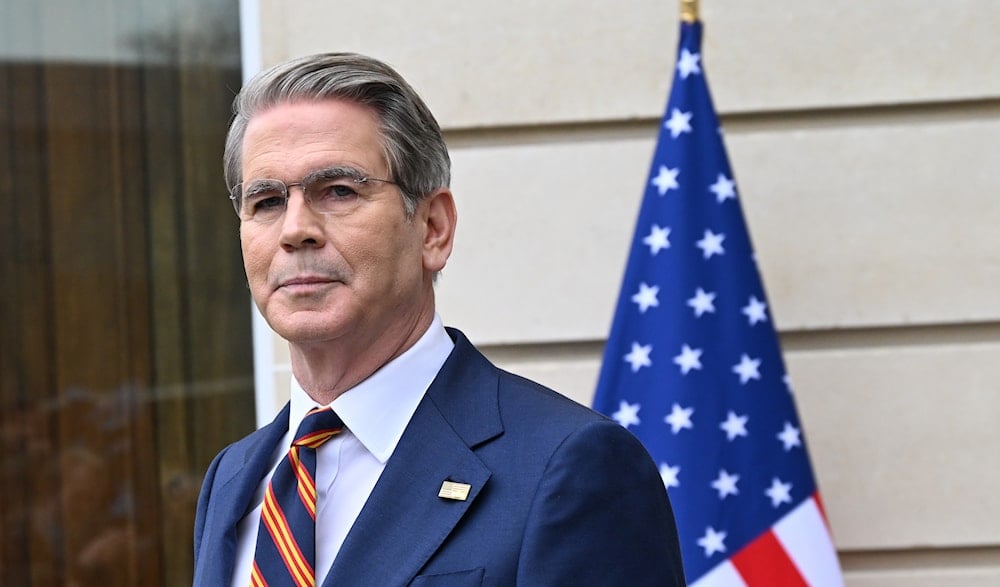
US Treasury Secretary Scott Bessent arrives to give a press statement at the OECD Headquarters, March 16, 2026, in Paris, France. (AP)
The United States may soon lift sanctions on Iranian oil currently stranded aboard tankers in a move aimed at boosting global supply and lowering prices, Treasury Secretary Scott Bessent said on Thursday.
"In the coming days, we may unsanction the Iranian oil that's on the water. It's about 140 million barrels," Bessent said during an appearance on Fox Business Network's Mornings with Maria.
Bessent said the volume involved could amount to roughly 10 days to two weeks of additional supply, depending on how it is measured.
"So, depending on how you count it, that's 10 days to two weeks of supply," he stressed.
He added that bringing sanctioned Iranian oil into the market would help restrain prices over the next 10 to 14 days.
US backing down on Iran sanctions
The potential US move to lift sanctions on Iranian oil stranded at sea is being interpreted by analysts as a sign of strategic retreat amid mounting economic pressure.
After weeks of attacks and efforts to tighten restrictions on Tehran, Washington’s consideration of releasing up to 140 million barrels into global markets reflects growing concern over surging oil prices and supply disruptions linked to the Strait of Hormuz crisis.
The shift suggests a retreat, with stabilizing energy markets taking precedence over maintaining maximum pressure on Iran. This move risks undermining the credibility of the US sanctions regime and US global power, signaling that economic constraints may be forcing Washington to ease its stance at a critical juncture.
Oil prices stay elevated amid Strait of Hormuz crisis
Oil prices have remained above $100 a barrel for much of the past two weeks amid the US-Israeli aggression on Iran.
Bessent pointed to a recent precedent in which the Treasury allowed the sale of sanctioned Russian oil that had also been stranded on tankers. According to the department, that step added 130 million barrels to global supply.
Bessent said the US was also prepared to take further steps to increase supply, including a unilateral release from the Strategic Petroleum Reserve on top of last week's coordinated G7 release of 400 million barrels.
He said the Treasury would "absolutely not" intervene in oil futures markets, but would instead focus on increasing physical supply to offset the daily shortfall caused by the closure of the Strait of Hormuz, which he estimated at between 10 million and 14 million barrels a day.
"So, to be clear, we're not intervening in the financial markets. We are supplying the physical markets," Bessent added.
Trump to discuss Hormuz security with Japan
Bessent said President Donald Trump was also expected to meet Japanese Prime Minister Sanae Takaichi at the White House on Thursday to discuss Japan's possible participation in efforts to secure maritime passage through the Strait of Hormuz.
He said the issue was particularly important because Japan relies heavily on oil shipments that pass through the waterway.
"She's very pro-U.S. I think we're going to have a very good discussion today," Bessent said.
He added that Takaichi could also announce an additional release from Japan's strategic petroleum reserve beyond its contribution to the joint action.
Bessent also said China had become an "unreliable" supplier of refined petroleum products, accusing it of halting exports of jet fuel and other products to countries across Asia.
Iran will rise from sanctioned state to global player: Mokhber
Iran intends to leverage the strategic Strait of Hormuz to assert its power regionally and globally following recent attacks, Mohammad Mokhber, advisor and aide to Iran's leader, asserted.
In a statement on Thursday, Mokhber stated that “the West and the system of hegemony were imposing sanctions on Iran until today, but after the end of the aggression and the establishment of a new system for the Strait of Hormuz, Iran will rise from a sanctioned state to a powerful state in the region and the world.”
He added that “Iran will impose sanctions on the West using the strategic location of the Strait of Hormuz and will not allow their ships to pass through the strait,” affirming that the establishment of a new system for the waterway is “one of the outcomes of the aggression against Iran.”


