
EU shifts to Spain's line in denouncing illegal strikes on Iran
 5 Min Read
EU leaders are increasingly aligning with Spain in criticizing the US-Israeli war on Iran and calling for adherence to international law.
-
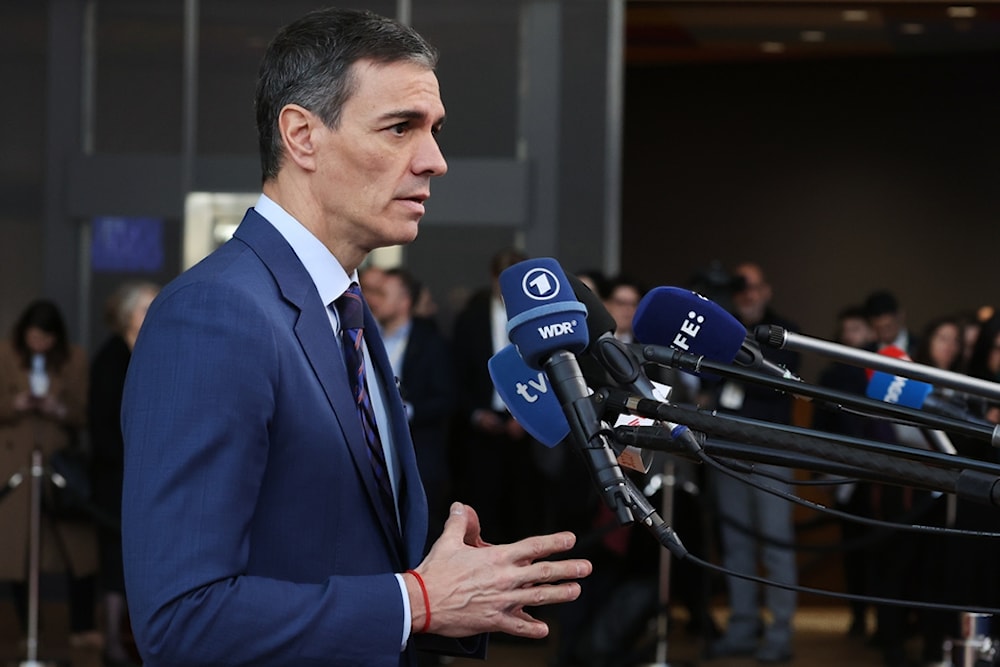
Spain's Prime Minister Pedro Sanchez speaks with the media as he arrives for the EU summit at the European Council building in Brussels, Thursday, March 19, 2026 (AP)
The European Union is experiencing a growing shift, as several member states move toward a more critical stance on the recent US-Israeli aggression on Iran, a position initially championed by Spain, Politico reported on Thursday.
Spanish Prime Minister Pedro Sánchez had been among the first European leaders to openly denounce the aggression, placing Madrid at odds with much of the bloc at the outset. He had previously described the strikes as “reckless and illegal,” refused to allow US forces to use Spanish bases, and rejected participation in military operations linked to the war, despite pressure and threats from Washington.
However, in the weeks since, that position has gained traction across European capitals, signaling an emerging consensus around the need to uphold international legal norms and avoid being drawn into what several officials now describe as a war imposed from outside Europe.
Spanish Foreign Minister José Manuel Albares framed the development as a broader awakening within the EU. “Europe is finally standing up — as Spain did from the start,” he said in an interview for Politico.
Legal reproach
According to draft conclusions cited in the report, EU leaders meeting at the European Council summit are expected to call for “full respect of international law by all parties, including the principles of the United Nations Charter and international humanitarian law.” The language represents a pointed message toward both Washington and Tel Aviv following the escalation, particularly as the strikes were carried out without UN authorization and without consultation with European allies, a move that has fueled growing resentment within the bloc.
The shift is notable in light of comments from leaders previously aligned with US policy. Italian Prime Minister Giorgia Meloni, often regarded as a close ally of US President Donald Trump, acknowledged that the attack fell “outside the scope of international law,” reflecting a broader recalibration within the bloc. Across Europe, governments that initially avoided confrontation with Washington are now under increasing domestic pressure, as public opinion remains largely opposed to involvement in the war.
Norms over realism
Albares also appeared to distance Spain from recent remarks by European Commission President Ursula von der Leyen, who had suggested that Europe must adopt a more pragmatic and interest-driven foreign policy. Rejecting that framing, he argued that adherence to international norms remains central. “True realism means speaking out for peace, protecting the well-being of our citizens, and advocating in favor of de-escalation,” he said.
He further dismissed the notion that the current moment represents a transition between competing global orders. “We are not living through a clash between an old and new world order,” he said. “What is at stake is the world order which has given Europe the greatest decades of peace and prosperity.”
War fallout
Drawing parallels with other international crises, Albares warned against the normalization of military force as a tool of foreign policy. “Foreign policy objectives can never be imposed with war,” he said, adding that ignoring established global rules would “only lead to chaos.” He linked the war on Iran to broader patterns of US "interventions", arguing that selective enforcement of international law undermines its legitimacy and disproportionately targets states outside the Western bloc.
Spain’s top diplomat also stressed that the war on Iran carries direct consequences for Europe, from rising energy costs to the risk of new displacement flows. The escalation has already disrupted global energy markets and exposed Europe’s structural dependence on Gulf stability, while fears grow that a wider regional war could trigger another refugee crisis. “There are already almost 1 million internally displaced persons in Lebanon,” he noted. “We all remember how the exodus of Syrian citizens affected us.”
EU reluctance
At the same time, multiple European governments have made it clear they will not participate militarily in the aggression, with officials in key states describing it as “not our war” and rejecting US requests for involvement in securing strategic waterways, such as the Strait of Hormuz, infuriating Trump and isolating the US. The EU’s foreign policy leadership has instead called on Washington and Tel Aviv to end the war and pursue diplomatic solutions, reflecting a broader reluctance to legitimize the escalation.
Positioning Spain as an early voice, Albares said Madrid had been “first, leading so that others could follow behind,” insisting that the EU now has a responsibility to take a clear stance.
He called for consistency in how the bloc responds to wars, regardless of geography. “We have always been on the side of the civilians who need to be protected,” he said. “We say the same thing when the victim is a white child with blue eyes as when the child has dark skin and dark eyes.”
Read more: Spanish Deputy PM: EU citizens oppose war on Iran


