
Spanish Deputy PM: EU citizens oppose war on Iran
 3 Min Read
Spain’s Deputy Prime Minister Yolanda Díaz says most Europeans oppose military action against Iran and warns EU support for the war could strengthen far-right movements.
-
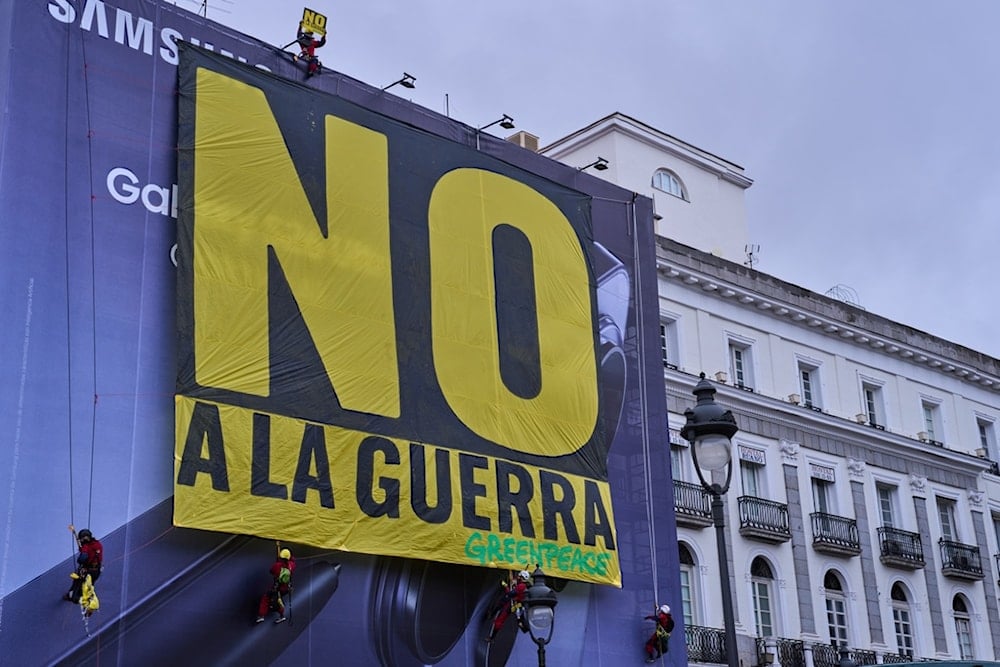
Greenpeace activists hang a banner reading in Spanish, "Not to war" in downtown Madrid, Spain, Tuesday, March 10, 2026. (AP)
Spain’s Deputy Prime Minister and Minister of Labour and Social Economy Yolanda Díaz said that European citizens largely oppose the US-Israeli aggression against Iran, warning that the European Union’s support for the war could intensify political divisions across the continent.
“The fact is that European citizens are against the illegitimate war in Iran,” Díaz said in remarks to Politico.
She cautioned that aligning with the conflict could have serious political consequences for the EU.
“By supporting it, the EU could end up increasing the Euroskeptic sentiment that often also fuels the growth of the far right,” Díaz said.
Spain signals readiness to challenge Washington
Díaz also indicated that Spain is willing to confront Washington over its position on the war, despite pressure from the United States.
She said Madrid “is not afraid” to challenge the United States, even as Washington has threatened economic retaliation.
With US President Donald Trump declaring a global state of emergency amid the escalating conflict, Díaz called on Spaniards to respond with resolve.
“We must respond bravely in these moments of uncertainty, of pain, of absolute uncertainty,” she said.
Dispute over US use of Spanish military bases
Tensions between Washington and Madrid escalated earlier this month after Spain initially refused to allow the US military to use Spanish bases for attacks against Iran.
On March 3, President Trump announced that the United States would end all trade with Spain, citing Madrid’s refusal to provide military support and its decision to maintain defense spending at 2 percent of GDP.
The White House later suggested that Spain had changed its position.
Press Secretary Karoline Leavitt said on March 4 that the Spanish government had begun cooperating with the United States “in the past several hours.”
However, Spanish Foreign Minister José Manuel Albares rejected that claim, stating that Spain’s position had not changed.
Europe’s divided response
The dispute highlights growing divisions in Europe over Washington’s aggression on Iran.
Several European governments have sought to maintain a delicate balance, expressing concern about escalation while avoiding direct confrontation with the Trump administration.
Germany and Italy have largely cooperated with Washington, while the United Kingdom only later agreed to allow US bases to be used for operations.
Spain, however, has taken a far more critical position, accusing Washington of "playing Russian roulette with the destiny of millions.”
Domestic political calculations
Analysts say Sánchez’s outspoken criticism may also reflect domestic political considerations.
Public opinion in Spain remains strongly opposed to involvement in US-led wars, and Trump’s popularity in the country is extremely low.
Spain’s government has also warned that the war could trigger higher energy prices, adding further pressure on European economies already facing energy challenges.
Read More: Spain’s Sánchez breaks with European leaders, condemns war on Iran


