
Netanyahu finally gets his Iran war, but under Trump's diktats: NYT
 7 Min Read
Israeli Prime Minister Benjamin Netanyahu appears to have secured the war he long advocated against Iran, but the offensive is unfolding largely on the terms set by US President Donald Trump.
-
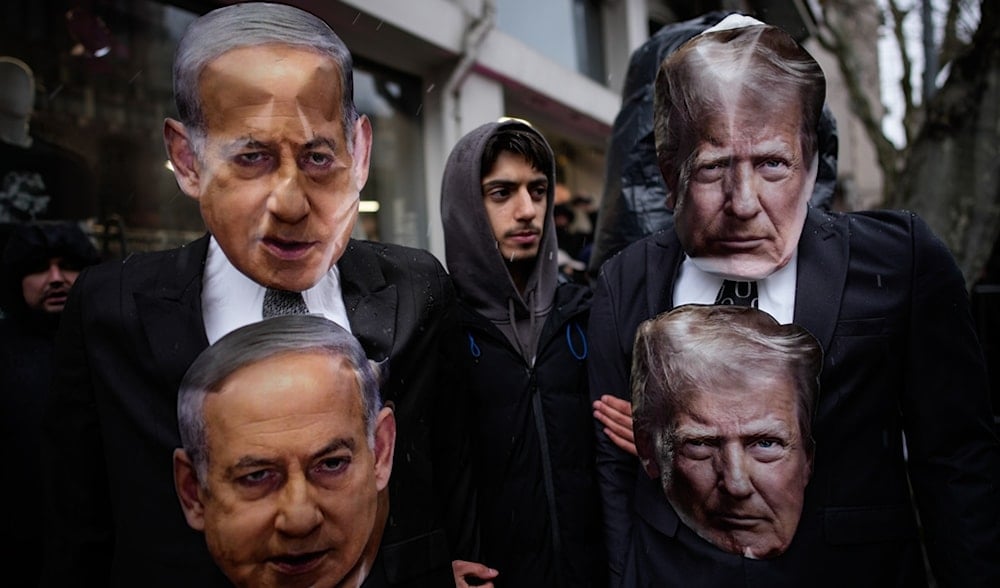
A man holds two mannequins depicting U.S. President Donald Trump and Israeli Prime Minister Benjamin Netanyahu during a rally in support of Iran, in Istanbul, Turkey, Sunday, January 18, 2026. (AP)
Israeli Prime Minister Benjamin Netanyahu appears to have secured the war he had long advocated against Iran. Yet the campaign is unfolding largely on the terms of US President Donald Trump, David M. Halbfinger, The New York Times' al-Quds Bureau chief wrote.
For years, Netanyahu had pushed for regime change in Iran. Now, however, it appears that Trump may be prepared to settle for less.
On February 28, Netanyahu announced the start of the war, declaring that "Israel" and the United States would work together to “remove the existential threat posed by the terrorist regime in Iran.”
Only two weeks into the war he claimed the US and "Israel" would dominate, Netanyahu has significantly scaled back his public war aims. He now says "Israel’s" objective is limited to weakening the Islamic Republic’s nuclear and ballistic-missile capabilities.
Regarding regime change, Netanyahu said during his first press conference since the war began that "Israel" continues to target Iranian internal security forces. However, he added that "Israel" can only hope the Iranian people will eventually find a way to overthrow their government themselves.
A war long sought, but not steered
The shift highlights both the limits of airpower in achieving sweeping political objectives and the paradox facing the Israeli prime minister.
For more than three decades, Netanyahu has publicly claimed that Iran and its nuclear ambitions pose a unique threat to "Israel". When the United States joined the military aggression, it appeared that Netanyahu had finally achieved the war he had long sought.
But the campaign is being fought according to Trump’s conditions.
According to NYT, Washington is exerting influence over what "Israel" can target inside Iran. The tension surfaced last week when US officials expressed dissatisfaction after Israeli strikes hit fuel depots in and around Tehran.
The following day, Senator Lindsey Graham, a South Carolina Republican and close Trump ally, wrote on social media: “Please be careful about the targets you choose.”
Washington's war: For 'Israel' or US interests?
The rebuke sparked speculation in "Israel" that the Trump administration may have broader strategic considerations than simply neutralizing threats to the Israeli entity.
Some analysts believe that if the United States emerges from the war with influence over Iran’s oil industry, it could gain leverage against China, the largest consumer of Iranian oil, particularly in a future confrontation over Taiwan.
For now, Israelis who overwhelmingly support the war increasingly acknowledge that Washington will ultimately decide when it ends, both in the campaign against Iran and on the second front "Israel" has opened against Hezbollah in Lebanon, where the Lebanese government receives US backing.
Writing in Yedioth Ahronoth, columnist Nahum Barnea summarized the dynamic: “Israel is at war, but it is not leading it. It is operating in the shadows. The central question hanging over every move is: when will Trump, the supreme leader of our side, declare victory and call for a ceasefire?”
Netanyahu's confidence collapsing
Netanyahu has tried to counter the perception that "Israel" is not in control of the war’s trajectory. At his press conference Thursday, he told settlers that he speaks with Trump “almost daily, frankly and openly.”
“We focus together, exchange ideas and advice, and make decisions together,” Netanyahu said. At the same time, he appeared to prepare the public for the possibility that the war would end without delivering a final resolution to "Israel’s" threats against Iran or the Resistance.
While falsely claiming the campaign has weakened Tehran to the point that it “no longer poses the same threat as before,” he stated that repeated offensives could be required.
“If we have to defeat them again and again, we will defeat them again and again,” he said. “There is no certainty that things will end. It requires further strikes. But those strikes significantly weaken our enemies.”
So far, Iran has maintained its dominance in the Strait of Hormuz, is carrying out several large-scale operations daily targeting not only the Israeli occupation, but also its assets across the entire Gulf, and is successfully countering attacks on its territories.
Absolute victory?
For Israelis who have been promised sweeping victories in Gaza, Lebanon, and Iran in recent years, promises that have fallen short, Netanyahu’s shift in rhetoric from decisive victory to an ongoing cycle of operations feels familiar.
Yaakov Katz, an Israeli analyst and founder of the Middle East–America Dialogue, described what he sees as Netanyahu’s strategic doctrine. “If you look at Netanyahu’s doctrine, it is to strike, weaken, declare victory, rebuild, prepare, and then repeat. That is likely what Israel will continue doing because we refuse to follow any military action with a political solution.”
Netanyahu suspiciously silent
For a prime minister who has often sought comparisons with Winston Churchill, Netanyahu has also been notably quiet and largely absent from the political spotlight during the war.
Until Thursday, he had released only a handful of video messages and given just one interview, conducted in English with Sean Hannity on Fox News.
That interview, arranged quickly on March 2, came after US Secretary of State Marco Rubio told reporters in Washington that the United States had attacked Iran partly because "Israel" would have struck regardless, risking Iranian retaliation against American forces.
Hannity put the criticism bluntly. “Some people say, ‘Wow, the Israeli prime minister dragged him into this.’”
Netanyahu laughed. “That’s ridiculous. Donald Trump is the strongest leader in the world. He does what he thinks is right for America.”
Read more: 'When Israel wants war, America Goes First': Rubio remarks under fire
The new Churchill
Openly claiming credit for persuading Trump to join the war would be politically risky. Trump has faced pressure from some of his MAGA allies to scale back strong support for "Israel". Nevertheless, Netanyahu does not need to make the argument himself, his allies are doing it for him.
On Channel 14, a network strongly supportive of Netanyahu, commentators such as Yaakov Bardugo have praised the prime minister, even suggesting he surpassed Churchill.
Bardugo argued that while Churchill persuaded Roosevelt to support Britain in World War II, Netanyahu succeeded in pushing the United States to enter the current war from the outset.
Netanyahu's coalition still in a rut
Polls suggest most settlers support Netanyahu’s handling of the war. Yet the campaign has not translated into improved political fortunes ahead of elections expected by October.
A Maariv poll published Friday found Netanyahu’s coalition of right-wing and religious parties would win only 50 of the Knesset’s 120 seats if elections were held now, unchanged from its weak standing in recent years.
Opposition parties would secure 60 seats, just short of a majority, while Arab parties aligned with the opposition would hold 10 seats.
Foreshadowing Netanyahu's political future
Even as the war rallies Israelis behind the military, Netanyahu’s opponents continue to criticize his policies.
When the government approved additional wartime spending on Tuesday, it also allocated hundreds of millions of dollars in new funding to ultra-Orthodox institutions.
The move comes as the Israeli military faces severe manpower shortages, while many ultra-Orthodox men avoid mandatory military service, fueling anger among thousands of reservists and their families.
All of this underscores the double-edged nature of comparisons between Netanyahu and Churchill.
While such comparisons may please the prime minister, they also remind his critics of a historical fact: Churchill, despite leading Britain through World War II, was voted out of office before the war ended.
Read more: Netanyahu’s power play: Manipulating Trump, American Jews


