
War on Iran failed to boost Netanyahu's popularity: Poll
 3 Min Read
Recent polling shows that the war on Iran has not significantly changed "Israel"’s political landscape, with Netanyahu’s Likud maintaining 26 seats.
-
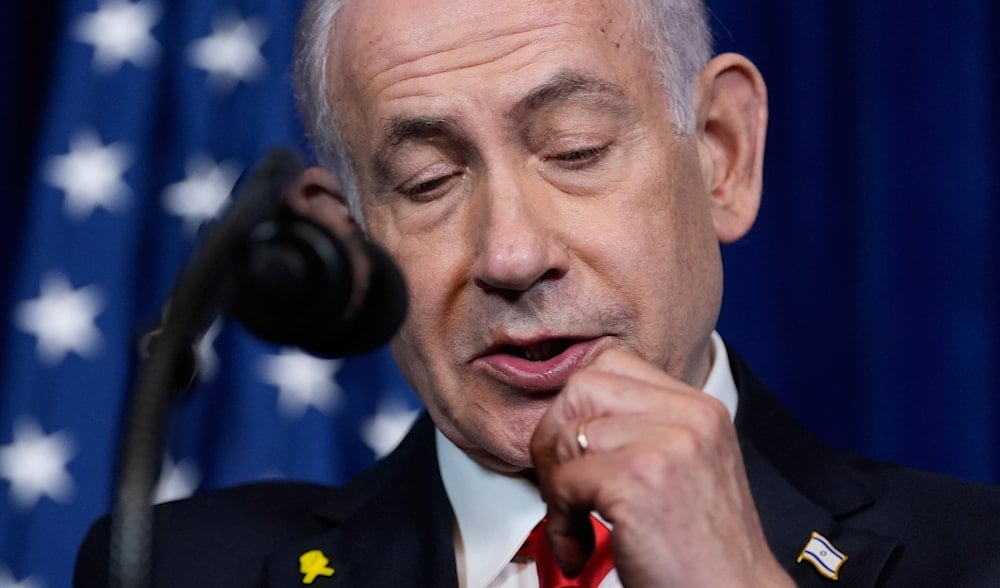
Israeli Prime Minister Benjamin Netanyahu speaks during a news conference with US President Donald Trump at Mar-a-Lago, Monday, Dec. 29, 2025, in Palm Beach, Fla (AP)
Recent polling indicates that the ongoing war on Iran has not significantly shifted "Israel’s" political landscape or meaningfully strengthened Prime Minister Benjamin Netanyahu’s reelection prospects.
An Israeli Channel 12 survey published Thursday evening found that if elections were held today, Netanyahu’s Likud party would secure 26 seats, the same number as in a poll conducted two days before the war began.
While Likud remains the largest party in the Knesset, Netanyahu’s right-wing coalition lost one seat compared to pre-war polling, holding 51 seats, short of the 61 needed to form a majority government.
The opposition bloc gained one seat compared to pre-war polling but still falls short of a governing majority without support from Arab parties. Similar results were reported by Maariv and Channel 13, with the coalition hovering around 50-51 seats in both surveys.
Analysts note that these trends mirror polling following the 12-day war in June, when Netanyahu experienced only a temporary boost.
"Israel" is officially scheduled to hold elections in October 2026, though Netanyahu retains the option to call early elections.
Elections come amid wide division in 'Israel'
"Israel’s" 2026 elections come at an unusually fraught moment, the first vote since October 7, 2023, and the ongoing war on Iran, testing public confidence in leaders and institutions amid sustained security threats.
Polling shows deep divides over both the government’s handling of "national security" and the war’s impact on daily life, from fears of further conflict to debates over captives and strategic priorities.
The campaign is shaping up not just as a choice between parties but as a referendum on Benjamin Netanyahu’s leadership and judgment, with critics arguing his tenure has worsened societal polarization and eroded trust in democratic norms. Opposition leaders have framed the vote as a battle for "Israel’s" future direction, warning that another Netanyahu victory could deepen fractures in Israeli society and governance.
At the same time, shifting party dynamics, including the rise of new formations like The Reservists and the revived Joint List among Arab parties, signal a potentially transformed Knesset where no single bloc can govern without cross‑spectrum negotiation. A united Arab list, in particular, could become a decisive kingmaker, reshaping coalition mathematics in ways unseen in recent years.


