
'It's not our operation': Macron rebukes Trump flip-flops on Iran war
 4 Min Read
Macron criticized Trump’s inconsistent statements on the war on Iran, warning that shifting rhetoric undermines credibility, risks escalation, and strains alliances.
-
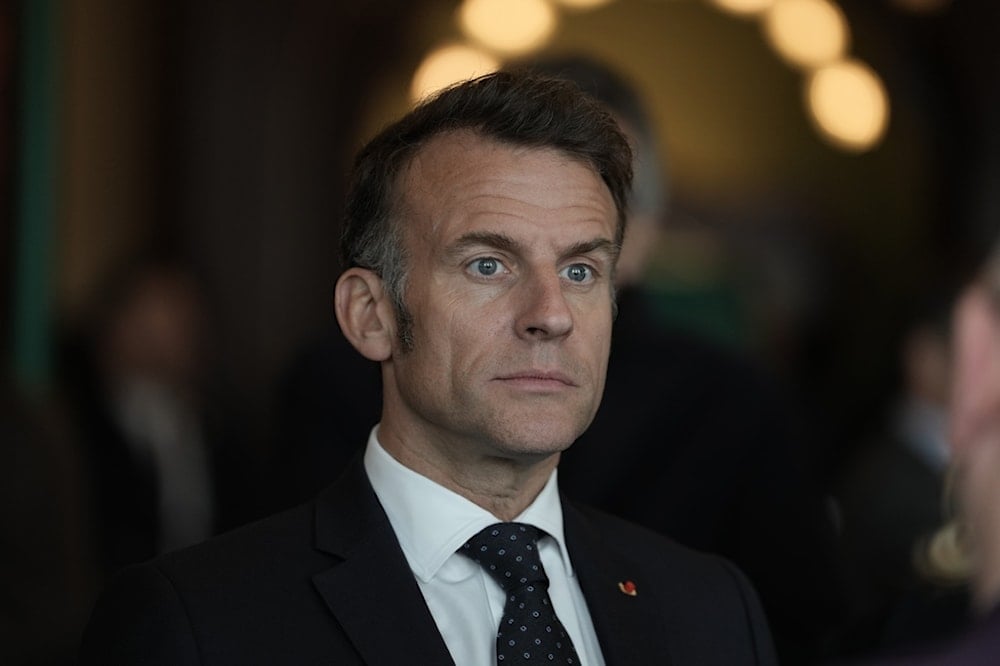
French President Emmanuel Macron speaks with employees as he visits Disneyland Paris ahead of the inauguration of the new themed World of Frozen, in Marne-la-Vallee, east of Paris, Friday, March 27, 2026 (AP, Pool )
French President Emmanuel Macron on Thursday sharply criticized Donald Trump over inconsistent messaging surrounding the war on Iran, warning that shifting positions risk undermining credibility during a major war.
Speaking to journalists during a state visit to South Korea, Macron stressed the gravity of the situation, stating, "This is not a show. We are talking about war and peace and the lives of men and women."
He added, "When you want to be serious you don't say every day the opposite of what you said the day before" and suggested that constant public commentary may be counterproductive.
"And maybe you shouldn't be speaking every day. You should just let things quieten down," he said.
The remarks come as Washington has issued mixed signals on the trajectory of the war on Iran, at times claiming that a ceasefire could be near, while also suggesting the war had already achieved its objectives or could continue further.
France distances itself
Macron also made it clear that France does not consider itself part of the ongoing aggression, noting that the United States and "Israel" initiated it independently.
"They then lament that they are alone in an operation they decided on alone. It's not our operation," he said.
Despite offering limited support in certain areas, European powers have so far avoided direct military involvement, reflecting broader concerns about escalation and long-term consequences.
The strain has also extended beyond diplomatic positioning, with "Israel" halting defense procurement from France following restrictions affecting military logistics linked to the war, reflecting the widening political and operational rift between Paris and key actors involved in the aggression.
Disputes over strategy
The French president questioned the effectiveness of the US approach toward Iran’s nuclear program, recalling earlier claims by Trump that previous strikes had neutralized the threat.
"I remind you that six months ago were told that everything had been destroyed and all had been sorted out," Macron said.
He argued that military action alone cannot eliminate Iran’s nuclear capabilities, calling instead for international monitoring and a structured framework to address enrichment concerns.
Strait of Hormuz tensions
Addressing proposals to reopen the Strait of Hormuz by force following Iranian restrictions on maritime traffic, Macron rejected the idea as impractical and dangerous.
"It would expose anyone crossing the strait to coastal threats from the [Iranian] Revolutionary Guards, who possess significant resources, as well as ballistic missiles, [and] a host of other risks," he said.
The strategic waterway has become a central flashpoint in the war on Iran, with disruptions raising concerns over global energy supplies.
Macron’s remarks appeared to contrast with earlier reports that France is assisting Bahrain in drafting a UN Security Council resolution that could authorize the use of force in the Strait of Hormuz, reflecting a dual-track approach in which Paris publicly questions military escalation while still engaging in diplomatic efforts that keep it on the table.
NATO and rising tensions
Macron also pushed back against Trump’s recent comments questioning the US commitment to NATO, stressing that alliances rely on trust rather than shifting public statements.
"Alliances like Nato are valuable because of what is unspoken – meaning the trust behind them," he said.
The dispute comes amid growing strain within the alliance over the war on Iran, as several European states have resisted supporting US-led military operations, including by restricting access to airspace and bases. These moves have exposed divisions over the scope of NATO’s role, with European capitals signaling that the conflict falls outside the alliance’s defensive mandate.
Trump has, in turn, criticized allies for failing to provide sufficient backing, framing the situation as an imbalance in which Washington bears the burden while others hold back.
The exchange reflects a broader erosion of cohesion within NATO, as disagreements deepen over both the conduct of the war on Iran and the future of transatlantic security cooperation.
Personal remarks escalate dispute
Tensions have also spilled into personal territory after Trump reportedly mocked Macron and his wife, comments the French president dismissed as "neither elegant nor up to standard."
The episode has drawn backlash in France, where even political opponents of Macron condemned the remarks, further straining relations between the two leaders.
Read more: Trump lashes out at France, 'The U.S.A. will REMEMBER'


