
France, Bahrain push UN bid for Hormuz intervention
 6 Min Read
France and Bahrain are advancing a UN Security Council resolution that could authorize force to reopen the Strait of Hormuz amid escalating tensions in the region.
-
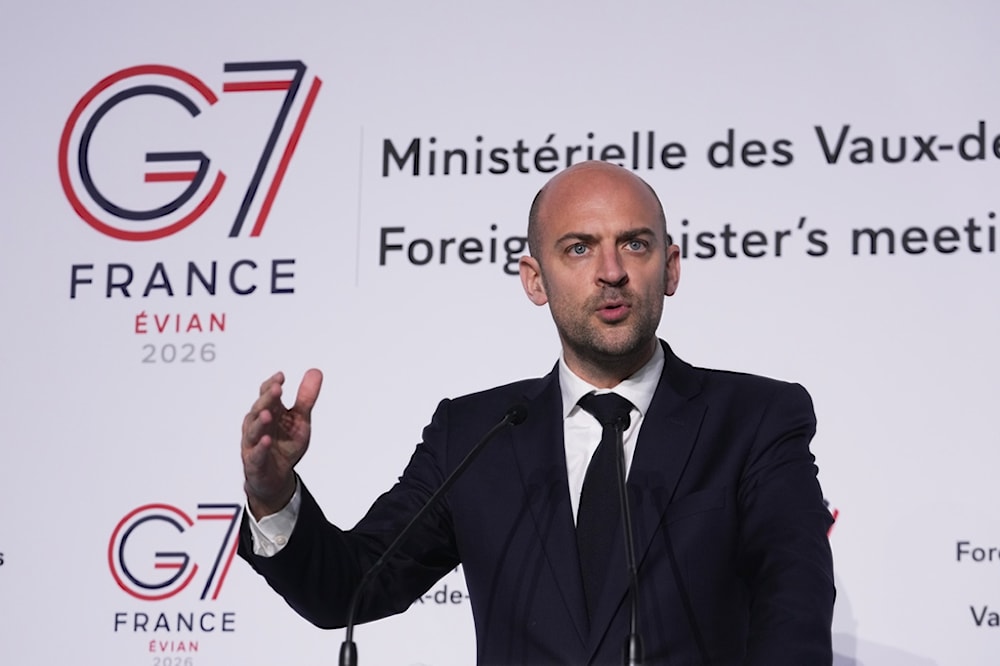
France's Foreign Affairs Minister Jean-Noel Barrot delivers a speech during a press conference at the G7 Foreign Ministers' meeting with partner countries in Cernay-la-Ville outside Paris, France, Friday, March 27, 2026 (AP)
France is assisting Bahrain in drafting a United Nations Security Council resolution that could permit the use of force to reopen the Strait of Hormuz and restore global energy flows, Politico reported on Thursday, citing diplomats familiar with the discussions.
The proposal, currently under deliberation in New York among France, the United States, and several Gulf countries, seeks authorization under Chapter 7 of the UN Charter to “restore international peace and security,” effectively providing legal cover for potential military action in a waterway that has become central in the confrontation with Iran.
The initiative comes as tensions in the strategic chokepoint intensify following Tehran’s retaliatory drone and missile operations, carried out in response to the US and "Israel" launching a war on Iran. These measures have disrupted shipping through the strait, tightening flows and amplifying pressure on global energy markets.
Bahrain, France take the lead
Diplomatic efforts gained momentum after Jean-Noël Barrot met with Bahraini and other Gulf officials on March 25. The discussions aimed to “share observations” in order to “maximize the likelihood of the text’s adoption and subsequent implementation,” one diplomat said.
France has taken a leading role in advancing Western efforts, combining diplomatic engagement at the United Nations with military positioning. Paris has signaled readiness to deploy naval assets to the Strait once conditions allow, while continuing to push for a multilateral framework through its position on the Security Council.
Bloomberg also reported that US President Donald Trump has pledged to continue military operations against Iran for at least the next “two to three weeks,” including threats to target Iran’s energy infrastructure, a move that has heightened fears that the war could further destabilize global supply routes rather than restore them. Nevertheless, French President Emmanuel Macron has publicly questioned the feasibility of reopening the strait through force, describing such efforts as “unrealistic” and calling instead for engagement with Tehran.
Bahrain has been at the forefront of the push, seeking international legal cover for a coordinated operation to secure maritime passage. The proposal aligns with parallel efforts to assemble a coalition tasked with enforcing tanker transit through the chokepoint.
At the same time, Bahraini authorities have intensified a domestic crackdown, including arbitrary detentions and allegations of torture in custody, notably in the case of Sayyed Mohammad al-Mousawi, whose killing has drawn renewed scrutiny over systematic repression, particularly against those accused of links to Iran.
Virtual meeting involving 35 countries
In this context, the United Kingdom is set to host a virtual meeting involving 35 countries that could potentially join such a coalition, reflecting growing coordination among Western and allied states
Foreign ministers from around 35 countries will discuss restoring freedom of navigation in the strait, with the United States not expected to attend. The initiative will explore three parallel tracks: diplomatic, economic, and military, Bloomberg reported, citing sources familiar with the discussions.
Three-track approach
The immediate focus is expected to remain on diplomacy, particularly coordination among countries that maintain channels with Tehran. However, if diplomatic efforts fail, participating states may consider economic measures targeting Iran’s oil and shipping sectors, signaling a phased escalation strategy that could precede or accompany any military option.
A senior European diplomat likened the initiative to earlier UN-backed arrangements designed to facilitate Ukrainian grain exports via the Black Sea, which ultimately secured Moscow’s approval.
However, significant hurdles remain. Although non-permanent members such as Bahrain can draft resolutions, adoption requires sponsorship by a Security Council member and approval from all five permanent members. Russia’s position is expected to be decisive, with diplomats casting doubt on whether Moscow would support a measure that effectively targets Iran’s response to the war.
“Why would they?” one diplomat said, referring to Russia’s likely stance on the proposal.
Russia's position has been framed in terms of its interpretation of international law, arguing that Iran is exercising its right to self-defense following the US-Israeli aggression. Moscow has pointed to Article 51 of the UN Charter, which recognizes the inherent right of states to respond to armed attacks, and has criticized resolutions it considers “one-sided” for failing to acknowledge the sequence of events that led to the war.
Lavrov questions Gulf silence
Russian Foreign Minister Sergey Lavrov has echoed this position in recent remarks, criticizing Gulf states for advancing initiatives that focus on Iran’s response while overlooking the initial assault.
“Many of the Arab monarchies have publicly said there is no need to pursue a military solution and that they will not allow the use of airspace. But when it all started, despite your repeated appeals to the United States and Israel, did you condemn what the United States and Israel began to do? Condemned the death of 170 girls at school?” Lavrov said.
He also pointed to efforts by some regional governments to advance a UN resolution that condemns Iran while omitting reference to the initial strikes.
“I have heard that your countries, and I believe even Bahrain, are planning to submit a draft resolution to the United Nations Security Council with wording along the lines I have just mentioned. It will condemn Iran’s aggression without saying a single word about the actions of the United States and Israel,” he added.
Lavrov warned that denying Iran the right to respond militarily after being attacked would effectively legitimize further escalation.
“We call for a united front to end this war. Simply saying that Iran has no right to respond effectively means you are encouraging the United States and Israel to continue. This contradicts logic,” he said.
Read more: Bahrain authorities kill detainee under torture, sparking outrage


