
'Terrorism' label obscures systemic nature of Israeli settler violence
 6 Min Read
A Truthout/Mondoweiss op-ed argues that labeling violent Israeli settlers as "terrorists" obscures the systemic, state-backed nature of settler colonial violence and risks creating false equivalence with Palestinian resistance.
-
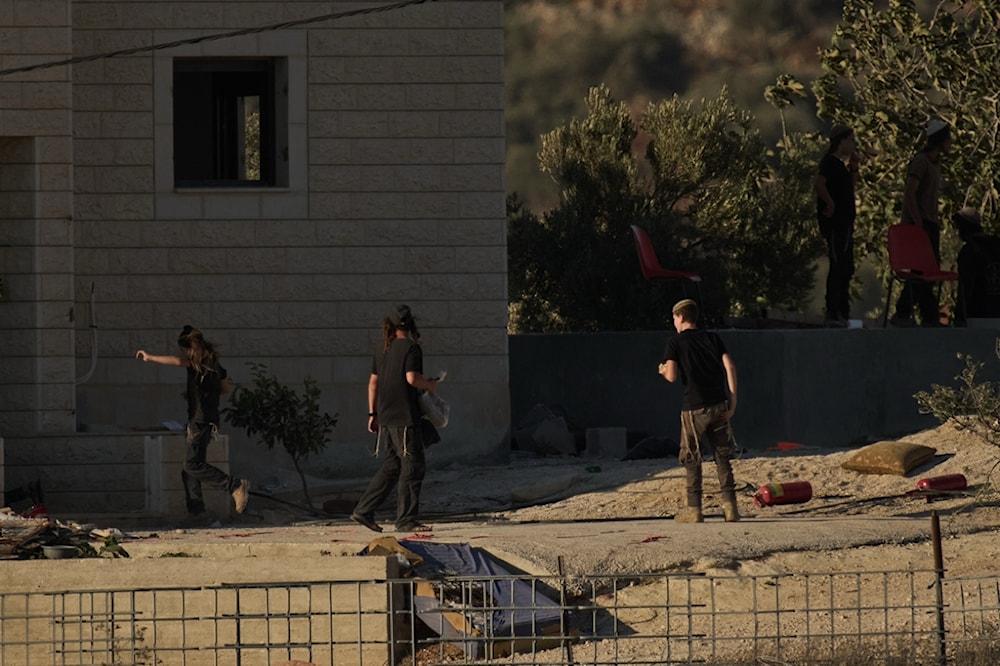
Israeli settlers are seen at one of the Palestinian houses belonging to the Tubasi family after they took it over in the West Bank village of Jalud, Tuesday, Aug. 25, 2026 (AP)
Describing violent Israeli settlers as "terrorists" risks reducing a systemic campaign of Palestinian dispossession to the actions of isolated extremists, Palestinian analyst Inès Abdel Razek argued in an opinion piece published by Truthout and Mondoweiss.
Abdel Razek said the growing use of the term "Israeli terrorists" by diplomats, media organizations and human rights groups may appear to represent stronger recognition of settler violence, but warned that the framework could ultimately shield the broader structures enabling those attacks.
Her argument followed an August 9 attack in Qusra, south of Nablus, where dozens of Israeli settlers surrounded three Palestinian homes, blocked residents from leaving, disrupted water and electricity supplies, damaged infrastructure and prevented food and other necessities from reaching the families.
Days later, US Ambassador to "Israel" Mike Huckabee, a longtime supporter of Israeli settlements, referred to those responsible as "Israeli terrorists".
Abdel Razek argued that such terminology risks presenting violent settlers as a fringe operating separately from the Israeli state, rather than as actors functioning within a system of military occupation, settlement expansion and Palestinian displacement.
'Terrorism' as a political framework
The writer traced the modern use of the "terrorism" label to Western campaigns against anti-colonial movements and later to the post-September 11 "War on Terror".
She argued that the concept has repeatedly been used by powerful states to criminalize resistance movements, justify military interventions and expand legal and security measures that undermine political rights and sovereignty.
For Palestinians, she said, the consequences have been particularly severe.
Israeli authorities have for decades categorized much of the Palestinian political and resistance spectrum as "terrorist", while invoking "counterterrorism" to justify assassinations, arrests, imprisonment and military operations across occupied Palestinian territories.
The same designation has also been applied to Palestinian civil society organizations, including six prominent groups previously labeled "terrorist organizations" by Israeli authorities.
Abdel Razek further argued that the rhetoric of counterterrorism has been used to justify the ongoing Israeli war on Gaza.
She pointed to a recent case in the occupied West Bank in which Israeli forces announced a "counterterror" operation in the north a day after armed settlers attacked Palestinians in the village of Tel.
According to the author, the absence of a universally agreed definition of terrorism under international law reflects the deeply political nature of the term.
"A framework built and weaponized by imperial powers against colonized peoples cannot become the tool through which we dismantle colonial violence," she wrote.
Settler attacks not isolated from Israeli state
Abdel Razek rejected portrayals of settler violence as the work of a small extremist minority, arguing instead that attacks on Palestinians form part of a much longer history of Zionist displacement.
She linked contemporary settler violence to the activities of Zionist militias before the establishment of "Israel", including expulsions and massacres during the 1947-48 Nakba, as well as the occupation established following the June 1967 war.
Today's settlers, she argued, operate alongside institutions that facilitate Palestinian land seizures, home demolitions, restrictions on movement and water access, imprisonment and forced displacement.
"Settlers are not an aberration from this system, but are among its agents," Abdel Razek wrote.
She cited the 1994 Ibrahimi Mosque massacre in al-Khalil as an example of how an individual settler could be condemned as an extremist while Palestinians were subsequently subjected to collective punishment.
Baruch Goldstein, an American-born Israeli settler, killed 29 Palestinian worshippers in the massacre. Although Israeli authorities publicly condemned him, the occupation imposed additional restrictions on Palestinians in al-Khalil afterward.
Abdel Razek argued that the same political logic is visible today when officials condemn particular settlers or Israeli Police Minister Itamar Ben-Gvir while continuing to support the broader structures surrounding them.
She also criticized Western sanctions targeting selected extremist settlers, saying such measures create the appearance of accountability while leaving the larger settlement enterprise untouched.
"The 'terrorist' label becomes a convenient smokescreen: remove the bad apples, and the system itself can remain unquestioned," she wrote.
Violence extends beyond Israeli far right
The article also challenged attempts to frame Palestinian dispossession as primarily the project of Prime Minister Benjamin Netanyahu, Ben-Gvir or the Israeli far right.
While political factions inside "Israel" differ in rhetoric and the pace at which they advocate settlement expansion or annexation, Abdel Razek argued that support for continued Israeli control over Palestinian land extends much further across the political spectrum.
She pointed to Israeli Foreign Minister Gideon Sa'ar's defense of settlement expansion following British criticism of the E1 settlement project.
Sa'ar defended what he described as "the Jewish people's right" to live throughout the "Land of Israel", while Netanyahu has repeatedly rejected the establishment of a Palestinian state between the Jordan River and the Mediterranean Sea.
Finance Minister Bezalel Smotrich has meanwhile openly advocated annexation and policies associated with the concept of "Greater Israel".
According to Abdel Razek, focusing exclusively on Netanyahu or the far right allows Western governments to maintain the belief that removing particular political figures could restore a supposedly more moderate Israeli political order without addressing the structures underpinning occupation and settlement.
Warning against 'both sides' equivalence
Abdel Razek also warned that applying the terrorism framework to Israeli settlers could reinforce political equivalence between an occupying power and Palestinians resisting occupation.
Once Israeli settlers are described as terrorists, she argued, Palestinian armed groups can easily be placed alongside them under the same political and legal framework.
That process transforms colonization into what appears to be a conflict between two equally violent parties, obscuring the imbalance of power between occupier and occupied.
The writer cited European Union sanctions against violent West Bank settlers that were accompanied by measures targeting Hamas figures under the same sanctions regime.
For Abdel Razek, pairing the two reproduced a "both sides" framework by treating settler violence and Palestinian resistance as equivalent phenomena.
She concluded that accountability should focus on the political and institutional structures that arm, protect and enable Israeli settlers rather than merely changing the terminology applied to individual perpetrators.
"I believe the 'terrorism' label should not be used for any group, globally," Abdel Razek wrote.
"West Bank settler violence is state-backed settler colonial violence. It is part and parcel of a century-long Zionist settler colonial project. Confronting this violence means confronting the institutions, policies, and structures that produce it — not simply the individuals who carry it out. Call it what it is."
Read more: West Bank settler violence escalates; news crews, activists attacked


