
14 nations, EC demand halt to Israeli E1 settlement expansion plan
 6 Min Read
Fourteen nations and the European Commission urge the Israeli occupation to withdraw E1 settlement tenders and halt expansion across the occupied West Bank.
-
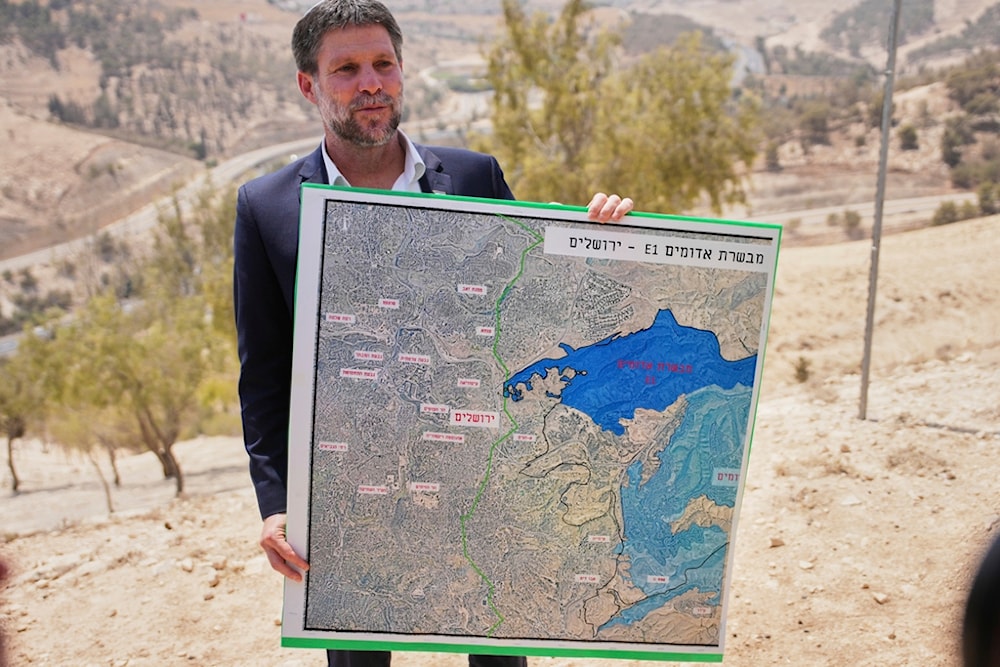
Israeli Finance Minister Bezalel Smotrich holds a map that shows the E1 settlement project during a press conference near the settlement of Maale Adumim, in the Israeli-occupied West Bank, Thursday, August 14, 2025 (AP)
Fourteen countries, including eight European Union members, along with the European Commission, have condemned the Israeli occupation's latest move to advance the controversial E1 settlement project in the occupied West Bank, calling for an immediate halt to settlement expansion, Euronews reported.
The United Kingdom, France, Germany, Italy, the European Commission, the Netherlands, Canada, Norway, Australia, New Zealand, Sweden, Belgium, Spain, Austria, and Greece issued a joint statement on August 20 after tenders were opened for more than 1,200 housing units in the E1 area, warning that the project threatens the territorial continuity of the occupied Palestinian territories.
"At a time of grave instability in the West Bank with unprecedented levels of violence by settlers against civilians, and serious restrictions on the Palestinian economy, this decision is even more concerning," the statement said, as released by the UK government, urging the Israeli occupation "to retract these plans immediately and end its expansion of settlements in the West Bank."
The 14 countries and the European Commission also stressed that "International law is clear that Israeli settlements in the West Bank are illegal" and said the position has been reaffirmed by the United Nations Security Council.
They further warned that businesses should not consider bidding for the construction tenders and should be aware of "legal and reputational consequences" for involving themselves in what the statement described as serious breaches of international law.
The countries also warned of "legal and reputational consequences" for those involved in the project, saying the plans would further undermine prospects for peace and a "two-state" solution.
E1 project threatens Palestinian territorial continuity
The E1 area covers roughly 12 square kilometers east of occupied eastern al-Quds and lies between the city and the illegal Israeli settlement of Ma'ale Adumim.
The plan, approved by the Israeli occupation last August, calls for approximately 3,400 housing units. The latest tenders cover more than 1,200 units, according to Israeli NGO Peace Now, with bids due by October 19, one week before the Israeli elections scheduled for October 27.
The project would connect Ma'ale Adumim with occupied eastern al-Quds while further separating the northern and southern parts of the West Bank, according to critics. Palestinian officials have long viewed occupied eastern al-Quds as the capital of a future Palestinian state.
UN Secretary-General Antonio Guterres has also warned that the E1 project poses an "existential threat" to the possibility of a contiguous Palestinian state.
In their joint statement, the 14 countries and the European Commission similarly warned that the E1 settlement "will undermine the prospect of the two-state solution by driving a wedge through the West Bank and harming the territorial contiguity of the Palestinian Territories."
Palestinian President Mahmoud Abbas welcomed the joint statement and called for the E1 plan to be immediately reversed, alongside an end to settlement expansion across the occupied West Bank.
Abbas stated that the project was a dangerous step toward settlement expansion and "annexation" and urged the countries, the European Union, and the UN Security Council to take concrete measures to prevent its implementation.
European officials denounce settlement expansion
Belgian Foreign Minister Maxime Prevot described the new tenders as "unacceptable" and warned that the project "would seriously undermine the viability of the two-State solution."
UK Foreign Secretary Ed Miliband also called for the project and wider settlement expansion to end. London summoned the Israeli occupation's charge d'affaires, while Miliband said he raised the issue directly with his Israeli counterpart Gideon Sa'ar.
Sa'ar rejected Miliband's criticism "outright" and objected to "the patronising tone of his words."
"The Jewish people have the right to live throughout the Land of Israel, just as the British have the right to live in London and throughout the United Kingdom," Sa'ar wrote on X.
He accused the UK of "blaming only Israel while ignoring Palestinian extremism" and said the decision had harmed relations between the two countries.
"The UK Government's decision to damage the relationship between our countries is deeply unfortunate," he added, vowing that "Israel will defend its rights, its interests and its people."
International condemnation grows
The Egyptian Foreign Ministry also expressed its "complete rejection of attempts to entrench the status quo through illegal settlement expansion" and called on the international community to "take serious steps to stop these violations."
Malaysian Prime Minister Anwar Ibrahim said the plans "gravely undermine the prospect of a contiguous Palestinian homeland."
He added that "Israel" had abandoned "even the pretence of seeking peace or respecting the will of the international community."
The UN has also condemned the latest developments. UN spokesperson Stephane Dujarric said Guterres was "deeply alarmed by the reports of new illegal Israeli settlement outposts in the occupied West Bank," including the new tenders.
The updated joint statement reiterated the signatories' commitment to "a comprehensive, just and lasting peace based on the two-state solution" and said they would "continue to act in its interest."
The latest move follows international opposition to the E1 plan last year, when more than 20 countries, including Britain and France, condemned its approval and called on the Israeli occupation to reverse the decision.
Settlement expansion accompanies rising settler violence
The latest settlement push comes amid escalating violence against Palestinians across the occupied West Bank, including attacks by Israeli settlers, demolitions and forced displacement.
UN humanitarian research found that more Palestinians were forcibly displaced through settler attacks, demolitions and evictions during the first four months of 2026 than throughout all of 2025.
Human Rights Watch has also warned that dozens of Palestinian communities in the West Bank face the risk of being erased.
The occupied West Bank is home to around three million Palestinians, while about 500,000 Israeli settlers live there, excluding occupied East al-Quds.
The expansion of settlements has accelerated since the start of the Israeli occupation's war on Gaza in October 2023, while analysts have linked the latest settlement drive to political pressure ahead of the Israeli elections in October.
Read more: Eight states reject 'Israel's' E1 settlement plan


