
'War on Iran this time could set entire region ablaze': Sheikh Qassem
 5 Min Read
Hezbollah says it cannot remain silent in the face of any threats against Iran’s Leader, Sayyed Ali Khamenei, and warns of serious regional consequences.
-
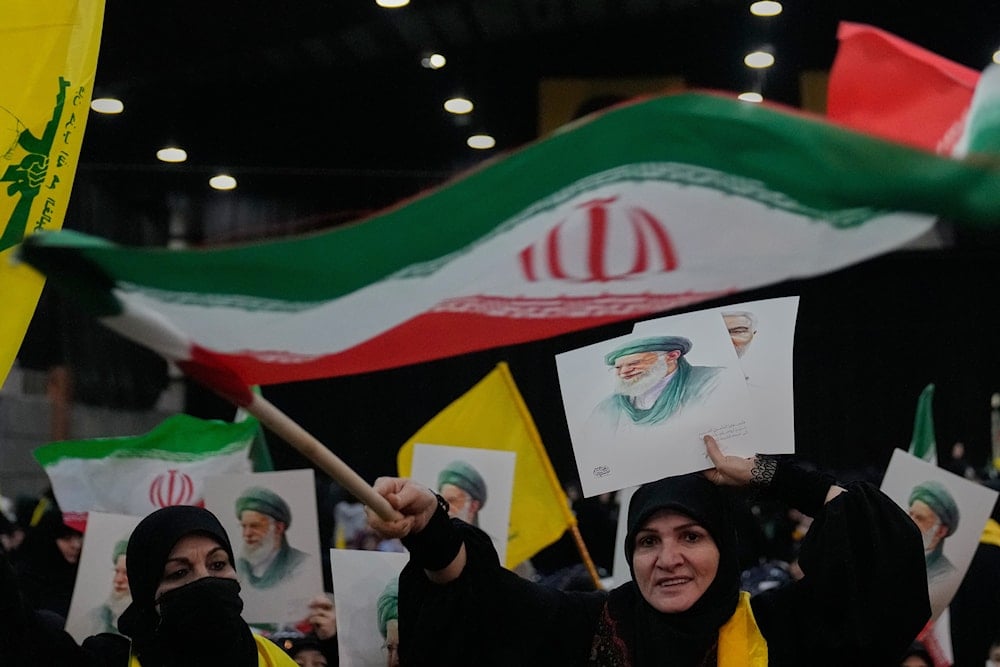
A Hezbollah supporter waves an Iranian flag and holds portraits of Iranian Leader Sayyed Ali Khamenei during a rally to show their solidarity with Iran, in the Southern Suburb of Beirut, Lebanon, Monday, Jan. 26, 2026 (AP)
Hezbollah cannot remain silent in the face of any threats against Iran’s Leader, Sayyed Ali Khamenei, whether they come from US President Donald Trump or others, Hezbollah Secretary-General Sheikh Naim Qassem emphasized.
Speaking at mass solidarity events held across multiple Lebanese regions in support of Iran on Monday, its leadership, and its people, and denouncing offenses against Sayyed Ali Khamenei, Sheikh Qassem stressed that “Hezbollah is concerned with taking all necessary measures to confront this threat.”
“It is a duty to confront this threat by all available means,” he added, warning that any harm done to Sayyed Khamenei would constitute “an assassination of stability and the situation in the region and the world.”
Threats against Sayyed Khamenei endanger region, globe
He further noted that the threats against Sayyed Khamenei are not directed at an individual alone but endanger tens of millions of Sayyed Khamenei's followers, with direct implications for regional and international peace. Sheikh Qassem cautioned that “a war on Iran this time could set the entire region ablaze.”
He also described the threat as a direct challenge to Hezbollah itself, affirming that the party possesses full authority to take whatever actions it deems necessary to counter it.
Sheikh Qassem revealed that over the past two months, several parties had asked whether Hezbollah would intervene if the United States and "Israel" went to war against Iran. He underscored that the party is fully aware of developments and determined to defend itself, adding that the decision to intervene or not would be made at the appropriate time.
Iran dealt biggest blow to US, 'Israel'
In his remarks, Sheikh Qassem highlighted that “the biggest blow dealt to the United States and Israel was the very establishment of the Islamic Republic of Iran.” He argued that since 1979, Iran has faced ongoing hostility from Washington, which “cannot tolerate the existence of a free and independent country that serves as a reference for Muslims and the oppressed worldwide.”
He pointed out that enemies have attempted to undermine Iran internally through economic pressure, inserting destructive groups into legitimate protests that targeted security forces and civilians, burning mosques, vehicles, and centers, yet these efforts failed to achieve their objectives.
Sheikh Qassem also recounted the eight-year war waged by the United States on Iran via Iraq, which involved massive military spending and various weapons, but ultimately failed to topple Iran. He added that Iran successfully resisted during the 12-day war, and under Khamenei’s leadership, “managed to foil US and Israeli projects."
“Washington seeks to dominate the entire world and works with Israel to strike every Resistance project in the region," he concluded.
Any attacks on Sayyed Khamenei 'act of madness'
Several Lebanese religious and political figures who took part in the central gathering voiced strong condemnation of any threats against Iran’s Leader, Sayyed Ali Khamenei, during solidarity events in support of the Islamic Republic.
Sheikh Ali al-Khatib, Deputy Speaker of the Supreme Islamic Shiite Council, warned of the potential consequences, saying, “We must be aware of the danger of the foolishness the United States would be committing if it causes harm to the great leader, Sayyed Ali Khamenei.” He described such an act as a precursor to “a war against the Shiite Islamic community worldwide.”
Addressing the solidarity gathering in the southern suburbs of Beirut, Sheikh al-Khatib cautioned “the peoples of the world, especially the United States, about the consequences of a dangerous action that only a fool who does not understand the consequences of his deeds would undertake,” and rejected any possibility of “forcing conditions on Iran” – both its leadership and its people.
Meanwhile, Sheikh Hassan al-Masri, Deputy Head of the Political Bureau of the Amal Movement, condemned the threats from “the mother of terrorism in the world, namely the United States, against the Supreme Leader in Iran.” He stated that any attack on religious authorities, regardless of their affiliation, constitutes “an assault on the highest ideals, religious values, and humanity in its entirety.”
Rabih Banat, leader of the Syrian Social Nationalist Party, criticized the assaults directed at Khamenei, asserting that Iran's Leader “proved that power is not only in military capabilities but in steadfastness and rejecting impositions," having succeeded in making Iran an unassailable regional power.” He added that “the suffocating blockade and economic sanctions imposed on the Islamic Republic of Iran are a clear link in an old-new colonial project targeting countries that refuse to submit.”
Sheikh Maher Hammoud, President of the International Union of Resistance Scholars, expressed solidarity with “Islamic Iran, which performs its duty on behalf of the Ummah,” emphasizing that it was not like others who claimed to support Palestine and did not. Iran, according to Sheikh Hammoud, was sincere and has spent lots of money for the sake of the cause and stood strong in its support no matter the consequences. He added, “Iran is not targeted because it is Shiite, but because it fulfills the Qur’anic duty that the Arab and Islamic countries have failed, and because it is sincere, steadfast, and persistent in its mission.”


