
Only future for Iran is regime change: Herzog echoes US threats
 4 Min Read
Amid Western and US pressure on Iran, Israeli occupation President Herzog calls Iran’s government fragile and says change must come.
-
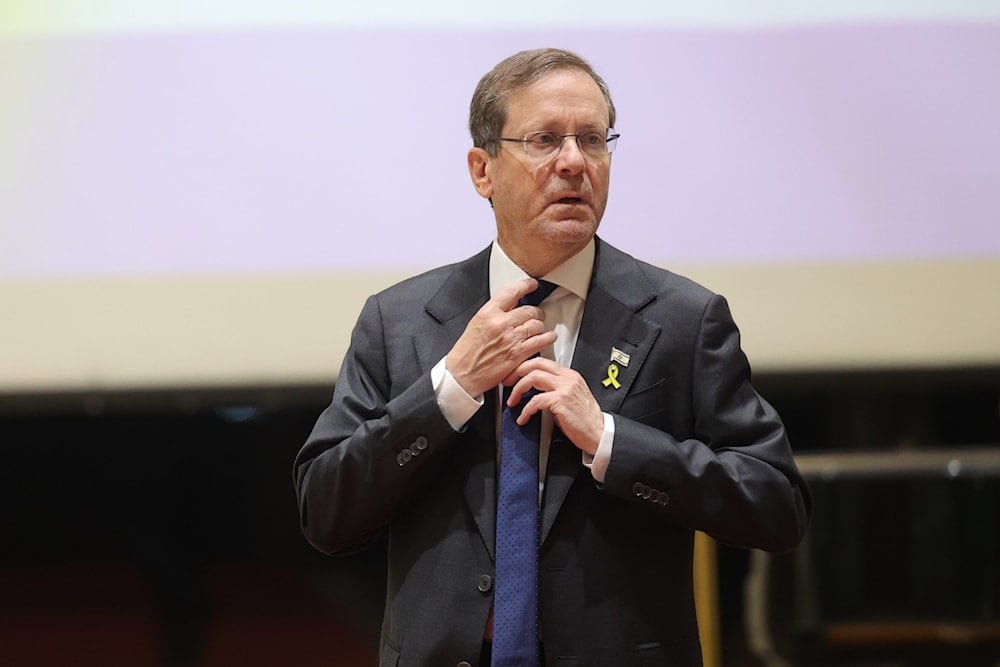
Israeli occupation President Isaac Herzog, during a meeting with German Chancellor Friedrich Merz in occupied al-Quds, occupied Palestine, on December 6, 2025. (Abir Sultan/Pool Photo via AP)
Israeli President Isaac Herzog declared on Thursday that replacing the government rule is the only viable future for Iran. Speaking at the World Economic Forum in Davos, Herzog asserted that the current Iranian leadership is "in quite a fragile situation."
"The Iranian people are yearning for change. The Iranian people deserve change," Herzog said in a televised interview. “The future for the Iranian people can only be in a regime change, and that has to be... within the realms of the Iranian people and the international community and its support.”
The latest wave of unrest in Iran was triggered by widespread economic dissatisfaction but quickly escalated into foreign-backed riots. Beginning around January 8, riots broke out and were met with a swift and forceful response upon becoming violent, exposing a clear foreign-backed agenda to affect Iran's internal state.
Herzog's comments mark one of the strongest statements yet from a senior Israeli official regarding the internal situation in Iran. His remarks also align with broader Israeli policy views that frame Iran as a regional threat. "It's clear to me that the Ayatollah regime is in quite a fragile situation," Herzog said, echoing .
While Western governments have largely condemned Iran's response to the riots, few have openly endorsed regime change. Herzog's comments come amid ongoing Western pressure against Iran and the political system it adopted since the revolution, which toppled the US-backed Shah. His comments also come amid ongoing Israeli ceasefire violations in Gaza and Lebanon and ongoing violence against Palestinians in the occupied West Bank.
US-Israeli pressure campaign against Iran has collapsed
The Speaker of Iran’s Parliament, Mohammad Bagher Ghalibaf, strongly condemned on Sunday ongoing attempts by the Israeli regime to keep the nations of the Middle East weak and dependent, while seeking to entrench itself as a dominant military power in the region with the backing of the United States and several European states.
Receiving Iraqi Foreign Minister Fuad Hussein in Tehran, Ghalibaf reiterated Iran’s firm rejection of external aggression, saying that adversaries believed recent hostile actions against the country would neutralize Iran’s aerospace capabilities. He stressed that these calculations had failed, noting that Iran’s missile arsenal has instead emerged as a central pillar of national strength and deterrence.
Ghalibaf said that “Israel” had instigated another wave of terrorist attacks inside Iranian cities roughly ten days earlier, accusing Washington of openly backing rioters and pledging assistance to armed extremist networks as part of a broader strategy aimed at destabilizing Iran from within and paving the way for foreign military intervention. He said US- and Israeli-linked armed groups, along with elements that infiltrated from abroad, carried out coordinated terrorist operations targeting multiple locations across the country, but failed to achieve their objectives within 48 hours.
The Iranian parliamentary speaker also pointed to what officials describe as a US-led sedition campaign, noting that attempts to exploit economic pressures and legitimate public grievances had been hijacked by organized armed networks seeking to provoke violence and undermine state authority.
Exploitation of economic pressures
On that note, it is crucial to mention that the US is the main reason behind Iran's fractured economy. US sanctions are not a marginal factor but a central architecture shaping Iran’s economic landscape, targeting oil, banking, shipping, and entire productive sectors. This policy has produced massive losses in output and income, shrinking Iran’s GDP and depriving the state of vital hard-currency revenues needed for investment, subsidies, and social protection
US oil sanctions generated an estimated 1.9 trillion dollars in cumulative economic losses for sanctioned states such as Iran and Russia, with Iran’s GDP contracting sharply and average Iranian incomes plunging over 12 years.
Washington’s explicit aim has been to choke Iran’s main source of foreign currency by strangling its oil exports and the logistics around them. Rather than generic “economic mismanagement,” this direct assault on the country’s key revenue stream structurally weakens Iran’s ability to plan long‑term and diversify.
In this reading, the United States is not just a contributing factor but the main architect of the economic fractures, chronic uncertainty, revenue strangulation, distorted trade routes, and financial isolation that define Iran’s contemporary economic condition.


