
'We told you: Keep your word or pay the price': Ghalibaf
 5 Min Read
Iran's Parliament Speaker has announced that one-sided deals where the US doesn't adhere to them are no longer viable, amid continued violations of the Islamabad MoU.
-
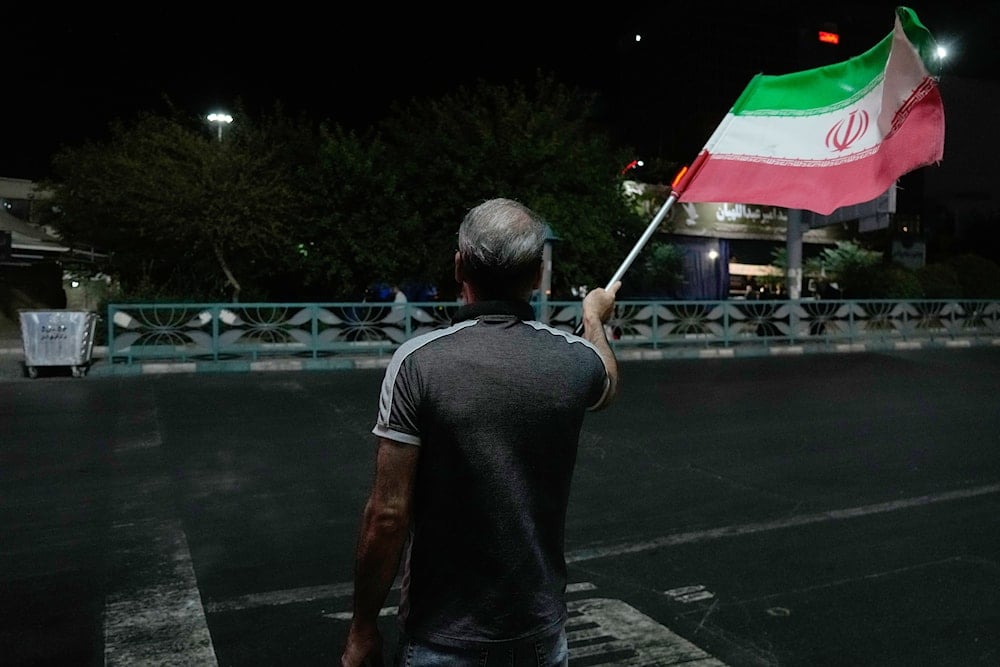
An Iranian demonstrator waves an Iranian flag in a gathering commemorating the late Iranian Leader Sayyed Ali Khamenei at a square in Tehran, Iran, Saturday, July 11, 2026 (AP)
One-sided deals are over, Iranian parliament speaker Mohammad Bagher Ghalibaf declared on Sunday.
"The era of one-sided deals is OVER," Ghalibaf said in a post on X, which highlighted a part of point 5 of the MoU, adding, "We told you: keep your word or pay the price."
The era of one-sided deals is OVER. We told you: keep your word or pay the price. Reality is knocking. pic.twitter.com/B97ogCYGaj
— محمدباقر قالیباف | MB Ghalibaf (@mb_ghalibaf) July 12, 2026
"Reality is knocking," he menacely asserted.
Point 5 of the Islamabad Memorandum stipulates: "Upon the signing of this MOU, the Islamic Republic of Iran will make arrangements using its best efforts for the safe passage of commercial vessels with no charge for 60 days only, from the Persian Gulf to the Sea of Oman and vice versa..."
On his part, Ebrahim Rezaei, spokesperson for the National Security and Foreign Policy Committee of Iran's Parliament, posted on X: "We have taken control of the Strait of Hormuz with power, and we will preserve it with power as well."
تنگه هرمز را با قدرت گرفتهایم و با قدرت هم حفظ خواهیم کرد.
— ابراهیم رضایی (@EbrahimRezaei14) July 12, 2026
Nevertheless, Al Mayadeen's correspondent in Iran said Tehran remains open to diplomatic solutions, asserting, however, that in the event of any attack, Iran cannot remain silent.
"Iran has not closed the door to diplomacy," our correspondent asserted.
IRGC Navy closes Strait of Hormuz following repeated US violations of MoU
This closely follows Iran's Islamic Revolution Guard Corps (IRGC) Navy announced that the Strait of Hormuz is closed, after several vessels had attempted to deviate from designated shipping lanes despite repeated warnings, saying the ships were encouraged by foreign actors to disregard Iranian instructions.
The force said one vessel that switched off its tracking systems and ignored repeated warnings was initially fired upon as a warning before being brought to a halt.
According to the statement, no ships will be permitted to transit the Strait of Hormuz until "US intervention" in the region ends.
US announces new strikes on Iran
Later, the US Central Command announced what it described as "a new round of strikes" against Iran.
CENTCOM claimed the strikes were launched in response to an attack on the Cyprus-flagged container ship M/V GFS Galaxy while transiting the Strait of Hormuz.
The US command said the vessel sustained damage from an onboard fire and engine room impact, preventing it from continuing its voyage, and reported that a civilian crew member was missing.
US Secretary of War Pete Hegseth said on X: "Iran made a poor choice. Now they pay."
Read more: IRGC: Second phase of response destroys US command center, Jordan base
IRGC missiles hit US bases in region, MQ-9 facilities in Jordan
In response, Iran's Islamic Revolution Guard Corps (IRGC) said its Aerospace Command targeted US military infrastructure at Jordan's Prince Hassan Airbase, destroying the facility's command and control center and MQ-9 drone hangars with ballistic missiles.
In a statement issued Sunday morning, the IRGC said the operation came in a first-stage response to US attacks on Iranian coastal bases and communication towers following a confrontation in the Strait of Hormuz.
In a later statement, the IRGC announced destroying the logistics support centers for US ships, along with the fuel supply platforms serving US naval vessels and aircraft at the Port of Duqm in Oman.
The statement said the United States had attempted to test Iran's resolve by encouraging several vessels to navigate illegally through the southern part of the Strait of Hormuz, which Tehran met with a "decisive response" from the IRGC Navy.
The IRGC said Washington conducted strikes "against several coastal bases and communication towers" after failing to achieve its objectives in the strategic waterway.
"Any further aggression by the treacherous American regime will be met with even stronger responses," the statement said.
Iran's strikes target US bases
According to the IRGC, the first phase of its retaliatory operation targeted key US military infrastructure at Prince Hassan Air Base in Jordan. The force said several ballistic missiles struck the base, destroying the command and control center as well as facilities housing MQ-9 drones.
Meanwhile, Iran's Army (Artesh) announced that it had launched a wave of drone strikes targeting US military positions in Kuwait and Bahrain. According to the statement, Patriot air defense systems, ammunition depots, radar installations, and communications facilities were among the targets.
In another wave of drone strikes, the Iranian Army said it targeted the US military's communications system and radar site in Bahrain, holding the US and "Israel" responsible for "the consequences of these actions and the resulting instability in the region."
The Artesh warned that any further US aggression would be met with a stronger military response.
The drone operations coincided with additional strikes announced by the IRGC, which said it had disabled a second vessel in the Strait of Hormuz after it violated Iranian navigation instructions.
The IRGC also announced the second phase of its retaliatory operation against the US-operated al-Udeid Air Base in Qatar, adding that ballistic missile strikes destroyed the base's fighter aircraft maintenance center and command and control center.


