
286 days at sea: US Navy stretched thin as Iran war strains sailors
 7 Min Read
Months of the US war on Iran have left USS Abraham Lincoln sailors facing severe fatigue, shortages, and collapsing morale after an exceptionally prolonged deployment.
-
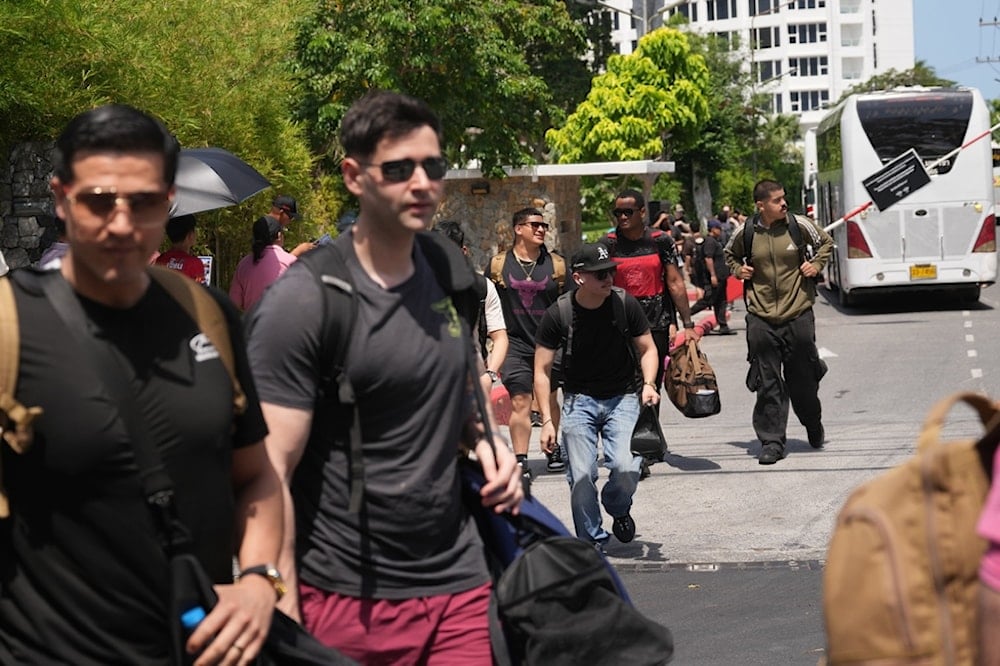
Crew members of the USS Abraham Lincoln leave a hotel in Pattaya, Thailand, Thursday, Sept. 3, 2026 (AP)
Months into Washington’s war on Iran, the mounting pressure on the US military is becoming increasingly visible, with the USS Abraham Lincoln emerging as a symbol of the logistical, personnel, and strategic costs of sustaining the aggression.
The US aircraft carrier arrived in Thailand this week after 286 days at sea, allowing roughly 5,000 sailors to disembark following one of the longest uninterrupted stretches of deployment in the modern history of the US Navy, Bloomberg reported.
The port call came after months of combat operations linked to the war on Iran, during which the carrier and its crew remained heavily engaged in Washington’s military campaign across West Asia.
U.S. sailors from the USS Abraham Lincoln are attracting quite an audience in Thailand: https://t.co/haVLsO4hX6 pic.twitter.com/74ty3UrMcd
— Mohsin Ali (@Mohsin_o2) September 3, 2026
Morale sinks aboard USS Lincoln
Accounts from sailors and their relatives pointed to shortages, failing infrastructure, communications blackouts, and severe fatigue aboard the vessel, underscoring the growing burden of a conflict that has continued for seven months without delivering Washington a clear strategic victory.
One sailor, identified by Bloomberg only as Mitchell, said that after the intensity of military operations subsided, personnel were left facing prolonged uncertainty over when they would be allowed to return home.
“During the war, it’s the peak — it’s the high,” he said. “After, it was the same thing every day, and nothing changing. That’s when it’s like, ‘What are we doing?’”
The deployment reportedly produced shortages severe enough to create an informal market aboard the ship, with energy drinks purchased for $3 being resold for as much as $10.
Sailors were also cut off from their families during a 40-day wi-fi outage.
Mitchell said morale at times deteriorated to such an extent that some personnel threatened to jump overboard, either to draw attention to their conditions or in hopes of being removed from the ship.
🇺🇸🇮🇷🇹🇭 After more than 9 months at sea, with the crew running out of rations and supplies and experiencing dozens of attempted suicides, the USS Abraham Lincoln has returned to port in Thailand
— Megatron (@Megatron_ron) September 2, 2026
Rust can be seen all over the ship, with some sections looking like they could fall… pic.twitter.com/lWMuGdXlVU
Washington’s prolonged campaign takes toll
The difficulties aboard the Lincoln come as the United States continues to devote extensive military resources to operations against Iran.
Reports from aboard the carrier have included shortages of fresh food and hygiene products, contaminated water, mold in shower areas, deteriorating toilets, and exhausting work schedules.
Around 200 family members and spouses reportedly confronted senior Navy officials at a meeting in San Diego last month over conditions faced by personnel aboard the ship.
Some raised reports of sailors attempting to throw themselves overboard.
US Central Command has maintained that “the one sailor who fell overboard” on August 3 was safely recovered.
Carrier shows visible wear
When the Lincoln reached Laem Chabang Port in Thailand, the physical wear accumulated during its deployment was readily visible.
Rust streaked sections of the carrier’s hull, while algae and grime had accumulated along the waterline.
Captain Daniel Keeler, the vessel’s commanding officer, likened its appearance to “a dirty car in a parking lot,” while insisting the condition was normal after such a lengthy period at sea.
Keeler acknowledged shortages of fresh produce and said the ship had also been forced for a period to carefully regulate sales of hygiene products.
He nevertheless rejected what he portrayed as exaggerated accounts of conditions aboard the carrier.
“Unfortunately, we did get caught up in the election cycle,” he said. “That kind of got thrown around like a football.”
Official narrative questioned
The contrast between official messaging and testimony from personnel has remained striking.
US Navy social media accounts have published footage showing sailors eating, attending recreational events and receiving fresh supplies, projecting an image of normality despite months of reports about exhaustion and shortages.
Yet sailors appearing even in Navy-produced material have acknowledged the pressure created by deployments with no clear end date.
Iran war forces US to stretch forces across two theaters
The pressure extends far beyond the crew of a single carrier.
Washington’s decision to sustain a prolonged war against Iran has required the deployment of warships, air-defense systems, personnel, and large quantities of advanced munitions to West Asia.
Those resources have increasingly been drawn away from the Asia-Pacific, where US military planners have spent years seeking to strengthen their position against China.
Pacific posture comes under strain
The dilemma became particularly visible when the Lincoln was finally permitted to head toward Thailand. The USS George Washington had to sail in the opposite direction to relieve it, temporarily leaving the western Pacific without a US aircraft carrier despite Washington’s efforts to maintain a persistent carrier presence there.
Chinese media quickly seized on the movement as evidence that US forces were becoming overstretched across multiple theaters.
“The broader story is about the strain the Iran war is putting on US readiness in the Pacific,” Gregory Poling, director of the Southeast Asia program at the Center for Strategic and International Studies, said. “It’s unclear when the regional command might be up to full carrier strength.”
Poling also pointed to the movement of US air-defense assets toward the war and “the expenditure of a mindboggling percentage of the US military’s most important munitions — the very stuff it would need for any conflict with China.”
The assessment points to one of the most significant strategic consequences of the war: every interceptor, warship and carrier diverted toward Iran represents a resource unavailable elsewhere. Washington has repeatedly portrayed its military as capable of sustaining operations across several regions at once. The experience of the Lincoln, however, has brought renewed attention to the limits of that posture.
US Navy faces wider readiness crisis
The war on Iran is compounding problems that already existed across the US Navy.
The service is facing maintenance backlogs, delays in shipbuilding, and shortages of dry-dock capacity, while increasingly long deployments are placing additional pressure on both vessels and personnel.
Carrier deployments have traditionally lasted around seven months, according to retired Navy captain Carl Schuster, a former operations director at US Pacific Command’s Joint Intelligence Center.
The USS Gerald Ford returned earlier this year after 326 days at sea, which the Navy says was the longest aircraft-carrier deployment since the Vietnam War.
The Lincoln, which left San Diego in November, has now been deployed for more than nine months.
Trump dismisses deployment concerns
US President Donald Trump dismissed concerns over the carrier’s lengthy deployment when asked about the matter, saying it was “not nearly long enough.”
Schuster warned that the Navy could no longer ignore the strain being imposed on its forces.
“The Navy needs to recognize its shortfalls, get serious about filling them, and give much more consideration to the impact the current situation is having on its personnel,” he said.
Sailors contradict official portrayal
The Thailand stop also exposed the gap between US military messaging and accounts from personnel serving aboard the carrier.
Bloomberg reported that most sailors approached in Pattaya declined to speak with journalists, citing strict instructions against doing so.
Two sailors who briefly answered questions reportedly shook their heads when asked whether official assertions that conditions aboard the ship were satisfactory were accurate.
One later returned and showed a reporter a message typed on his phone:
“Pamela Brown got it right.”
The reference was to a CNN report produced after Brown spent three days aboard the carrier in July documenting isolation, sleep deprivation, and mounting psychological pressure among the crew.
Taken together, the accounts present a picture of a US military being forced to absorb growing costs from a war that has consumed personnel, weapons and naval capacity while complicating Washington’s ability to maintain its military posture elsewhere.
Read more: Iran is the new regional power, not the US or 'Israel': The Atlantic


