
US to deploy new carrier to West Asia as Trump claims 'big victory'
 4 Min Read
The US is preparing to deploy the USS Theodore Roosevelt to West Asia for at least seven months as Trump claims Washington is achieving a "very big victory" over Iran.
-
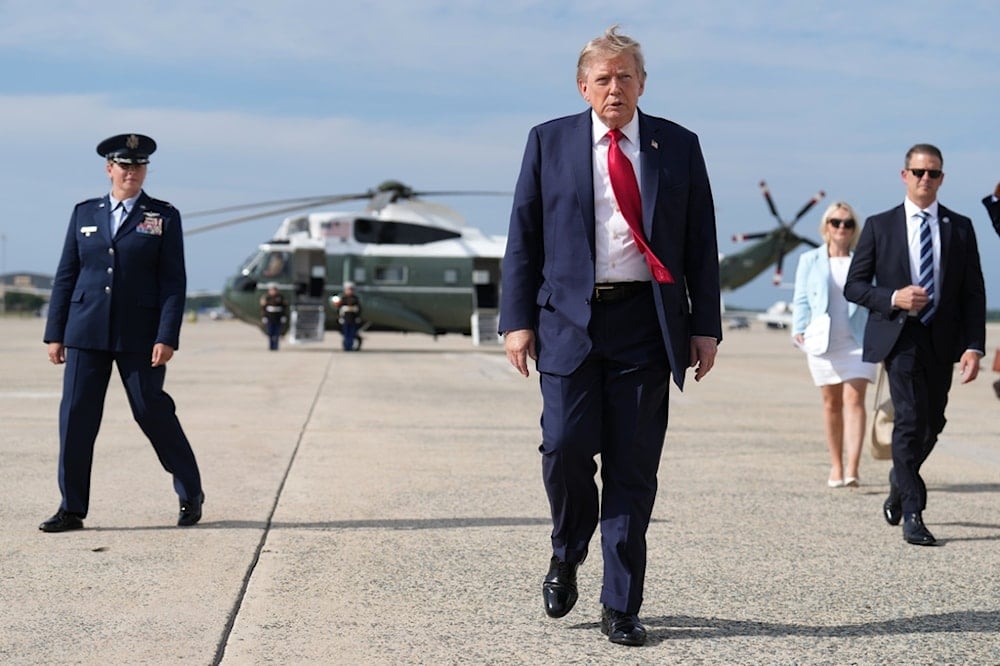
US President Donald Trump, center, walks from Marine One to board Air Force One, Aug. 21, 2026, at Joint Base Andrews, Md., en route to South Carolina. (AP Photo/Jacquelyn Martin, File)
The United States is preparing to deploy another aircraft carrier to West Asia as US President Donald Trump says Washington will continue its war on Iran for as long as necessary and has no timetable for returning to peace talks.
Senior US Navy officials told CNN that the USS Theodore Roosevelt is expected to deploy for at least seven months. The carrier is expected to relieve the USS George Washington, according to USNI News, as the war on Iran continues.
The planned deployment comes as Trump claimed the United States is achieving a "very big victory" over Iran, despite the ongoing war and Washington's continued military buildup in the region. Trump said he was "not in a hurry" to resume negotiations with Tehran and insisted that Washington had "no timeline" for returning to peace talks.
Trump says US has no timetable for ending war
Trump said the United States was "winning very big" and pointed to economic difficulties in Iran as evidence of Washington's progress in the war. "We are winning very big," he said. "They’ve got massive inflation, their economy is falling apart... I have no time schedule; whatever it takes."
His comments came as the US military prepares for an extended carrier presence in West Asia, with the USS Theodore Roosevelt expected to take over from the USS George Washington.
The deployment reflects Washington's preparations for a prolonged war, even as Trump continues to claim that the United States is gaining the upper hand against Tehran.
Trump has previously vowed to continue the war "for as long as necessary" while maintaining that Washington could eventually return to negotiations with Iran.
The latest deployment comes nearly six months after the war began and as tensions remain high across the region, with the Strait of Hormuz and broader US-Iran military confrontation continuing to dominate regional security concerns.
War puts military stockpiles under growing strain
Meanwhile, the prolonged war is placing growing pressure on Washington’s weapons stockpiles, raising concerns that depleted munitions and diverted military assets could undermine US readiness in the Indo-Pacific, according to The Washington Post and other US media.
The war has consumed large quantities of weapons, including more than 1,000 Tomahawk missiles, while US Patriot and THAAD interceptor stocks have also been heavily depleted. CSIS estimates that only about 1,000 missile-defense interceptors remain, raising concerns over Washington’s ability to respond to a potential conflict with China.
The strain is already affecting US allies in Asia. Taiwan expects significant delays in deliveries of Patriot missiles, while Japan has reportedly been warned that deliveries of Tomahawk cruise missiles could be delayed by as much as two years.
At the same time, US forces and naval assets have been redirected from the Indo-Pacific to West Asia. More than 30 ships reportedly intended for the Pacific were sent to the region during the war on Iran, while the USS George Washington was diverted to help sustain US carrier operations.
US officials maintain that US forces remain capable of deterring threats in the Indo-Pacific, while the Pentagon is accelerating weapons production to replenish depleted stocks. Lockheed Martin has received a $58.6 billion contract aimed at tripling Patriot interceptor production by 2030.
However, military analysts warn that the war on Iran is exposing a potential vulnerability in US weapons supplies. Mark Cancian of the Center for Strategic and International Studies said the weapons consumed in the war overlap significantly with those that would be needed in a major confrontation in the western Pacific.
CSIS simulations have estimated that the United States could expend around 5,000 long-range missiles within four weeks of a conflict with China, highlighting the scale of the challenge facing Washington as it continues the war on Iran.


