
War on Iran drains US weapons, testing readiness against China: WashPo
 8 Min Read
The war on Iran is draining US munitions stockpiles, raising concerns in Taiwan, Japan and South Korea over weapons delays and US readiness.
-
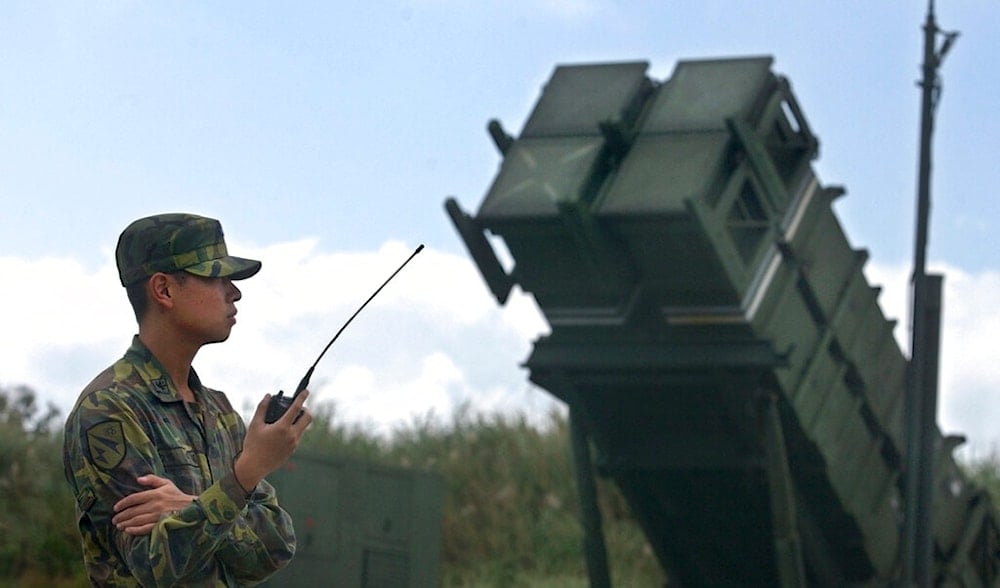
In this Oct. 22, 2004 photo, a Taiwanese soldier stands in attention in front of a Patriot missile air defense system near the northern coastal town of Wanli, Taiwan. (AP)
The prolonged war on Iran is putting growing pressure on US weapons stockpiles, raising concerns among Washington’s Asian allies and officials responsible for the Indo-Pacific that the demands of the conflict could weaken US military readiness for a potential confrontation with China.
According to The Washington Post (WP), the strain is already affecting military planning. The United States canceled an amphibious landing exercise with South Korea scheduled for September, citing demands on US forces from the war on Iran. The decision came a week after President Donald Trump announced that Washington would scale back joint military exercises with Seoul.
South Korea, Japan, and Taiwan depend heavily on the United States for major conventional weapons and are already facing significant delivery backlogs. The conflict in West Asia has intensified those pressures by consuming and redirecting munitions that could be needed in a potential conflict with China.
A Taiwanese official said Taipei expects "significant delays" in receiving Pac-3 Patriot missiles as the Pentagon has depleted much of its interceptor stockpile in West Asia. The official described the shift in focus from the Indo-Pacific as “troubling.”
Taiwan already has nearly $30 billion in US arms approved for sale that have yet to be delivered, including $882 million worth of Patriot missiles, according to Taiwan Security Monitor. Japan has also been warned about possible delays in defense shipments, including Tomahawk cruise missiles, according to an Asian diplomat familiar with the matter.
Japanese Defense Minister Shinjiro Koizumi said in May that delays were “possible,” but said Tokyo's plans to acquire Tomahawk missiles had not changed. Taiwanese defense officials told parliament in March that they still expected 102 Patriots to be delivered this year. The Financial Times (FT) reported that delivery of 400 Tomahawks to Japan could be delayed by as much as two years.
A War Department official claimed “the Joint Force remains postured, ready, and capable of deterring aggression” in the Indo-Pacific, adding that US military resources routinely move between combatant commands.
Jennifer Kavanagh, director of military analysis at Defense Priorities, questioned whether Taiwan would receive the full number of Patriot interceptors it expects. “It seems to me that the likelihood that [Taiwan is] going to get a whole 100 is pretty low. I think the number one priority for the United States, rightly, will be refilling its own stockpiles,” she said.
“The United States probably also feels like it owes Gulf state allies some replenishment. The war on Iran is not over,” Kavanagh added.
The depletion of US weapons has also reportedly become a source of tension between Trump and War Secretary Pete Hegseth, although Trump has denied that US weapons stocks are running low.
US forces diverted from the Indo-Pacific
The pressure on weapons stocks has been accompanied by a broader redistribution of US military assets from the Pacific to West Asia, WP stated.
Officials at Pacific Command have expressed frustration over the resources being redirected from the region and the resulting challenges for efforts to deter Beijing. One US official said more than 30 ships that were supposed to be in the Pacific had been sent to West Asia during the war. "It’s clear that they’re paying a big price, especially on the Navy side of things", the official said.
The Japan-based USS George Washington was diverted to West Asia this month, helping relieve pressure on the USS Abraham Lincoln following concerns about the carrier's extended deployment and conditions for its sailors.
The move underscored the broader diversion of US naval power from the Indo-Pacific, where China has the world's largest navy by number of vessels.
Missile-defense capabilities have also been shifted. Gen. Xavier Brunson, commander of US Forces Korea, told the Senate Armed Services Committee in April that radars used in missile-defense systems were taken from the Korean Peninsula ahead of US strikes on Iranian nuclear facilities in June 2025. Additional munitions were moved this year, although Brunson said the THAAD system remained in place.
China expands military pressure
The concerns over US readiness come as Washington pursues warmer relations with Beijing and the DPRK.
Trump has repeatedly said Chinese President Xi Jinping will not "invade" Taiwan while Trump remains president, and he recently described DPRK leader Kim Jong Un as “unthreatening and respectful” and said he expects to meet him this year.
A roughly $14 billion US arms package for Taiwan was shelved ahead of Trump's May summit with Xi in Beijing. The two leaders are expected to meet again in Washington on September 24.
A Chinese official said any indication that the White House would approve the package would “severely undermine” further potential visits this year.
Colby and other US officials have also pressed Asian allies to assume a greater share of their defense costs. Speaking in the Philippines this month, he rejected suggestions that Washington was reducing its commitment to the region. "We are not leaving; in fact, we are digging in", he said.
The pressure has created a difficult situation for allies being encouraged to purchase more US weapons while facing delays in deliveries. “The situation is very challenging,” the Taiwanese official said.
Trump also said arms sales to Taiwan were a “good negotiating chip” with China in May, raising concerns in Taipei about his commitment to the island. However, an $11 billion package approved by Trump late last year remains the largest single US arms commitment to Taiwan.
China has continued increasing military activity around Taiwan in response to growing military provocations. After its record-breaking drills around the island in December, Beijing expanded military infrastructure in the South China Sea and conducted additional coast guard exercises near Taiwan. In July, China also carried out its first known test of a sea-based nuclear-capable missile.
A growing window of vulnerability
Concerns over US munitions supplies have also emerged from the war in Ukraine, during which Washington has provided billions of dollars in weapons to support Kiev. However, the weapons used there differ from those expected to be essential in a long-range, maritime-heavy conflict in the Pacific.
The war on Iran has brought the issue into sharper focus because many of the weapons being consumed are directly relevant to a potential confrontation with China. "Between Iran and the western Pacific, there’s a lot of overlap", said Mark Cancian, a retired Marine colonel and senior adviser at the Center for Strategic and International Studies.
CSIS war games conducted since 2023 found that aiding Taiwan in the event of a confrontation could exceed current Pentagon supply plans, with some critical weapons potentially being exhausted within weeks. "Even at the beginning of the war against Iran, we were likely inadequate for a conflict with China in the western Pacific", Cancian said, amid claims that the Chinese military is preparing for a 2027 conflict with Taipei.
The 2027 benchmark has nevertheless intensified concerns about a “window of vulnerability” in US munitions stocks.
The Pentagon is attempting to rebuild supplies by accelerating weapons production. Lockheed Martin received a $58.6 billion contract to triple Patriot interceptor production by 2030.
China's military capabilities make the potential challenge particularly demanding. Beijing has spent decades developing a large arsenal of ballistic, hypersonic, and anti-ship missiles, despite not fighting a major war since 1979 in Vietnam.
CSIS simulations indicate that the United States could expend about 5,000 long-range missiles within four weeks of a conflict with China.
The Washington Post reported that US forces fired more than 850 Tomahawk missiles during the first four weeks of the war on Iran. CSIS later estimated that total use had surpassed 1,000, compared with a prewar stockpile of between 3,100 and 4,500 missiles.
Other weapons have also been depleted. April CSIS figures showed that the Pentagon had used roughly one-quarter of its prewar Joint Air-to-Surface Standoff Missile inventory and as much as three-quarters of its 90 Precision Strike Missiles.
Missile-defense interceptors are particularly concerning because alternatives are limited. “They are the most critical because there are no good substitutes. When you run out of Patriots, when you’re out of THAADs, there’s no way you can stop missiles coming in,” Cancian said.
In an Indo-Pacific conflict, those systems would help protect roughly two dozen US bases in Asia and tens of thousands of US troops in Japan and South Korea.
CSIS figures published in late July estimate that the United States has already used most of its prewar Patriot and THAAD inventory, leaving roughly 1,000 interceptors. "China has 3,000 ballistic missiles or more. So that’s just bad math", Kavanagh said.
Read more: China challenges Trump’s plan to economically isolate Iran


