
China challenges Trump’s plan to economically isolate Iran
 6 Min Read
Trump’s new economic pressure campaign against Iran faces a major challenge as China rejects US sanctions and defends its trade ties with Tehran.
-
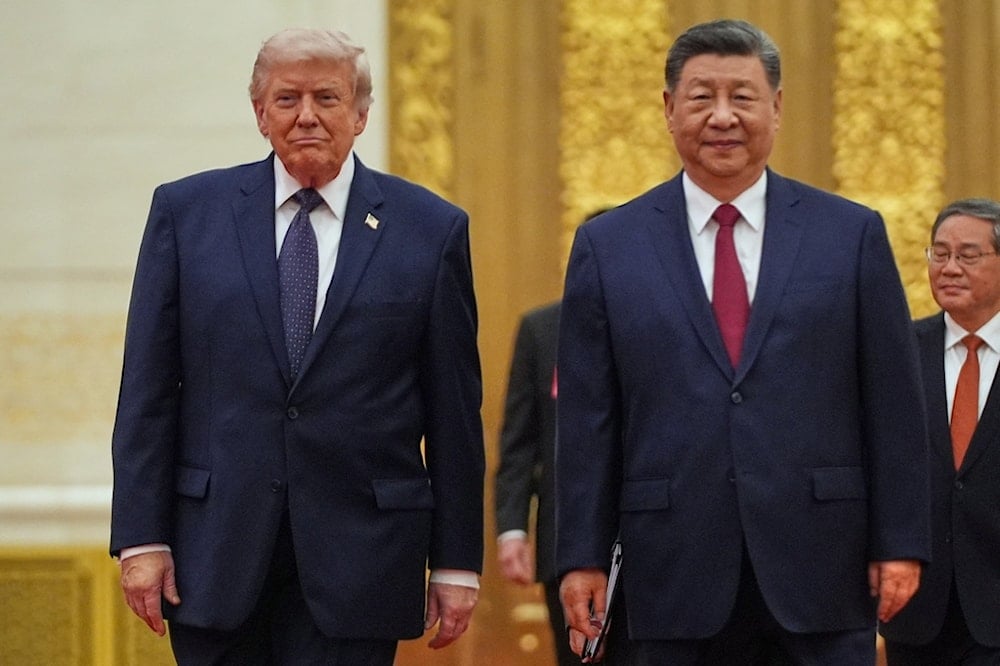
President Donald Trump, left, and Chinese President Xi Jinping arrive at a state dinner at the Great Hall of the People May 14, 2026, in Beijing. (AP Photo/Mark Schiefelbein)
The Trump administration is preparing a new economic pressure campaign against Iran, but securing China's cooperation could prove critical to whether Washington can make the strategy effective, as per an analysis published by CNN.
US Treasury Secretary Scott Bessent recently unveiled “Operation Economic Outcast,” threatening sanctions against countries that continue doing business with Iran. While Bessent did not specifically name China, Beijing is a major economic lifeline for Tehran and has continued purchasing large quantities of Iranian oil.
China's role makes it particularly difficult for Washington to enforce a broader sanctions campaign against Iran. Beijing has consistently rejected unilateral US sanctions and defended its right to maintain normal trade with countries including Iran and Russia.
China rejects US sanctions pressure
Following Bessent's announcement, China's Foreign Ministry said Beijing would take measures to protect its interests against US sanctions threats.
“Economic warfare and maximum pressure will not help resolve the issue; they will only further intensify tensions and conflicts, create spillover risks, disrupt the global economic and financial order,” Chinese Foreign Ministry spokesperson Lin Jian said on Tuesday, as reported by CNN.
China has maintained that Washington should not dictate how Chinese companies conduct legitimate trade with third countries. Zhao Long, director of the Institute for International Strategic and Security Studies at the Shanghai Institutes for International Studies, said Beijing was unlikely to accept such restrictions.
“China is unlikely to accept a situation in which Washington determines what Chinese companies can legally trade with third countries,” Zhao said, warning that this could establish a precedent in which US secondary sanctions influence China's commercial relations with other countries.
The confrontation comes as US President Donald Trump and Chinese President Xi Jinping prepare for a highly anticipated meeting in the United States next month. The summit could include efforts to extend a fragile trade truce between the two countries that is due to expire later this fall.
Trump previously said he did not ask Xi “for any favors” regarding Iran during their meeting in May. Washington's new push for cooperation on Iran could therefore complicate the broader effort to stabilize US-China relations ahead of the summit.
Washington's pressure on trade
Despite China's resistance, Washington has potential avenues for increasing pressure on Chinese entities involved in Iranian trade.
China imports Iranian oil through a network designed to remain largely insulated from the US financial system. So-called teapot refineries purchase and process Iranian crude under US sanctions, while ports, financial institutions and tankers involved in the trade have also sought to limit their exposure to international sanctions.
China has not officially recorded such purchases for years, following Washington's reimposition of sanctions on Iran after the first Trump administration withdrew from the Obama-era nuclear agreement. However, analysts say the United States could target links between some of the companies involved and China's larger state-owned enterprises.
Max Meizlish, a senior research analyst at the Foundation for Defense of Democracies, said some entities involved in the Iranian oil trade are directly or indirectly connected to major Chinese state-owned companies that remain deeply integrated into the US dollar system.
“By sanctioning their subsidiaries, the US can apply pressure to the parents to divest at risk of being deemed as providing direct or indirect support to sanctioned entities,” Meizlish said, as carried by CNN.
Bessent said earlier this year that Washington had warned two unnamed Chinese banks over their alleged involvement in transactions linked to Iran. Asked what could happen to Chinese banks and shipping companies that failed to comply with US demands, Bessent said “no one is above” US sanctions.
Sanctions could threaten Trump-Xi summit
China, however, has already experienced US threats of sweeping sanctions and may calculate that Washington would be reluctant to impose measures capable of triggering a broader economic confrontation.
Beijing also has significant leverage of its own, particularly through its dominant position in global rare earth supplies, which are strategically important to numerous industries.
Sun Chenghao, a senior fellow at Tsinghua University's Center for International Security and Strategy, warned that sanctions targeting major Chinese banks could trigger a direct response from Beijing.
“If Washington crossed that threshold (of sanctioning major Chinese banks), Beijing would almost certainly respond, and the political atmosphere for a summit (between Trump and Xi) would deteriorate sharply,” Sun said, as per CNN. He added that such a move might not necessarily cancel the meeting but could transform it from an effort at stabilization into “damage control.”
The stakes are particularly high because Xi's expected visit would be his first state visit to the United States in 11 years.
Beijing weighs Iran ties against wider interests
China is unlikely to openly support Washington's sanctions campaign, but Beijing has room to make adjustments that could serve its own economic and diplomatic interests, according to CNN's report.
Those measures could include quietly reducing Iranian oil purchases, increasing diplomatic pressure on Tehran to exercise restraint, or supporting efforts to restore shipping through the Strait of Hormuz.
Chinese purchases of Iranian oil have already fallen sharply from last year as the US blockade has constrained Iran's crude exports.
Beijing has also intensified calls for a broader de-escalation of the war. Following a meeting with Jordan's King Abdullah II in Beijing on Monday, Xi called for the restoration of “normal passage” through the Strait of Hormuz and a “comprehensive solution” to the war.
Chinese Vice Foreign Minister Miao Deyu also said last week, while hosting Iranian officials in Beijing, that China was “actively committed to promoting peace talks.”
At the same time, Beijing has remained cautious about assuming a direct mediation role. Instead, according to CNN, it has sought to protect its economic interests while presenting itself as a stabilizing force in West Asia.
That position makes outright cooperation with Trump's maximum-pressure strategy unlikely. Zhao said any Chinese contribution to restoring regional stability “should not be reduced to ‘doing Trump a favor.’” “Beijing is willing to contribute to ending the crisis, but it is not willing to become an instrument of Washington’s maximum-pressure strategy.”


