
China rejects US tariff coercion, counters EU sanctions
 4 Min Read
China condemns new US tariffs targeting dozens of economies and imposes export restrictions on 14 European companies in retaliation for EU sanctions on Chinese entities.
-
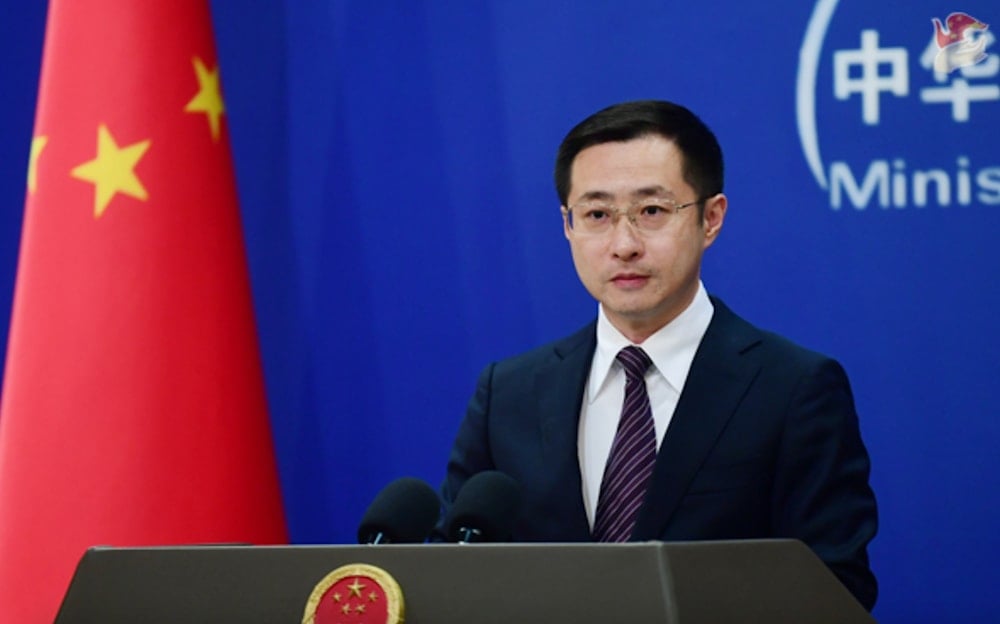
Chinese Foreign Ministry spokesperson Lin Jian addresses a regular press briefing in Beijing, July 22, 2026 (Chinese Ministry of Foreign Affairs)
China has condemned a new round of US tariffs as a protectionist measure disguised as concern for labor rights, while imposing targeted export controls on European companies in response to Brussels’ sanctions against Chinese businesses.
The two developments underscore Beijing’s growing resistance to the weaponization of trade, human rights, and economic restrictions by Western governments seeking to pressure China and contain its development.
Washington uses tariffs to pressure trade partners
The United States imposed duties of between 10% and 12.5% on imports from China and 59 other economies, accusing them of failing to take sufficient action against products allegedly linked to forced labor.
China, India, and Japan were placed in the higher tariff category, while economies that have adopted forced-labor import bans similar to those imposed by Washington, including Canada, the European Union, and the United Kingdom, received the lower rate.
Beijing has argued that the arrangement exposes the coercive nature of the policy, as Washington is effectively using access to the US market to pressure other governments into adopting American trade rules and legislation.
"We oppose all forms of unilateral tariff measures," Chinese Foreign Ministry spokesperson Lin Jian told a news briefing on Friday.
"Tariff wars and trade wars are not in the interests of any party," he warned.
Reproducing US policies under threat of economic penalties
The Chinese government has consistently rejected US accusations related to forced labor, maintaining that Washington uses human rights allegations as a pretext to erect trade barriers, suppress Chinese industries, and interfere in the country’s internal affairs.
US Trade Representative Jamieson Greer said Washington was "rigorously" enforcing its forced-labor import ban and that it was "well past time for our trading partners to do the same."
From Beijing’s standpoint, the remarks confirm that the tariffs are intended not merely to regulate US imports but to compel other countries to reproduce Washington’s policies under the threat of economic penalties.
The duties replace a temporary global tariff introduced by US President Donald Trump earlier this year and form part of his administration’s effort to reconstruct its tariff program after the Supreme Court struck down several previous measures in February.
The move also threatens to destabilize the trade understanding reached by Trump and Chinese President Xi Jinping last October following months of escalating economic confrontation.
China later expressed readiness to work with Washington to reduce tariffs following Trump’s visit to Beijing. The latest decision, however, signals that the US administration continues to rely on unilateral pressure despite ongoing trade discussions.
Beijing responds to EU sanctions
In a separate measure, China prohibited the export of products with both civilian and military applications to 14 European Union companies, citing the need to protect its national security and economic interests.
"In order to safeguard national security and national interests... China has decided to place 14 EU entities including Lafert Group on its export control list," the Chinese Commerce Ministry said.
The restrictions, which entered into effect on Friday, will "prohibit exporters from exporting dual-use items to the above-mentioned entities,” the Ministry added.
The list includes German arms and automotive manufacturer Rheinmetall AG and Polish electronics company Vigo Photonics S.A., alongside other European firms operating in sensitive industrial and technological sectors.
Russia sanctions package affects Chinese companies
China said the measure was adopted in response to the EU’s latest sanctions package against Russia, under which Brussels targeted 14 companies based in mainland China and Hong Kong.
Beijing has repeatedly rejected sanctions imposed without authorization from the United Nations Security Council, arguing that the EU has no legal basis to punish Chinese companies over their commercial relations with Russia.
By targeting the same number of European entities sanctioned by Brussels, China presented its response as proportionate and reciprocal rather than an indiscriminate escalation.
The restrictions also signal that European companies, particularly those connected to defense, aerospace and advanced technology, may face direct consequences when the EU places Chinese businesses under unilateral sanctions.
Read more: China slams US 'double standards' after Trump's 100% tariff threat


