
How Trump's 'Liberation Day' tariffs accelerated multipolarity
 11 Min Read
Discover how Trump tariffs 2025 reshaped global trade, from US-China tensions and inflation impact to supply chain shifts fueling multipolarity. Insight ahead.
-
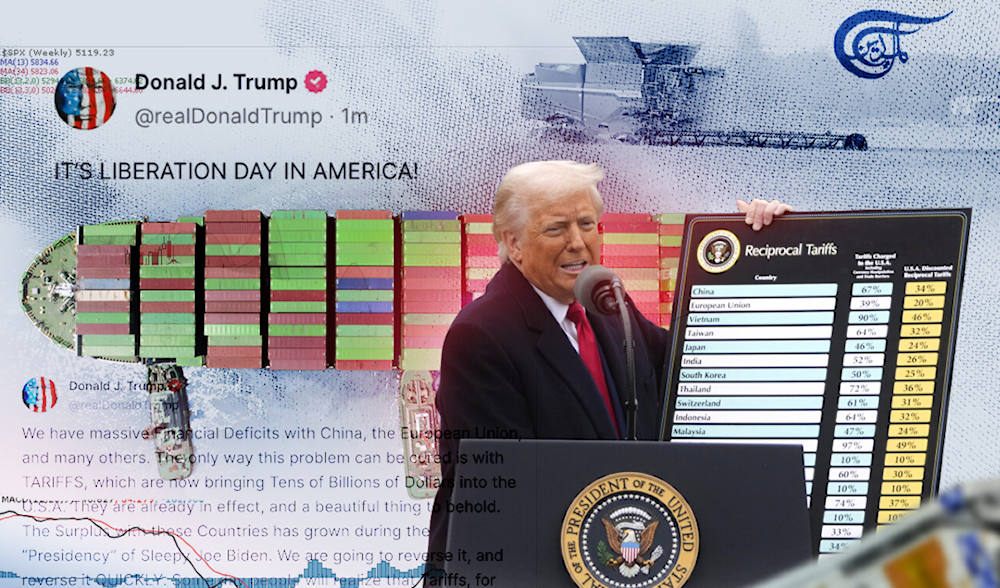
How Trump's 'Liberation Day' tariffs accelerated multipolarity (Illustrated by Mahdi Rtail; Al Mayadeen English)
Trump tariffs 2025, launched as Liberation Day duties to revive US manufacturing, ended up costing 78,000 jobs, weakening the dollar, and accelerating the shift to a multipolar trade order.
When the Trump administration unveiled its sweeping tariff regime on April 2, 2025, a date branded "Liberation Day," it triggered the most dramatic shift in US trade policy since the 1930s.
What began as a promise to revitalize American manufacturing evolved into a fundamental restructuring of global commerce that left both the United States and its trading partners economically weakened while accelerating the fragmentation of the international order.
Average US tariff rates, which stood at 2.4% in 2023, spiked to 27% by April before settling around 15-17% by year's end. This universal baseline of 10% affected approximately $1.7 trillion in imports, roughly 71% of all goods entering the United States.
Unlike the first Trump administration's targeted approach, which raised rates modestly to 2.9%, the 2025 regime spared no one. Allies faced the same barriers as adversaries, with Canada and Mexico initially hit with 25% duties and the European Union threatened with rates as high as 30%.
-
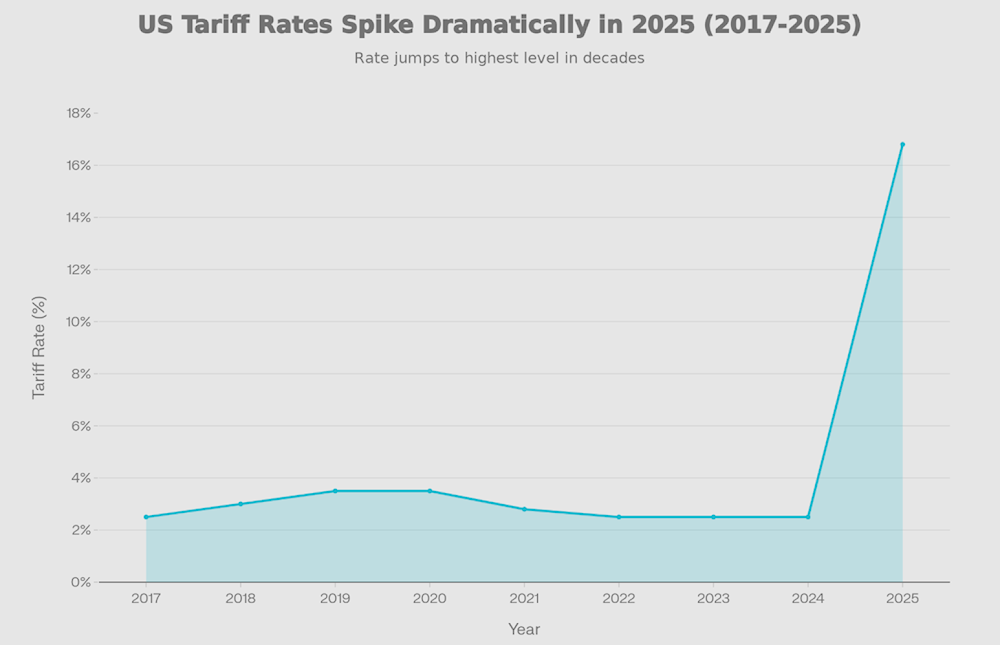
US average effective tariff rates surged from 2.5% in 2024 to 16.8% in November 2025 following Liberation Day (April 2), marking the highest level since 1934. Sources: US International Trade Commission Tariff Database; Yale Budget Lab (State of US Tariffs, May-August 2025); visualized by Al Mayadeen English
The US-China trade war reaches new extremes
The US–China trade war, intensified by Trump tariffs in 2025, escalated into a retaliatory spiral as US duties on Chinese goods soared to between 125% and 145%, prompting Chinese countermeasures at roughly 125%.
The impact was immediate and severe, whereby China's share of US imports plummeted from 13% in 2024 to just 9% by mid-2025, effectively erasing two decades of market integration and returning the relationship to its 2001 level when China joined the World Trade Organization.
China's rare earth checkmate
China's retaliation extended beyond conventional tariffs. Beijing leveraged its 90% dominance in rare earth element refining to impose strategic export controls on materials critical to US high-tech manufacturing, including components for F-35 fighters and electric vehicles.
This "rare earth checkmate" forced the administration to delay threatened 100-300% semiconductor tariffs until 2027, revealing the limits of US leverage when 66% of American tech products rely on Chinese legacy chips.
The bilateral trade volume between the world's two largest economies was projected to contract by 80% under peak tariff levels. By the first eight months of 2025, merchandise trade had fallen 14.4%, with Chinese exports to the United States down 15.5% and the value of imported Chinese goods dropping nearly 25%.
-
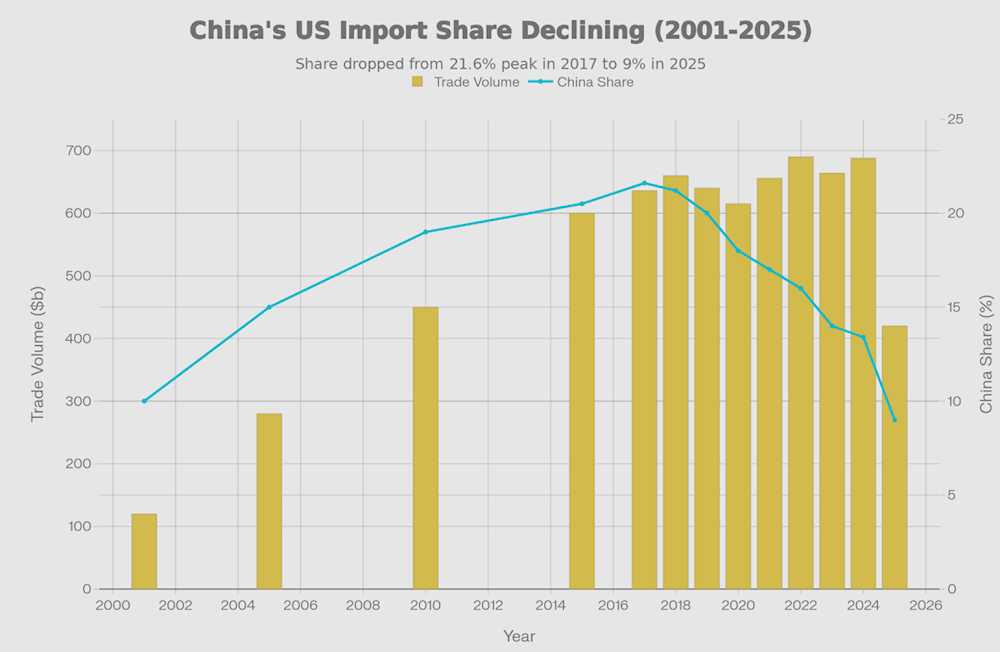
China's share of US imports collapsed from a peak of 21.6% in 2017 to 9% in July 2025, alongside a $268 billion contraction in bilateral trade volume, returning to pre-WTO accession levels. Sources: US Census Bureau Trade Data; ITIF (Information Technology Innovation Foundation); China's State Council Information Office; visualized Al Mayadeen English
The manufacturing paradox: Protection without jobs
Trump's tariffs were essentially designed to bring "jobs and factories roaring back" to US soil. Instead, they created what analysts call a "protectionist paradox," policies that undermined the very sector they aimed to protect.
Between April and November 2025, the United States lost approximately 67,000 to 78,000 manufacturing jobs. Job openings in the sector fell by 100,000, reaching their lowest levels since 2016.
The input cost squeeze
The mechanics of this failure are straightforward. While tariffs protected some upstream producers like steel mills, they devastated downstream manufacturers who rely on imported inputs. In fact, steel-using industries employ 12 million Americans compared to just 140,000 in steel production.
When tariffs raised input costs by 20-30%, these firms became less competitive internationally, leading to layoffs rather than expansion. The automotive sector exemplified this squeeze, with tariffs on vehicles, steel, aluminum, and copper adding between $1,700 and $5,700 to the cost of a single car.
Agriculture suffered perhaps the most severe blow through foreign retaliation. US soybean exports to China, once the largest market, collapsed by 50% as Beijing permanently redirected supply chains to Brazil and Argentina. Farm bankruptcies surged 60% in the first half of 2025, and a $12 billion aid package proved insufficient to offset the losses from vanished export markets.
-
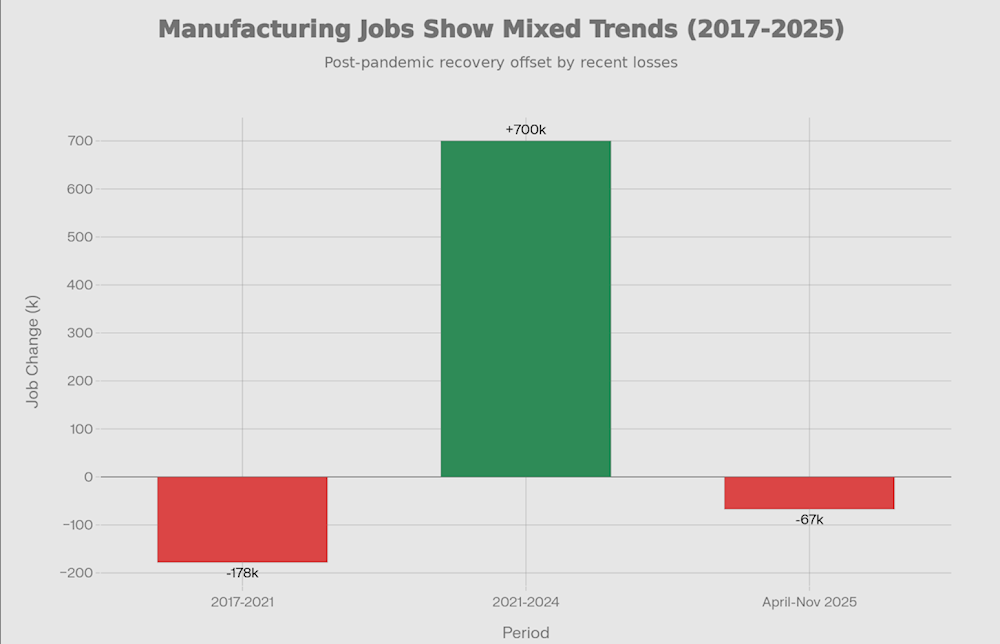
US manufacturing shed 67,000 jobs between April-November 2025 despite record tariff protection. The sector shed 178,000 jobs during Trump's first term (2017-2021), mainly due to the pandemic. Sources: US Bureau of Labor Statistics Current Employment Statistics (December 2025); National Association of Manufacturers (December 2025); visualized by Al Mayadeen English
The return of inflation, consumer pain
Tariffs effectively function as a regressive consumption tax, and American households bore their burden. Economists estimate that 70% to 100% of tariff costs were passed directly to consumers, adding between $1,300 and $2,300 to annual household expenses.
This "sneakflation" manifested in multiple forms: higher sticker prices, shrinkflation where package sizes shrank, and ingredient substitutions that degraded product quality.
Inflation stays stubbornly above target
By August 2025, imported goods prices had risen 5% to 6.6% above pre-tariff trends. The inflationary impact added an estimated 0.5 to 1.0 percentage points to headline inflation readings, keeping core personal consumption expenditures stuck at 3.0% through September, well above the Federal Reserve's 2% target.
This created a stagflationary trap: the Fed maintained higher interest rates longer to combat price pressures even as the economy showed signs of tariff-induced slowdown, with real GDP growth revised down from 2.5% to 1.8% and a 0.3% annualized contraction in the first quarter.
The great reallocation
Rather than reshoring production to the United States, the tariffs triggered what economists call the "Great Reallocation," a massive diversification of supply chains across multiple regional hubs. Mexico surpassed China as America's largest source of imports, with its market share reaching 15.5% by mid-2025. Mexican manufacturing exports to the United States rose approximately 9% despite facing weighted average tariffs of 8.2%. Vietnam benefited similarly, nearly tripling its exports to the United States since 2018.
Supply chains become more resilient through diversification
Critically, this supply chain shift created more resilience in global supply networks. Chinese-owned firms accounted for over half of the trade rerouting through Vietnam, establishing new facilities specifically to maintain US market access while bypassing duties.
Nearly one-third of Mexico's exports to the United States now consist of Chinese value-added content. Rather than concentrating economic power, trade became more distributed geographically.
Regional integration offers stability
This transformation accelerated the formation of regional trading blocs that offer members stability independent of US policy swings. The Regional Comprehensive Economic Partnership in Asia saw intra-ASEAN trade increase by over 7%, while intra-regional trade across Asia grew 25% as China redirected exports to Southeast Asian neighbors.
The African Continental Free Trade Area and strengthened European Single Market initiatives represented similar moves toward regional self-sufficiency and reduced vulnerability to external economic coercion.
The dollar's diminished stature
Perhaps the most significant consequence was the erosion of the dollar's unchallenged dominance in global finance. Historically, the dollar strengthens during global crises as investors seek the safety of US Treasury securities.
Following the Liberation Day announcements, however, the dollar fell sharply even as market volatility, measured by the VIX equity index and MOVE Treasury volatility index, soared to levels comparable to the COVID-19 pandemic peak. The US Dollar Index also plummeted approximately 9% over 2025, its steepest decline since 2017, and the first-half decline of roughly 11% marked the largest drop since 1973.
Diversification into gold, alternative systems
As reliance on dollar-denominated assets decreased, investors and central banks built more diversified reserves. Gold hit all-time highs in 2025, surging approximately 70% year-to-date by late December.
Central banks, particularly in Asia and West Asia, accelerated purchases of gold and non-dollar reserve assets. The BRICS bloc intensified development of alternative payment systems independent of the dollar-centric SWIFT network, while global trade invoicing gradually shifted toward a multipolar monetary order incorporating the euro, yen, and yuan.
-
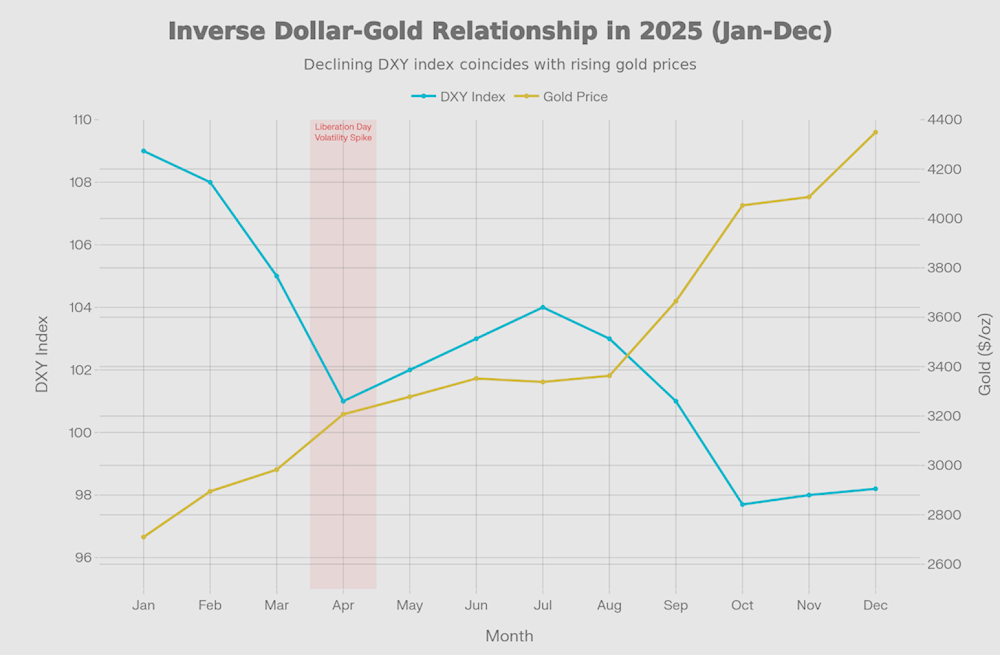
The US Dollar Index (DXY) declined 10.8% from January to December 2025 (109 to 98.2) while gold prices surged 60.5% ($2,710 to $4,349/oz), reflecting a safe-haven rotation amid trade policy uncertainty. April 2025 experienced record volatility following Liberation Day tariff announcements. Sources: US Dollar Index Historical Data (Federal Reserve, Trading Economics); Gold Price Historical Data (London Bullion Market Association, Gold.org, YCharts); visualized by Al Mayadeen English
When ambiguity becomes policy
Beyond the direct economic costs, the tariffs created what economists call "Knightian uncertainty," a fog where businesses cannot even estimate the range of possible policy outcomes. Tariff rates announced on April 2 were suspended within 24 hours for negotiation, then revised, reduced, or increased repeatedly over subsequent months. This whiplash made long-term planning impossible.
Survey data revealed investor paralysis, where 45% of business executives reported plans to pull back capital investment, and 40% planned to scale back hiring specifically due to policy uncertainty. This "wait and see" posture acts as an invisible tariff, with policy uncertainty alone estimated to have reduced short-term US investment by 4.4% in 2025.
The effect is particularly destructive for industries with high setup costs, like semiconductor fabrication plants, automotive assembly lines, and advanced manufacturing facilities; companies in these industries must commit billions of dollars, years in advance.
-
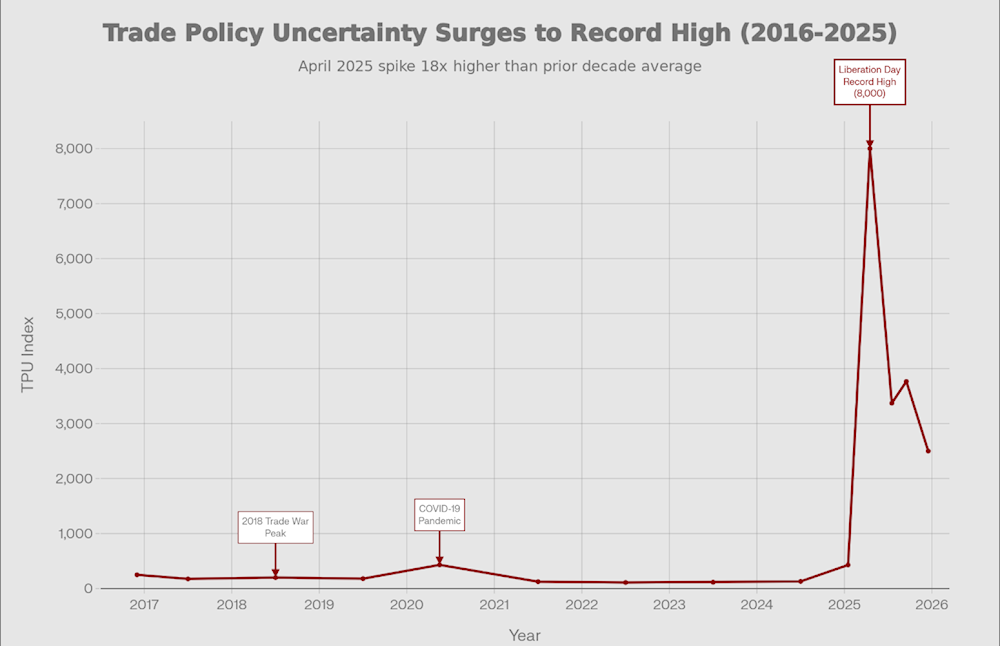
The Trade Policy Uncertainty Index reached 8,000 in April 2025, a record 40-fold spike above historical averages (200-250) and 18-fold increase from January 2025, reflecting unprecedented policy volatility. Readings remained elevated at 2,500+ through December 2025, 10-15 times normal levels. Sources: Economic Policy Uncertainty Index (policyuncertainty.com, Caldara-Iacoviello TPU methodology); St. Louis Federal Reserve FRED Database; visualized by Al Mayadeen English
Long-term GDP impact of uncertainty alone
The uncertainty created what economists describe as an "option value" for waiting: when rules are in flux, postponing irreversible decisions becomes rational even when interest rates are low or tax incentives are offered.
This freezes innovation and modernization, with long-run projections from economic models suggesting the uncertainty environment alone could contribute to a 6% reduction in permanent GDP.
Global growth forecasts slashed repeatedly
International economic projections were repeatedly slashed. The International Monetary Fund cut global GDP growth from an initial projection of 3.3% to 2.8% in April, though some forecasts recovered slightly to 3.2% by October as businesses adapted.
China's growth expectations fell from over 5.0% to 4.5-4.8%, while Canada's slowed from 1.8% to 1.2-1.3%. International officials warned that a permanently bifurcated trading system could eventually reduce global GDP by 5% to 7%.
-
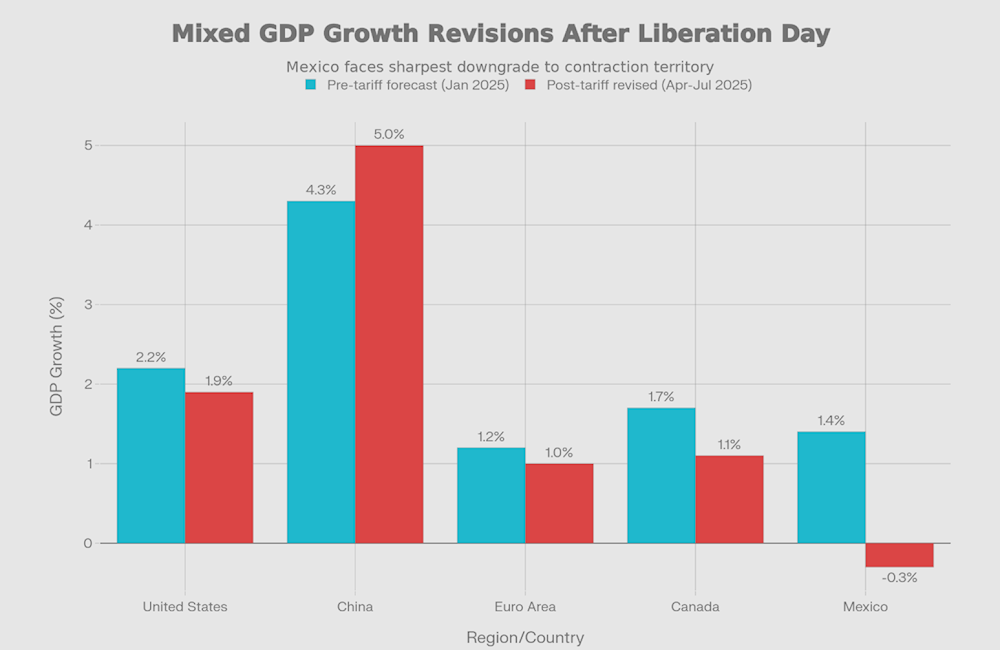
International organizations revised 2025 GDP forecasts downward following April 2 Liberation Day tariff announcements, with Mexico facing the steepest revision from +1.4% to -0.3%, becoming the only G20 economy projected to contract. Sources: International Monetary Fund World Economic Outlook (October 2025); World Bank Global Economic Prospects (June 2025); OECD Economic Outlook (June 2025); Bank of Canada Monetary Policy Report (July-October 2025); Bank of Mexico (Banxico) official forecasts; visualized by Al Mayadeen English
Fragmented future ahead
As 2025 drew to a close, the global economy entered what the World Trade Organization characterized as a transition from "borrowed growth" to imminent stagnation.
The apparent resilience of world merchandise trade, which grew 2.4% in 2025, reflected importers rushing shipments in early 2025 to beat impending duties rather than genuine expansion. The WTO projects this front-loading effect will fade in 2026, causing global trade growth to plummet to just 0.5%.
Supreme Court decision looms
The Supreme Court ruling on the legality of using the International Emergency Economic Powers Act for these tariffs, expected in early 2026, could force a partial retreat. Lower courts have already found the IEEPA application unlawful, and a majority of Supreme Court justices appeared skeptical during oral arguments.
However, analysts expect the administration to simply reimpose duties using alternative legal authorities, like Section 301 (unfair trade practices), or Section 232 (national security), creating fresh market volatility.
Permanent restructuring of global trade
The fundamental question is whether these policies represent a temporary aberration or a permanent restructuring, and current evidence suggests the latter. Tariffs have become deeply entrenched in domestic politics and fiscal planning, generating more than $236 billion in revenue through November 2025.
More significantly, firms are increasingly authorizing long-term capital investments to relocate supply chains to third countries, making the current fragmentation structurally permanent rather than reversible.
The end of Pax Americana
The ultimate legacy of Liberation Day extends beyond tariff rates or trade volumes. The United States, which designed and championed a "rules-based" multilateral trading system serving primarily its own interests for eight decades, has stepped back from that role.
What emerges in its place is a more balanced, multipolar order where regional blocs pursue stability within their own spheres, coalitions of small and medium nations coordinate to maintain open trade paths independent of great power preferences, and economic relationships are negotiated among more equal partners rather than dictated by a single hegemon.
The year 2025 may be remembered not for the revival of American manufacturing, but for marking the transition from Pax Americana, a system benefiting primarily Western powers, toward a more distributed global economy where developing nations exercise greater agency, multiple currencies share reserve status, and regional institutions provide alternatives to Western-dominated frameworks.


