
Trump prepares fresh tariffs on dozens of countries: FT
 4 Min Read
US President Donald Trump prepares to impose fresh tariffs on dozens of countries as a temporary 10% global tariff approaches its Friday expiration.
-
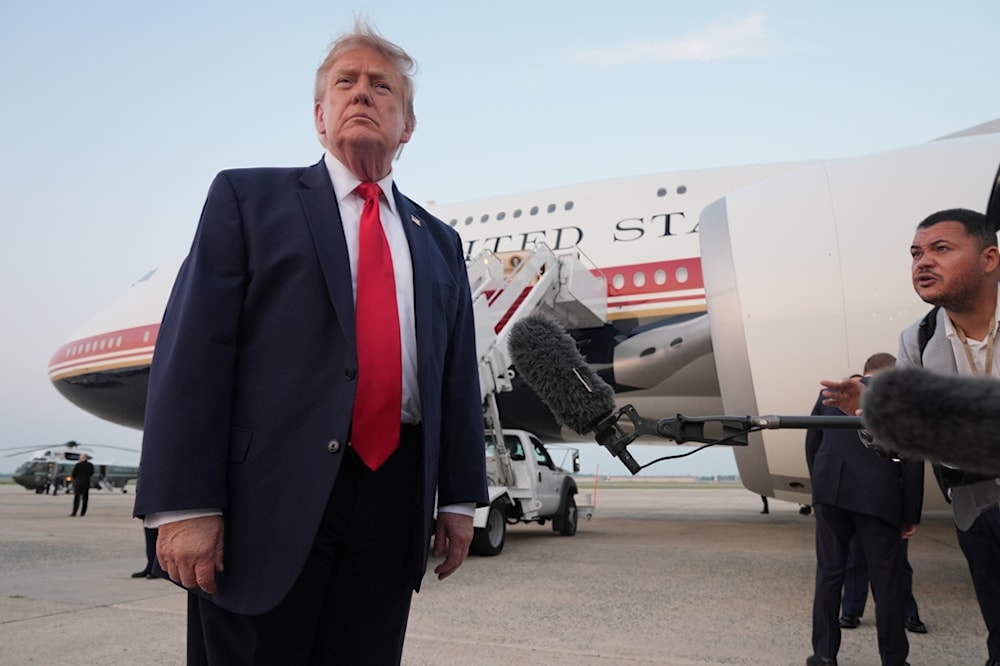
US President Donald Trump speaks to reporters as he exits Air Force One at Joint Base Andrews, Md., after attending the World Cup final soccer match on July 19, 2026. (AP Photo/Jacquelyn Martin)
US President Donald Trump is poised to impose fresh tariffs on dozens of countries as soon as this week, the Financial Times (FT) reported on Tuesday, as a temporary 10% global tariff is set to expire on Friday.
According to the report, the most immediate new duties are expected to match the 10% tariffs currently in place. The Trump administration is also pursuing other investigations that could provide it with the legal authority to impose higher tariffs, according to FT.
The potential new measures come as the administration approaches the expiration of the temporary global tariff, raising uncertainty for trading partners and businesses awaiting clarity on Washington's next steps.
The broader tariff push follows Trump's decision to impose steep new duties on Canadian imports, adding to concerns over the direction of US trade policy as the administration prepares fresh tariffs on dozens of countries.
Trump targets Canada with new tariffs
Trump on Monday announced tariffs of up to 50% on certain Canadian goods, including electrical equipment and machinery, in a move that threatens to reignite trade tensions with one of the US' closest allies and largest economic partners.
The new tariffs, which the White House said will take effect in 30 days, cover about $20 billion worth of Canadian goods. While Trump had recently threatened tariffs against Canada over wildfire smoke affecting northern parts of the United States, administration officials said the latest measures were unrelated.
The tariffs are among the steepest imposed by the Trump administration on any country. However, several major Canadian imports, including energy products, critical minerals, and fish, were excluded, while cars and metals remain subject to separate industry-specific duties.
Unlike previous tariffs imposed on Canada, the latest measures will not exempt goods covered by the United States-Mexico-Canada Agreement, which is currently under negotiation.
Canada warns of possible retaliation
Canadian Prime Minister Mark Carney said Ottawa continued to support free and fair trade but warned that Canada would take measures to protect its economy and workers.
"In all circumstances, Canada will work relentlessly and take any measures necessary to build our strength at home and to support Canadian workers, farmers, businesses, and families," Carney said in a statement.
Ontario Premier Doug Ford called for an immediate retaliatory response, saying, "If these tariffs proceed, Canada should respond tariff for tariff, dollar for dollar."
The new tariffs could affect about 5% of Canadian imports, equivalent to around 0.6% of total US imports, according to research firm Capital Economics.
Trump invokes rarely used tariff authority
Trump cited Section 338 of the Tariff Act of 1930, which allows a US president to impose tariffs of up to 50% if another country is found to discriminate against American goods. The provision, however, has never previously been used in this manner.
Stephen Brown, chief North America economist at Capital Economics, said the administration's use of Section 338 could provide a new tool for future trade negotiations if the measure withstands legal challenges.
"Taking a step back, it’s striking that the Trump administration is now reaching to a new method to implement tariffs," Brown wrote in a research note.
The move comes as the Trump administration continues to rely heavily on tariffs as an economic and diplomatic tool. The Supreme Court ruled in February that Trump could not use the International Emergency Economic Powers Act to impose sweeping global tariffs, prompting the administration to adopt temporary 10% across-the-board duties under Section 122 of the Trade Act of 1974.
Those temporary tariffs are due to expire later this week, while Washington has also imposed or threatened additional duties on other major trading partners, including China and Brazil.
The White House said Canada was among two countries, alongside China, that had chosen to retaliate against US tariffs rather than negotiate.


