
China rejects Bessent's demand to economically isolate Iran
 4 Min Read
Beijing rejected Bessent's call to "get with the programme" on Iran sanctions, saying pressure campaigns will not resolve the six-month US war.
-
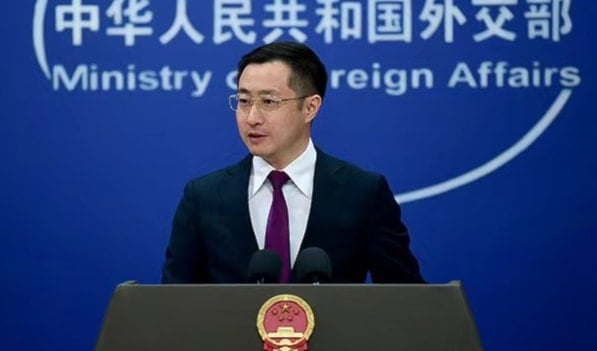
Chinese Foreign Ministry Spokesperson Lin Jian speaks at a regular press conference in Beijing on April 29, 2026. (Official websited of Ministry of Foreign Affairs of the People's Republic of China)
China said Friday it will not join Washington's campaign to isolate Iran economically, rejecting US Treasury Secretary Scott Bessent's call for Beijing to fall in line as officials in Beijing branded sanctions and pressure counterproductive to resolving the six-month US war on Iran.
Foreign Ministry spokesperson Lin Jian told reporters in Beijing on Friday that "sanctions and pressure will not help resolve the issue," urging "all relevant parties to take responsible measures and resolve the problem through political and diplomatic means."
"China always believes military actions, sanctioning, pressuring do not help solve the problem; it only builds up tensions in the current situation," Lin said, adding that such actions do "not fit the interests of any party."
Lin added that China "opposes illegal unilateral sanctions that have no basis in international law and are not authorised by the UN Security Council," and said Beijing "hopes all sides take responsibility to solve the current issues through political settlement."
Bessent tells Beijing to get with the program
The statement came after Bessent, asked whether Washington would pressure China to join the campaign, told CNBC that "many conversations are best to have in private," but called on Beijing "to get with the programme."
Bessent had said a day earlier that Washington would impose the "toughest sanctions in history" on Iran as part of the "greatest coordinated economic isolation in the history of the world."
He said the US "will put its full might and force toward" nations found transferring money, buying oil, or conducting seaborne shipping with Iran. Washington would tell countries they are "either with us or against us," he said.
Trump's economic D-Day campaign
Bessent's comments build on Trump's announcement this week of "the MOST CRUSHING ECONOMIC OPERATION EVER TAKEN AGAINST ANY COUNTRY," an escalation he labeled "Economic D-Day," vowing "Economic Warfare and Isolation on an unprecedented scale."
Trump warned that any country allowing its "financial institutions, businesses, airports, or government entities" to extend Iran a "lifeline" would face "TREMENDOUS Economic Consequences," naming oil smuggling, swap lines, cash transfers, exchange houses, ship registries, and front companies as targets.
He offered few specifics on the measures themselves, saying only, "We have things that we could sanction. We have very draconian sanctions, and we'll see what happens."
Iran dismisses sanctions as economic terrorism
Iran has dismissed the campaign as economic terrorism. Foreign Minister Abbas Araghchi wrote on X Thursday that "the so-called 'Economic D-Day' is a diversion from America's own crisis: unprecedented debt & surging interest costs," warning that "doubling down on failed policies will only bring further defeat, and enmity of Iranians." He added that "US economic terrorism threatens the global economy and sovereignty worldwide."
Iran's Foreign Ministry separately denounced the sanctions as "economic terrorism" and a "crime against humanity," stressing that Iran "remains determined to defend its security and national interests" and that the measures "would not weaken the country's resolve to preserve its independence, dignity and national sovereignty."
For his part, Parliament Speaker Mohammad Bagher Ghalibaf mocked threats from Bessent and Secretary of War Pete Hegseth earlier in the week, saying Washington officials were "way out of their league" and telling them to "stop waiting for the clown crew to pull a rabbit out of their hat."
The exchange comes nearly six months into the US war on Iran, launched February 28 with the declared aims of toppling Iran's government, destroying its military capabilities, eliminating its nuclear program, and reopening the Strait of Hormuz. None of those objectives have been achieved.


