
AEOI: No IAEA inspections of bombed sites without protocol
 4 Min Read
AEOI chief Eslami says Iran won't allow IAEA inspections of nuclear sites attacked in the war until a special inspection protocol is approved.
-
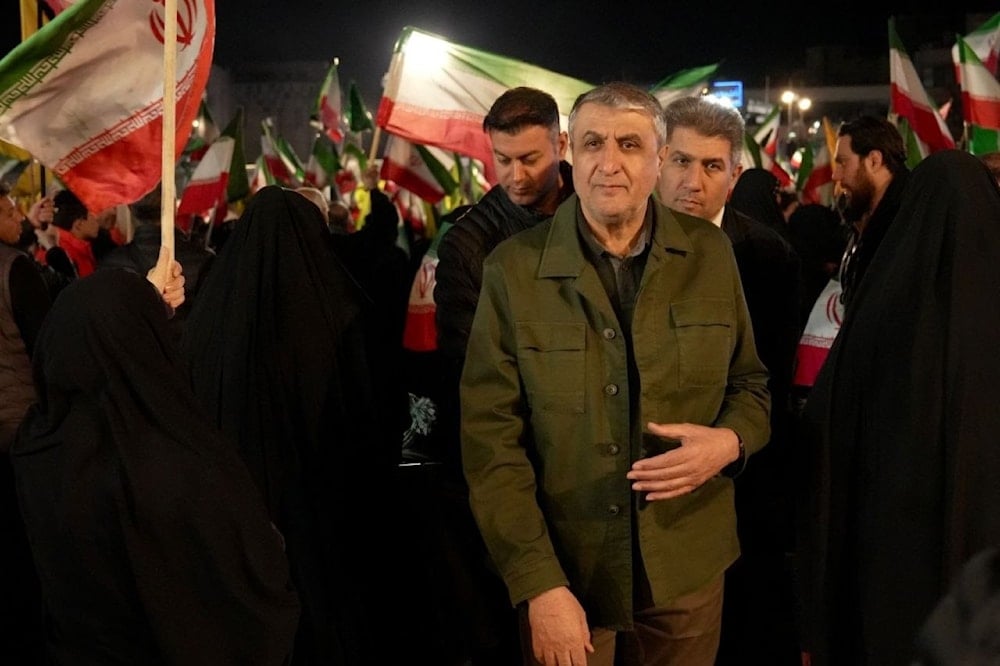
The Head of the Atomic Energy Organization of Iran, Mohammad Eslami, at the public gathering in Enqelab Square, April 15, 2026 (@AEOI_admin on Telegram)
Iran will not permit the International Atomic Energy Agency to inspect its nuclear facilities that were bombed by the US and "Israel" until the agency drafts and formally approves a special protocol for inspecting attacked sites, said Mohammad Eslami, head of the Atomic Energy Organization of Iran (AEOI), on Wednesday.
Eslami said the law passed by Iran's Parliament now provides the legal framework governing Tehran's dealings with the IAEA, and that Iran has formally notified the agency of its position under that framework. He was speaking at a ceremony marking the unveiling of four AEOI technological achievements during Government Week.
IAEA yet to define inspection protocol
Eslami drew a distinction between facilities that were attacked and those that were not, IRNA reported. Sites that came under military strikes were registered with the IAEA and had undergone regular inspections before the attacks, he said, while untouched facilities have already received the inspections required under Iran's safeguards agreement.
The attacked sites are a different matter, according to Eslami. Under the framework set by Parliament's law, Iran holds that any inspection of a bombed facility cannot proceed until the IAEA clarifies how it will handle the safety and security of these sites and announces the specific protocol it will follow. Eslami said the agency has not yet drawn up such a protocol.
He added that Iran remains in a state of war and has not reached a point where the war can be considered over or the security of its nuclear sites treated as stable, a condition he tied directly to the absence of an inspection protocol for attacked facilities.
Eslami said the United States and "Israel" are pressuring Iran to allow the IAEA to visit and inspect the destroyed sites, and that the purpose of this pressure is to determine the condition of the sites following the military strikes that targeted them.
Ghalibaf: Iran will not allow access to damaged nuclear sites
Iran's Parliament Speaker Mohammad Bagher Ghalibaf stressed that Tehran will not permit access to its damaged nuclear facilities, underlining that the country will continue to confront external pressure through strength while advancing its strategic partnerships abroad.
In an interview with Iranian state television last month, Ghalibaf said that "the enemy understands nothing but the language of power," underscoring Iran's determination to maintain a firm stance against foreign pressure.
He added that Iran "will not allow, under any circumstances, access to the nuclear sites that were bombed and damaged," referring to facilities targeted by the United States during the 12-day war last year.
Iran-IAEA tensions in recent years
Eslami's conditions build on more than a year of deteriorating relations between Tehran and the IAEA. In February 2025, the AEOI noted that roughly a quarter of all IAEA inspections were directed at Iranian nuclear facilities, despite those facilities making up less than 3% of nuclear sites worldwide.
Relations broke down further in June 2025, when the IAEA passed a non-compliance resolution against Iran the day before "Israel" launched its attack on the Islamic Republic. Tehran accused the agency of giving the Israeli regime diplomatic cover and said sensitive nuclear data it had shared with the IAEA was leaked to Israeli intelligence, leaks Iranian officials say contributed to the assassination of nuclear scientists. Iran suspended cooperation with the agency and barred Director General Rafael Grossi from its facilities.
Egypt brokered a partial reset in September 2025 through the Cairo Agreement, under which the IAEA acknowledged the strikes were illegal. Tehran terminated the deal weeks later after the US and E3 passed a new censure resolution.
When the current war began on February 28, the IAEA again stopped short of condemning the aggression, instead calling on both sides to show restraint.
During the war, AEOI spokesperson Behrouz Kamalvandi said the agency's silence amounted to complicity with "criminals," revealing that Iran had sent 12 letters to the IAEA warning of the consequences of continued strikes on its nuclear facilities. He said the Bushehr nuclear power plant was hit four times, with one security personnel member martyred in an attack near the plant's perimeter.


